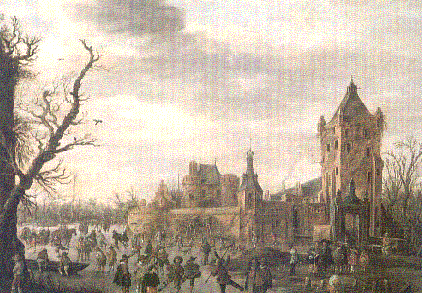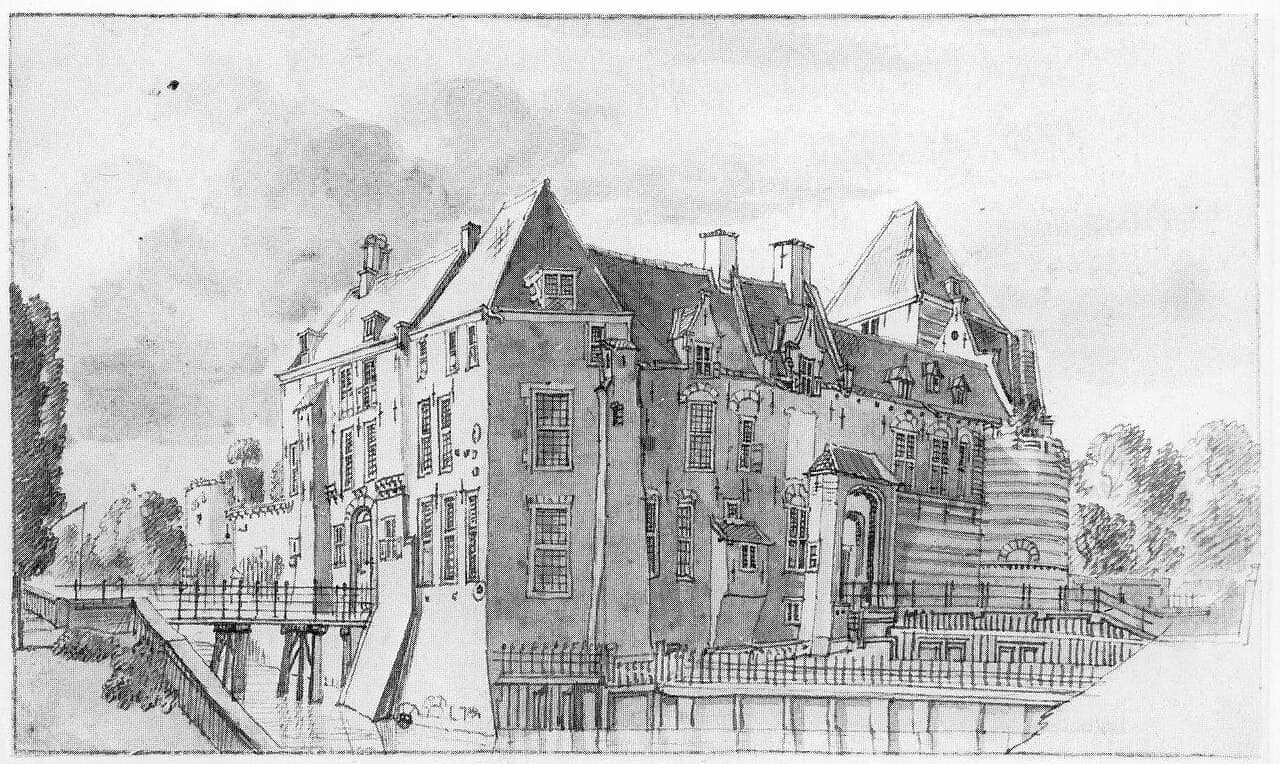
IJsselstein Castle
IJsselstein Castle, locally known as Kasteel IJsselstein, is a historic hill castle situated in the town of IJsselstein in the province of Utrecht, the Netherlands. Its origins are closely intertwined with the development of the town itself, located near the banks of the IJssel river. Although the exact date of the castle's initial construction remains unknown, historical records reveal the presence of a Lord of IJsselstein as early as 1144, with the castle first mentioned explicitly in 1279.
The medieval origins and early history
The castle's early history is marked by its strategic importance and turbulent events. In 1297, Gijsbrecht van Amstel, the Lord of IJsselstein, notably refused to surrender his castle to the Count of Holland. This defiance led to Gijsbrecht's imprisonment and a protracted siege of the castle lasting a year. Remarkably, the castle was defended during this siege by Gijsbrecht's wife, Berta, alongside a small garrison of soldiers. The castle was eventually returned to Gijsbrecht in 1309.
Later, in 1349, the castle endured another siege, this time by the Bishop of Utrecht, lasting five weeks. The resilience of the castle's defenses was further tested in 1356 when the bailey was briefly captured by a group of townspeople from Utrecht, who set fire to the buildings before being driven out.
Destruction and rebuilding in the 15th and 16th centuries
The castle and the town of IJsselstein faced significant upheaval in the early 15th century. In 1417, Willem van Egmond took control of the castle, prompting a siege by allies of Jacqueline, Countess of Hainaut. Following Willem's surrender, the Countess ordered the demolition of the entire castle and the town walls. The destruction was thorough; in 1418, she commanded the demolition of all houses in the town except for religious buildings. The lands were restored to the Van Egmond family in 1421.
Reconstruction efforts began around 1470, and by 1480, the castle was once again defensible. However, the castle's fortifications were tested in 1510-1511 when it was besieged by troops from the city of Utrecht; during this conflict, two towers were severely damaged.
Between 1527 and 1532, the castle underwent significant enlargement, including the construction of several buildings and the notable stair tower that still stands today, known as the Loyer tower. This tower, along with part of the moat, represents the surviving elements of the castle. Architectural historians attribute the design of the tower to the prominent Belgian architect Rombout II Keldermans, renowned for his work in the Renaissance style.
Later history and decline
In 1558, IJsselstein Castle came under the ownership of the Dutch Royal family, the House of Orange. Despite this prestigious association, the castle gradually fell into disrepair starting in the 17th century. During the period of French occupation from 1795 to 1798, the castle was repurposed as housing for soldiers of the French army.
Following the occupation, the castle was left vacant for several years, occasionally rented out and sold twice. The final blow came in 1888 when the castle was almost entirely demolished, sparing only the Loyer tower. Today, this tower is incorporated into the local city museum, serving as a tangible link to the castle's rich past.
Architectural features and significance
IJsselstein Castle was originally a hill castle, constructed to take advantage of the elevated terrain near the IJssel river, which provided natural defensive benefits. The castle's layout included a bailey, defensive walls, and multiple towers, typical of medieval fortifications in the region.
The surviving Loyer tower is a stair tower characteristic of the Renaissance architectural style, reflecting the influence of Rombout II Keldermans. Its robust masonry and design elements illustrate the transition from purely military fortifications to more residential and representational architecture during the Renaissance period.
The partial moat that remains also highlights the castle's defensive measures, which were standard for the time to protect against siege warfare.
IJsselstein Castle today
Currently, the castle exists primarily through the preserved Loyer tower, which is integrated into the city museum of IJsselstein. This museum offers visitors insight into the castle's history as well as the broader historical context of the town and region.
The castle's story, marked by sieges, destruction, and rebuilding, reflects the complex political and military history of the Utrecht province and the Netherlands at large. The remaining tower stands as a monument to the castle's enduring legacy and the architectural heritage of the Renaissance period in Dutch castle construction.
Frequently asked questions (FAQ)
- When was IJsselstein Castle first mentioned in historical records?
- IJsselstein Castle was first mentioned in historical records in 1279, although a Lord of IJsselstein is noted as early as 1144.
- What remains of IJsselstein Castle today?
- Today, only the Loyer tower and part of the moat remain of IJsselstein Castle. The tower is part of the city museum in IJsselstein.
- Who was the architect of the surviving tower?
- The Loyer tower is believed to have been designed by the Belgian architect Rombout II Keldermans, known for his Renaissance architectural style.
- Can visitors tour the interior of the Loyer tower?
- Yes, the Loyer tower is part of the IJsselstein city museum and is accessible to visitors, offering insights into the castle's history and architecture.
- Why was the castle demolished in 1888?
- The castle was demolished in 1888 due to its state of disrepair and changing ownership, with only the Loyer tower preserved as a historic monument.
Photo gallery

Photo by Jan de Beijer•Public domain
Information
Address
Kronenburgplantsoen 9, Netherlands
Loading map...
Visitor reviews
No reviews yet. Been here? Write the first review and help other travelers!
Write the first reviewVisited this castle? Share your experience
Your review helps other travelers and adds first-hand knowledge to our encyclopedia.