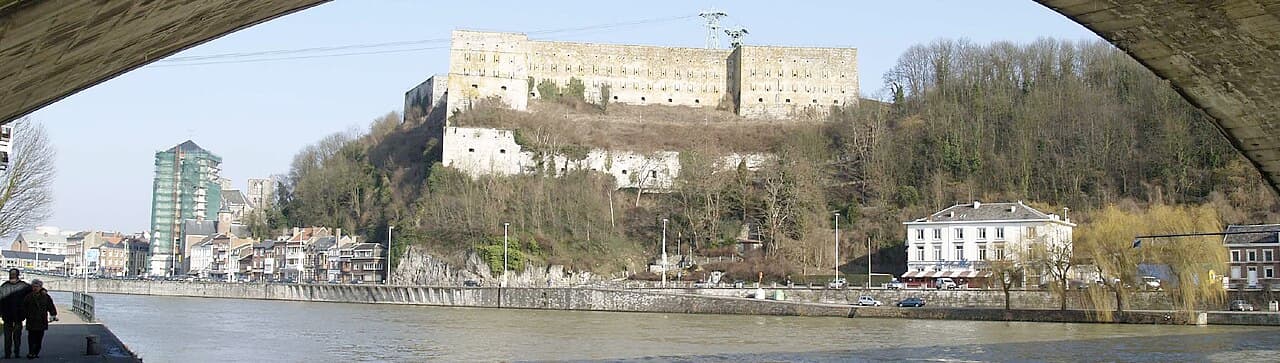
Huy Citadel
Huy Citadel, locally known as Citadelle de Huy or Li Tchestia in Walloon, is a prominent bastioned fortress perched above the town of Huy in the province of Liège, within the Wallonia region of Belgium. It commands a strategic position overlooking a bend in the Meuse River, a crucial waterway that historically served as a vital route for trade and military movements. This citadel is one of the four important Meuse Citadels, alongside those at Dinant, Liège, and Namur, which collectively formed a defensive network controlling the Meuse valley.
Early fortifications and medieval origins
The site of Huy Citadel has been fortified since the 9th century, marking it as one of the oldest fortified locations in the region. The original medieval castle, known as Li Tchestia, was first documented in this period. This early fortress was strategically placed on a rocky outcrop, providing natural defenses enhanced by man-made fortifications. Throughout the medieval period, the castle played a significant role in regional power struggles and was a key stronghold of the Prince-Bishopric of Liège.
In 1525, the castle was besieged and captured by Dutch forces during conflicts involving the Habsburg Netherlands. However, it was swiftly retaken by the Prince-Bishop of Liège with assistance from Spanish troops, reflecting the turbulent political landscape of the Low Countries in the early modern period. Despite its military importance, the original medieval castle was demolished in 1715 following the Barrier Treaty, which aimed to create a buffer zone between the Dutch Republic and the Kingdom of France. This treaty led to the deliberate dismantling of several fortifications in the region, including Huy, leaving the site empty for about a century.
Construction of the current citadel
The present-day Huy Citadel was constructed between 1818 and 1823 during the period of the United Kingdom of the Netherlands, under the direction of Lieutenant Colonel H. Kamerlingh. This new fortress was designed as a modern bastioned fortification, reflecting advances in military architecture that incorporated angled bastions and thick walls to better withstand artillery bombardment. The fortress was built to house approximately 600 soldiers and to secure the Meuse valley against potential French incursions.
After the Belgian Revolution of 1830, the citadel became Belgian property. During the 19th century, it was frequently used as a prison for political detainees. Notably, members of the revolutionary Belgian Legion were imprisoned here following their failed invasion attempt at Risquons-Tout in 1848. The fortress's role as a political prison continued until 1876.
Role in 20th-century conflicts
In the lead-up to World War I, the Belgian state integrated the Huy Citadel into a defensive system along the Meuse River. Despite these efforts, the fortress fell to German forces early in the war. The Germans utilized the citadel as a prison, detaining numerous prisoners during their occupation. Following the war, the citadel briefly served as a military school and housed Russian prisoners before being demilitarized in 1932 and opened as a tourist attraction.
With the approach of World War II, the citadel was re-garrisoned in 1937. After the German invasion in 1940, it again became a prison, this time holding thousands of Belgian political prisoners, including prominent Communist leader Julien Lahaut. Many detainees were subsequently deported to Nazi concentration camps, primarily Neuengamme. The citadel's use as a prison during the German occupation marks a dark chapter in its history.
Post-war period and current status
After World War II, the Huy Citadel was repurposed for tourism and historical education. Since 1992, it has housed a museum dedicated to the victims of World War II, commemorating those imprisoned and lost during the conflict. Visitors can explore the fortress's extensive fortifications, including its bastions, ramparts, and military cells, gaining insight into its multifaceted history.
The citadel is accessible via a long stairway from the riverside, offering panoramic views of the Meuse valley and the town below. Until 2012, a cable car provided an alternative route across the river, but it ceased operation following an accident involving a helicopter. Today, the fortress stands as a well-preserved monument reflecting centuries of military architecture and regional history.
Architectural features and design
The Huy Citadel exemplifies early 19th-century bastioned fortress design, characterized by angled bastions that allowed defenders to cover adjacent walls with cannon fire, minimizing blind spots. The fortress's walls are thick and robust, constructed to resist artillery fire, and the layout incorporates multiple defensive layers, including moats and glacis slopes.
Inside, the citadel contains barracks, powder magazines, and prison cells, arranged around central courtyards. The elevated position enhances its defensive capabilities and provides commanding views of the surrounding landscape, which was crucial for surveillance and control of river traffic.
Cultural and historical significance
As part of the Meuse Citadels, Huy Citadel played a vital role in the military history of Belgium and the Low Countries. Its continuous use from the medieval period through both World Wars illustrates the strategic importance of the Meuse valley. The fortress also serves as a poignant reminder of the political struggles and human suffering associated with its use as a prison, particularly during periods of occupation and revolution.
Today, the citadel is a cultural landmark and a popular destination for visitors interested in military history, architecture, and Belgian heritage. The museum and preserved fortifications provide educational opportunities and commemorate the resilience of those affected by the conflicts that shaped the region.
Frequently asked questions (FAQ)
- How do I get to Huy Citadel?
- Huy Citadel is accessible by a long stairway from the riverside in Huy. Although a cable car once operated, it has been out of service since 2012 due to an accident.
- What is the historical significance of Huy Citadel?
- Huy Citadel has been a strategic military site since the 9th century, serving as a fortress, prison, and part of the Meuse Citadels defensive network controlling the Meuse valley.
- When was the current citadel built?
- The current Huy Citadel was constructed between 1818 and 1823 during Dutch rule, designed as a bastioned fortress by Lieutenant Colonel H. Kamerlingh.
- Can I visit the museum inside the citadel?
- Yes, since 1992 the citadel houses a museum dedicated to World War II victims, open daily during visiting hours with an admission fee.
- Why was the original medieval castle demolished?
- The medieval castle was demolished in 1715 following the Barrier Treaty, which aimed to create a buffer zone between the Dutch Republic and the Kingdom of France by dismantling fortifications.
Photo gallery

Information
Opening hours
10:00-18:00, daily
Ticket prices
€5 adult, €3 child
Current owner
Belgian State
Address
Chaussée Napoléon, Belgium
Loading map...
Visitor reviews
No reviews yet. Been here? Write the first review and help other travelers!
Write the first reviewVisited this castle? Share your experience
Your review helps other travelers and adds first-hand knowledge to our encyclopedia.



