Hunedoara
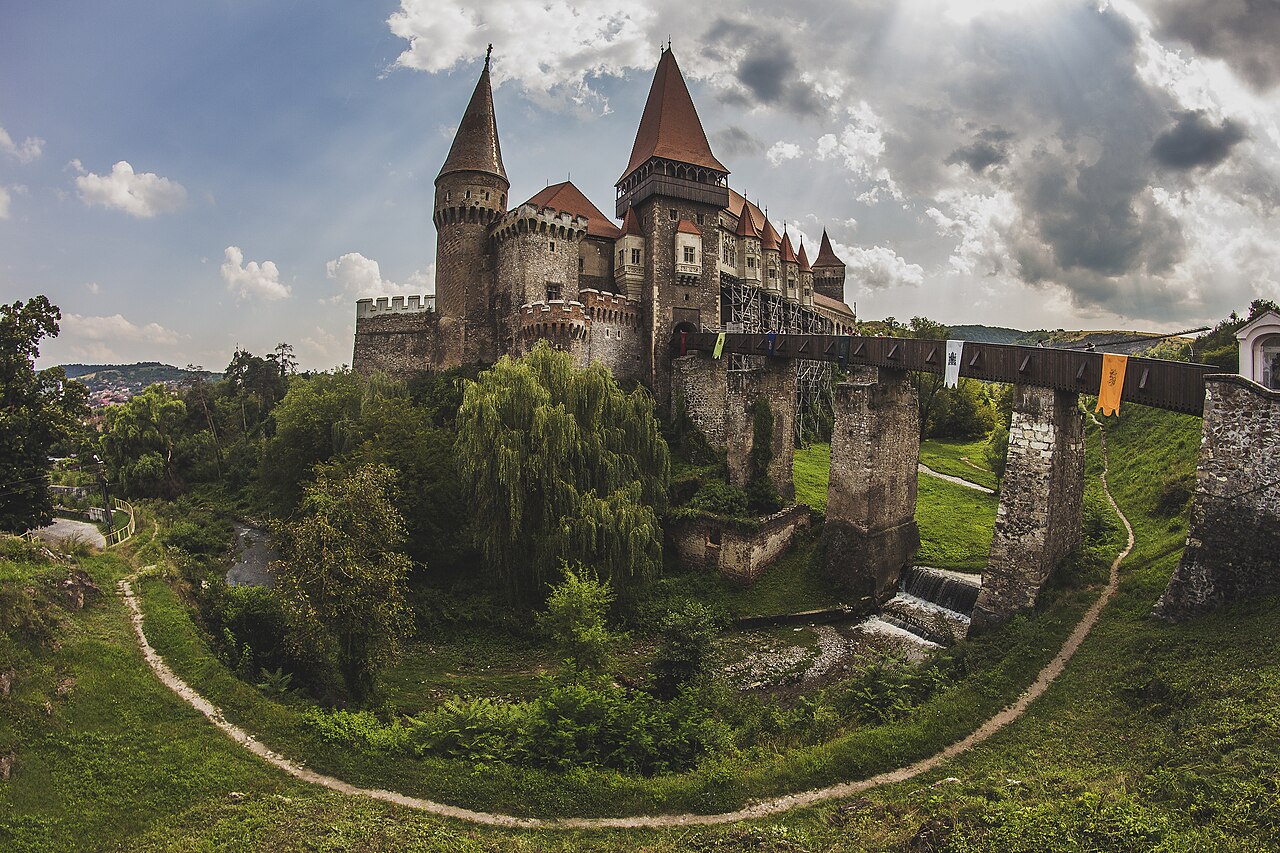
Hunedoara Castle, also known as Corvin Castle, is a monumental bastioned fortress located on a small rocky hill in the city of Hunedoara, Romania. It is one of the most iconic and well-preserved medieval castles in the country, renowned for its imposing Gothic-Renaissance architecture and rich historical significance. The castle's strategic location atop a rocky plateau provided natural defense advantages, which were enhanced by massive stone walls and fortifications.
Early history and foundation
The site originally hosted a small royal fortress constructed on an elliptical plan with a northern tower. This early fortification was surrounded by thick walls made from dolomite limestone blocks and river stones, approximately 2 meters thick. In 1409, King Sigismund of Luxembourg granted the Hunedoara estate to the Wallachian voivode Voicu Hunyadi. After Voicu's death, his son John Hunyadi inherited the property. John Hunyadi would later become the regent of Hungary and ruler of Transylvania, playing a crucial role in the castle's expansion and transformation.
Major construction phases and architectural features
First phase: fortification expansion (c. 1440-1446)
Beginning around 1440, John Hunyadi initiated a significant rebuilding of the fortress. This first phase likely concluded before 1446 and included the construction of two concentric defensive walls reinforced with towers. Among the towers, three were round: Capistrano Tower, Lonely Tower, and Drummers' Tower. These towers featured three levels, with the middle level designed for archers and the uppermost level serving as living quarters. Another round tower, the Muscat Tower, was dedicated solely to defense. Rectangular towers such as the Old Tower and New Gate Tower served primarily defensive purposes, housing firing positions and weapon storage.
A distinctive rectangular tower named Ne Boisa ("Don't be afraid") functioned as a typical dansker, projecting far beyond the main defensive perimeter. This tower was connected to the castle by a 33-meter-long arcaded gallery supported by nine massive pillars. The Ne Boisa Tower, reportedly named by Serbian mercenaries, had five levels and was adapted for the use of firearms, highlighting the castle's evolution in military technology. Access to the castle was originally via a drawbridge over a moat.
Second phase: gothic palace and chapel (1446-1453)
During the years 1446 to 1453, a representative Gothic palace was constructed within the fortress. This included the Knights' Hall and the Council Hall, connected by spiral staircases. Both halls featured a large six-bay, two-nave layout supported by octagonal marble pillars with ribbed vaulting, exemplifying high Gothic architecture. The eastern courtyard area saw the addition of a castle chapel, richly decorated with heraldic stone carvings bearing the Hunyadi family coat of arms.
Renaissance additions and later ownership
Following John Hunyadi's death, his wife Elisabeth Szilágyi and later their son Matthias Corvinus (King of Hungary from 1458 to 1490) took over the castle. During Matthias's reign, the northern wing was expanded with a Renaissance-style addition known as the Matia Wing, featuring one of the earliest examples of a loggia in Transylvania. The last Hunyadi owner was Matthias's illegitimate son, John Corvin.
Over the following centuries, Hunedoara Castle changed hands multiple times, passing through various Hungarian noble families. In 1613, it became the property of the Transylvanian prince Gábor Bethlen, who undertook Baroque-style expansions. These included the construction of the Bethlen Palace, a massive semicircular White Tower with three defensive levels equipped for firearms, the Artillery Terrace, and the Gate Tower. The castle chapel and parts of the Gothic interiors were also remodeled during this period.
Habsburg period and restoration efforts
In 1724, the castle passed into Austrian Habsburg ownership. The Habsburgs showed little interest in the fortress, using it mainly as a warehouse for nearby ironworks. The castle suffered several fires in the 19th century, notably in 1854. After the fire, a decision was made to convert the castle into a summer residence for the Habsburgs. Renovations between 1870 and 1880, led by Hungarian architects Imre Steindl and Frigyes Schulz, involved controversial alterations that significantly impacted the historic architecture.
A subsequent restoration from 1907 to 1913, overseen by István Möller, aimed to reverse some of the earlier changes and restore the castle's Gothic appearance. After World War I in 1918, the Romanian government took control of the castle. Throughout the 20th century, conservation efforts have continued, allowing the castle to be opened to the public as a major tourist attraction.
Architectural highlights and notable features
Hunedoara Castle impresses visitors with its massive defensive towers, pointed spires, crenellated walls, drawbridges, and richly decorated interiors. The Gothic palace with the Knights' Hall and Council Hall remains a highlight, showcasing exquisite rib-vaulted ceilings and marble pillars. The castle chapel, with its heraldic stonework, reflects the Hunyadi family's prominence.
The defensive towers, especially the Ne Boisa Tower, stand out for their adaptation to firearms, with multiple defensive levels and strategic placement. The Artillery Terrace and the so-called "Bear Pit" moat add to the fortress's formidable defenses. The castle well is steeped in legend: it was reportedly dug by three Turkish prisoners over 15 years, promised freedom upon finding water. After the well was completed, the prisoners were allegedly killed by the widow of John Hunyadi, a story immortalized by an inscription in the rock.
Historical significance and cultural impact
The castle's association with Matthias Corvinus, one of Hungary's most famous kings, and the tradition that Vlad the Impaler (Vlad III) was imprisoned here, add to its mystique and historical importance. Its architectural blend of Gothic and Renaissance elements illustrates the transition in European castle design during the late medieval period.
Today, Hunedoara Castle is among Romania's most visited castles, attracting tourists with its dramatic silhouette and well-preserved interiors. It has also served as a filming location for numerous movies, enhancing its cultural presence internationally.
Visitor information and accessibility
The castle is accessible year-round, with guided tours available that explore its extensive history and architectural details. Visitors can explore the defensive walls, towers, palace rooms, chapel, and the legendary well. The site offers a unique glimpse into medieval and Renaissance fortification and noble residence architecture in Transylvania.
Hunedoara Castle's combination of military and residential architecture, rich history, and legends make it a compelling destination for history enthusiasts, architecture lovers, and tourists alike.
Frequently asked questions (FAQ)
- What is the historical significance of Hunedoara Castle?
- Hunedoara Castle, also known as Corvin Castle, is one of the largest and most impressive Gothic-Renaissance castles in Europe. Built in the 14th century, it served as a royal residence and a strategic fortress during various historical conflicts, showcasing Romania's medieval heritage.
- When was Hunedoara Castle built?
- The construction of Hunedoara Castle began in 1446 under the rule of John Hunyadi, a key figure in the defense against the Ottoman Empire. The castle went through several phases of construction and renovations, reflecting the architectural styles of different periods.
- What are the opening hours of Hunedoara Castle?
- Hunedoara Castle is typically open to visitors from 9 AM to 5 PM during the weekdays, with extended hours on weekends. It's advisable to check the official website for seasonal variations and any potential closures due to events or maintenance.
- Can I buy tickets in advance for Hunedoara Castle?
- Yes, you can purchase tickets online through the official website, which can help you avoid long queues at the entrance. Advanced ticket purchases are highly recommended during peak tourist seasons.
- Is Hunedoara Castle accessible for visitors with disabilities?
- While Hunedoara Castle has made efforts to improve accessibility, some areas may still be challenging due to the castle's historical architecture and terrain. It is advisable to contact the castle management in advance to inquire about specific accessibility options available for visitors with disabilities.
- What is the best time to visit Hunedoara Castle?
- The best time to visit Hunedoara Castle is during the spring and early fall when the weather is mild, and the crowds are smaller. Visiting during weekdays can also provide a more relaxed experience compared to weekends and holidays.
- Are there any nearby attractions to visit while at Hunedoara Castle?
- Yes, nearby attractions include the historical town of Hunedoara, the Dacian Fortresses of the Orăștie Mountains, and the beautiful Retezat National Park. These sites offer additional insight into Romania's rich history and natural beauty.
- What are the ticket prices for Hunedoara Castle?
- As of the latest updates, ticket prices for Hunedoara Castle vary based on age and group discounts, typically ranging from 30 to 50 Romanian Lei for adults. Children and students may receive reduced rates, so be sure to check the latest information before your visit.
Information
Loading map...
Visitor reviews
No reviews yet. Been here? Write the first review and help other travelers!
Write the first reviewVisited this castle? Share your experience
Your review helps other travelers and adds first-hand knowledge to our encyclopedia.