Corvin Castle
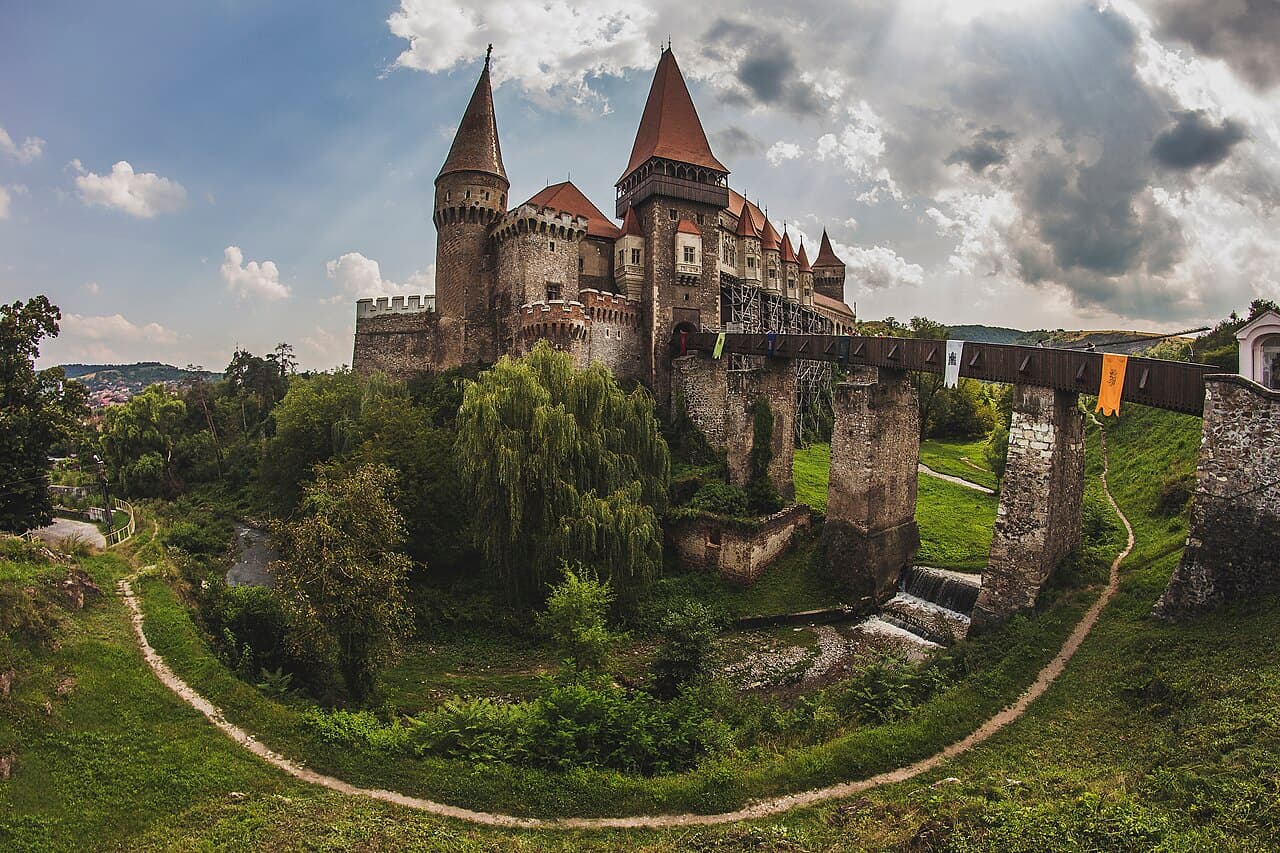
Corvin Castle, also known as Hunyadi Castle, stands as one of the most impressive and largest hill castles in Europe, majestically perched atop a rocky limestone outcrop in Hunedoara, Transylvania, Romania. Built primarily in the 15th century, this fortress is a remarkable example of Gothic architecture combined with Renaissance influences, reflecting the military, residential, and political ambitions of its builders and owners over several centuries.
The castle’s strategic location on a natural rocky bluff, surrounded on two sides by the Zlaști River and protected by a wide moat, exemplifies medieval defensive design. Access is granted via a narrow bridge crossing the moat, enhancing its fortress-like appearance and security. This dramatic setting contributes to Corvin Castle’s fairy-tale aura, a feature amplified by 19th-century restorations that emphasized romantic Gothic elements.
Founding and historical development
The origins of Corvin Castle trace back to the 14th century when a smaller fortification was established by the Kingdom of Hungary. The site’s significance grew under John Hunyadi, a prominent military leader and regent of Hungary, who acquired the property around 1446. Hunyadi initiated extensive construction over the remains of an earlier keep built by Charles I of Hungary, transforming it into a formidable fortress and the ancestral seat of the Hunyadi family.
Following John Hunyadi’s death, his son, Ladislaus Hunyadi, and later King Matthias Corvinus (r. 1458–1490), further expanded and embellished the castle. Matthias Corvinus, Hungary’s renowned Renaissance ruler, added significant residential wings and enhanced fortifications, including the famous Matthias Wing with its Renaissance-style bridge supported by tall brick pillars. These additions underscored the castle’s dual role as a military bastion and a noble residence.
In the early 17th century, Prince Gábor Bethlen commissioned further modifications, adapting the complex to new administrative and military needs. His contributions included the construction of the Great Palace and the White Tower, which reflected evolving architectural styles and the castle’s continued strategic importance during the period.
Architectural features and layout
Corvin Castle’s layout is irregular, shaped by the natural contours of the rocky plateau it occupies. The castle covers approximately 7,000 square meters and is divided into three main areas: the Knight's Hall, the Diet Hall, and the circular stairways. These areas are fortified by a series of both circular and rectangular towers that served defensive purposes and functioned as prisons.
The castle’s defenses include five bastions and a combination of towers such as the Pustiu, Tobosarilor, and Capistrano towers with circular plans, alongside the rectangular Nou de poarta and Vechi de poarta gate towers. The main gate tower, dated 1480, features an elaborate defensive system with a drawbridge and a covered gallery connecting to the Njebois Tower via a 33-meter passage, enhancing the castle’s security.
The Knight’s Hall, built in 1452, is notable for its impressive size and richly decorated interior. It displays the Hunyadi family coat of arms, featuring a raven clutching a golden ring, alongside Latin and Gothic inscriptions and 15th-century frescoes depicting allegorical and family scenes. The hall served as a ceremonial and social center within the castle.
Residential quarters expanded with the addition of the Matthias Wing, showcasing Renaissance architectural elements, including a distinctive bridge supported by five tall brick pillars. The eastern sector houses the Great Palace and the White Tower, built in the early 1600s to meet the requirements of Prince Gábor Bethlen.
Supporting facilities within the castle complex included a bakery, barns, cattle stables, and a poultry yard, reflecting the castle’s role as a self-sustaining estate. The castle’s defensive architecture incorporated 181 embrasures for firearms and 97 windows, some bearing marks from historic battles. A sophisticated drainage system with rainwater outlets protected the foundations from water damage.
Cultural significance and legends
Corvin Castle is steeped in legend and folklore, contributing to its mystique and cultural importance. One famous legend involves Vlad the Impaler, the Wallachian ruler often associated with Dracula, who is popularly but mistakenly believed to have been imprisoned here. Historical records do not support this claim, yet the story persists in popular imagination.
Another notable legend concerns a deep well within the castle, reportedly dug by Turkish prisoners. An Arabic inscription in the castle chapel, attributed to a prisoner named Hassan, commemorates this labor. This inscription is a rare epigraphic artifact linking the castle’s infrastructure to forced labor during its history.
Preservation and restoration efforts
Since the 19th century, Corvin Castle has undergone various restoration campaigns aimed at preserving its Gothic and Renaissance architectural features. While some 19th-century interventions introduced romanticized Gothic elements that were not original, these efforts helped maintain the castle’s structural integrity and visual splendor.
Today, Corvin Castle is classified as a well-preserved hill castle, showcasing a harmonious blend of medieval defensive architecture and noble residential design. It remains one of Romania’s most visited historic sites, attracting tourists with its imposing towers, richly decorated halls, and evocative atmosphere.
Visitor experience and accessibility
Visitors to Corvin Castle can explore its extensive courtyards, towers, and halls, gaining insight into the life and times of the Hunyadi family and later owners. The castle’s location in the city of Hunedoara makes it accessible by road and serves as a cultural landmark in the Transylvania region. Guided tours often highlight the castle’s architectural features, legends, and historical significance.
Facilities around the castle include visitor centers and amenities to enhance the tourist experience. The castle’s dramatic setting and well-preserved state make it an ideal destination for those interested in medieval history, architecture, and Romanian heritage.
Frequently asked questions (FAQ)
- How do I get to Corvin Castle?
- Corvin Castle is located in Hunedoara, Romania, and can be reached by car or public transport. If you are traveling by train, the nearest railway station is in Hunedoara, from where you can take a short taxi ride to the castle.
- What is the historical significance of Corvin Castle?
- Corvin Castle, also known as Hunyadi Castle, is one of the largest Gothic-Renaissance castles in Europe and has a rich history dating back to the 14th century. It served as a residence for the Hunyadi family and is associated with the legendary figure John Hunyadi, a key military leader against the Ottoman Empire.
- When was Corvin Castle built?
- Construction of Corvin Castle began in the 14th century, with significant expansions and renovations occurring in the following centuries. The castle was completed in the 15th century, reflecting a blend of Gothic and Renaissance architectural styles.
- Can I take photos inside Corvin Castle?
- Yes, photography is allowed inside Corvin Castle, but it is advisable to check for any specific restrictions in certain areas. Capturing the stunning architecture and historical artifacts is a great way to remember your visit.
- Why is Corvin Castle considered an architectural masterpiece?
- Corvin Castle is renowned for its impressive design, featuring tall towers, massive stone walls, and intricate details that showcase the Gothic architectural style. Its unique blend of defensive and residential elements makes it a prime example of medieval military architecture.
- Is it possible to visit Corvin Castle year-round?
- Yes, Corvin Castle is open to visitors throughout the year, although hours may vary by season. It's best to check the official website for the most current opening hours before planning your visit.
- What are the ticket prices for Corvin Castle?
- Ticket prices for Corvin Castle are generally affordable, with discounts available for students and children. It's advisable to purchase tickets in advance during peak tourist seasons to avoid long lines.
- What is the best time to visit Corvin Castle?
- The best time to visit Corvin Castle is during the spring and fall months when the weather is pleasant and the tourist crowds are smaller. Summer can be busy, while winter may bring snow, offering a different but picturesque view of the castle.
- Are there any nearby attractions to visit?
- Yes, there are several attractions near Corvin Castle, including the historic city of Hunedoara and the nearby Dacian Fortresses of the Orăștie Mountains. These sites provide additional insights into the region's rich history and culture.
Photo gallery

Information
Website
Visit websiteSources & official resources
Verify the information above using these authoritative references.
Loading map...
Visitor reviews
No reviews yet. Been here? Write the first review and help other travelers!
Write the first reviewVisited this castle? Share your experience
Your review helps other travelers and adds first-hand knowledge to our encyclopedia.