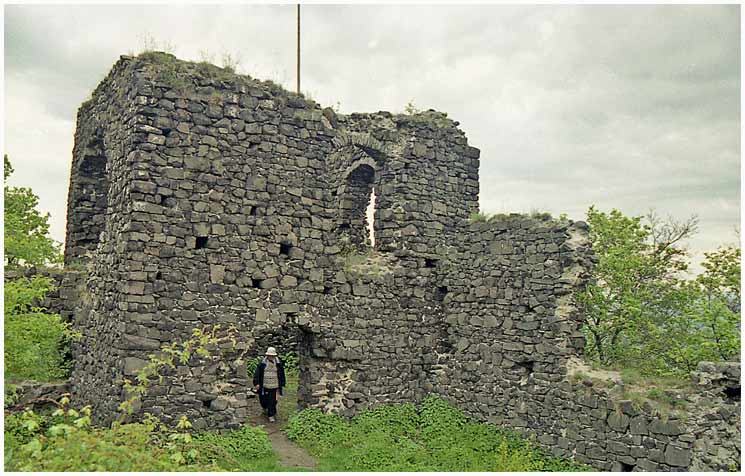
Hřídelík
Hřídelík castle stands as a compelling example of a medieval rock castle in the Czech Republic, perched near the village of Blíževedly. Its strategic location atop a steep sandstone rock at approximately 362 meters above sea level highlights the medieval practice of adapting fortifications to natural terrain. Constructed in the late 13th century, Hřídelík reflects the territorial ambitions and administrative reach of the Prague bishopric during the High Medieval period, serving as a fortified administrative center and prison within the ecclesiastical domain.
Historical context and ecclesiastical role
The origins of Hřídelík trace back to the late 1200s, with archaeological evidence indicating settlement and fortification efforts before 1300. The earliest known figure associated with the castle is Martin of Hřídelík, documented in 1292 as the burgrave responsible for overseeing the nearby village of Blíževedly. The castle itself appears in written records by 1334, confirming its role within the church's territorial administration. During this era, Hřídelík was primarily used as an administrative center and a prison managed by the Prague archdiocese. Notably, in 1395, it held clerics convicted by church courts, underscoring its function in enforcing ecclesiastical law.
The castle's significance waned following the acquisition of the nearby Helfenburk castle by the church in 1375. This shift diminished Hřídelík's strategic importance, a decline that became more pronounced during the Hussite Wars in the early 15th century. These religious conflicts led to widespread devastation across Bohemia, and Hřídelík suffered damage during this turbulent period. Subsequently, the castle was abandoned and fell into ruin, eventually becoming known locally as the "Old House" (Starý dům), a testament to its faded prominence.
Architectural features and layout
Hřídelík is classified as a hill castle and a rock castle due to its integration with the natural sandstone formation. The castle's compact layout is adapted to the rocky terrain, with a small upper plateau serving as the core defensive and residential area. This plateau is enclosed by a surviving ring wall, which, although now only about half a meter high, once provided a formidable barrier.
Within the enclosure, remnants of walls reveal the footprint of a rectangular palace, indicating a well-organized internal structure despite the castle's modest size. Access to this palace was secured by a unique 18-meter-long underground corridor carved directly into the rock, featuring a Gothic arch profile. This bent passage served defensive purposes by controlling entry and providing protection from direct assault.
The southeastern part of the rock includes partially hewn galleries and natural overhangs, which likely functioned as covered spaces for storage or shelter. These features demonstrate the adaptive use of the natural environment in the castle's design, maximizing the defensive and utilitarian potential of the sandstone outcrop.
Originally, the castle was further protected by a moat encircling the site. Although now overgrown with old fruit trees, the moat's outline remains visible in the landscape, marking the former defensive perimeter. Only limited fragments of the exterior walls survive today, emphasizing the ruinous state of the castle after centuries of neglect and conflict.
Later history and transformations
In the early 19th century, Bishop Augustin Hille sought to repurpose the site by constructing a small brick summer house, or letohrádek, atop the castle ruins. This structure represented a shift from the castle's original military and administrative functions to leisure use. However, the summer house was short-lived and fell into disrepair by around 1850.
The 20th century brought further changes when innkeeper Franz Josef Pietzsch cleared the site in 1906 with the intention of operating a summer tavern. This commercial venture was similarly short-lived. Prior to World War I, the rock caves at Hřídelík were adapted for practical uses such as drying spaces, while the surrounding slopes were cultivated with hop gardens. These adaptations reflect a transition from defensive and administrative roles to agricultural and local economic activities.
Preservation and cultural significance
Today, Hřídelík is recognized as a protected cultural monument of the Czech Republic. Despite its ruinous condition, the site offers valuable insights into medieval ecclesiastical fortifications and the integration of natural rock formations into defensive architecture. Its location near the Kokořínsko – Máchův kraj Protected Landscape Area situates it within a region of notable natural beauty, although the castle itself lies outside the conservation zone.
Visitors to Hřídelík can explore the remains of the ring wall, the underground corridor, and the rock galleries, gaining an appreciation for the castle's historical role and architectural ingenuity. The site exemplifies the medieval balance between natural landscape and constructed defense, reflecting broader themes in Central European castle development during the High Medieval period.
Frequently asked questions (FAQ)
- What is the historical significance of Hřídelík Castle?
- Hřídelík Castle, located in Blíževedly, Czechia, dates back to the 14th century and is a notable example of Gothic and Renaissance architecture. It has served various purposes throughout its history, including a noble residence and a military stronghold, reflecting the region's rich cultural heritage.
- When was Hřídelík Castle built?
- The construction of Hřídelík Castle began in the late 1300s, with significant modifications and expansions occurring over the centuries. Its architectural evolution showcases the various styles and influences prevalent in Czechia during the Middle Ages.
- Can I visit Hřídelík Castle?
- Yes, Hřídelík Castle is open to visitors, allowing you to explore its historic rooms and beautiful grounds. Guided tours are typically available to enhance your experience and provide insight into the castle's fascinating history.
- What are the opening hours for Hřídelík Castle?
- Hřídelík Castle is generally open to the public from Wednesday to Sunday, with specific hours varying by season. It is advisable to check the castle's official website or contact the visitor center for the most current opening times before your visit.
- Is Hřídelík Castle accessible for visitors with disabilities?
- Hřídelík Castle strives to accommodate all visitors, but due to its historical nature, accessibility can be limited in certain areas. It is recommended to contact the castle in advance to inquire about specific accessibility options and assistance.
- What is the best time to visit Hřídelík Castle?
- The best time to visit Hřídelík Castle is during the spring and early autumn when the weather is pleasant, and the surrounding gardens are in full bloom. Additionally, visiting during these seasons often means fewer crowds, allowing for a more enjoyable experience.
- Are there any nearby attractions to Hřídelík Castle?
- Yes, the area surrounding Hřídelík Castle offers several attractions, including beautiful hiking trails and nearby historical sites. Visitors can also explore local villages and enjoy the picturesque Czech countryside, making it a perfect day trip destination.
- What are the ticket prices for Hřídelík Castle?
- Ticket prices for Hřídelík Castle are generally affordable, with discounts available for students, seniors, and children. It is best to check the official website for the latest pricing information and any special promotions that may be available during your visit.
Information
Website
Visit websiteSources & official resources
Verify the information above using these authoritative references.
Loading map...
Visitor reviews
No reviews yet. Been here? Write the first review and help other travelers!
Write the first reviewVisited this castle? Share your experience
Your review helps other travelers and adds first-hand knowledge to our encyclopedia.