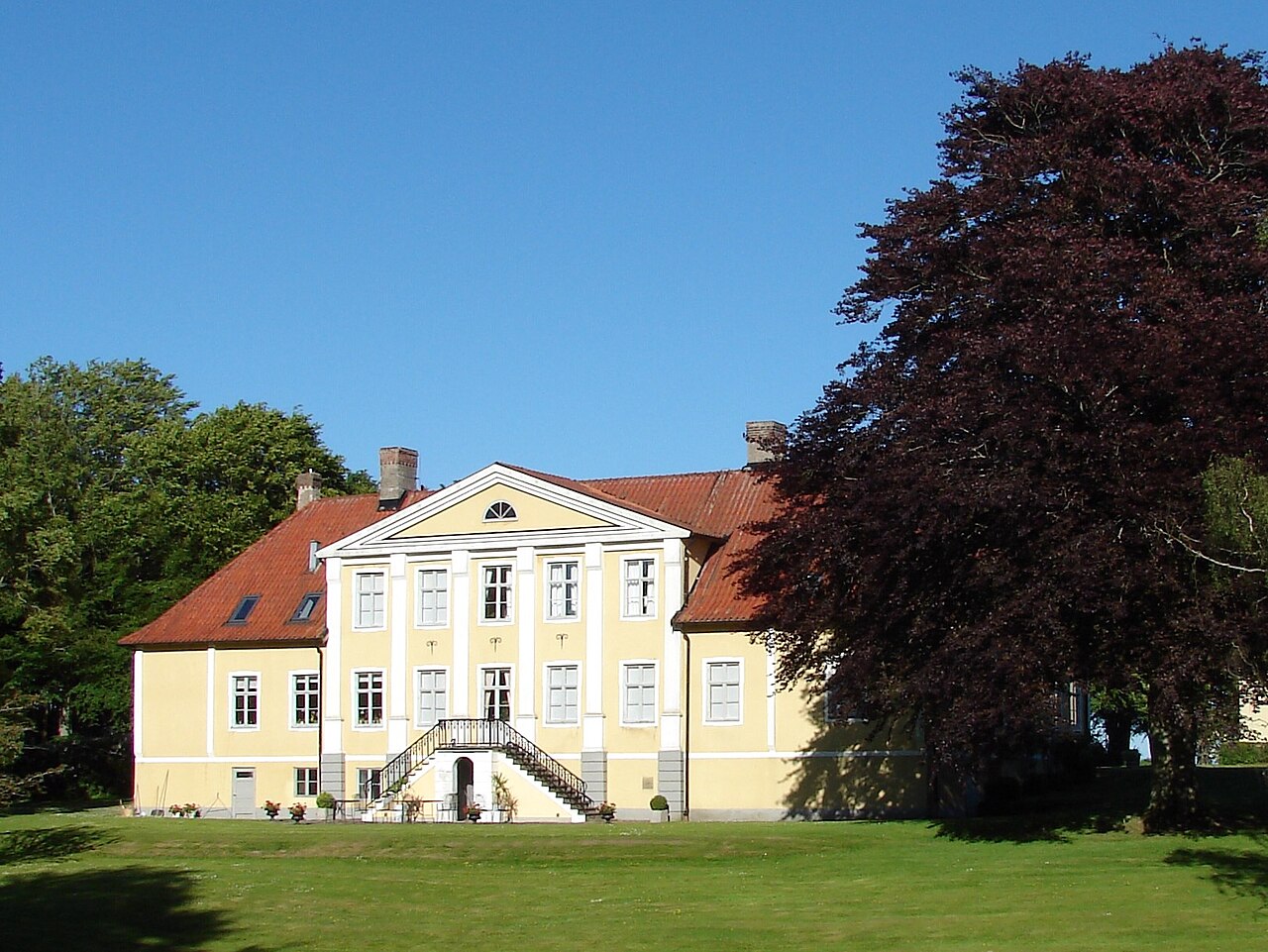
Hovdala Castle

Hovdala Castle in Hässleholm, Sweden
Hässleholm, Sweden
Renaissance (15th–17th c.)
Well Preserved

Hovdala Castle is a historic fortress located near Hässleholm in Scania, Sweden. While the castle was first mentioned in records as early as the 12th century, the oldest surviving parts of the complex date from the 16th century. The castle's history reflects the turbulent times of the region, especially during the Scanian Wars and other conflicts in southern Sweden.

Early history and origins

The site of Hovdala Castle has been occupied since medieval times, with the earliest references dating back to the 1100s. However, the extant structures primarily originate from the Renaissance period, with significant construction around 1511. This date is marked on the facade of one of the buildings by anchoring irons, which are visible to visitors today. These irons not only served structural purposes but also acted as historical markers.

Architectural features and construction

The gate tower

One of the most prominent features of Hovdala Castle is its gate tower, constructed in the early 1600s. This imposing four-storey structure, with walls approximately three feet thick, was designed to serve as a formidable entrance and defensive stronghold. The tower's robust construction enabled it to withstand intense fighting during the region's many conflicts.

Castle layout and buildings

The castle complex includes a range of buildings arranged around a courtyard, typical of Renaissance castles in Scandinavia. The thick stone walls, defensive battlements, and limited access points reflect the military architecture of the period. The buildings feature traditional masonry techniques and have been preserved to maintain their historical integrity.

Historical significance and conflicts

Hovdala Castle played a key role during the Scanian Wars in the 17th century, a period marked by conflict between Denmark and Sweden over control of the Scania region. The castle's defenses were tested during these turbulent times, and its survival is a testament to its solid construction and strategic importance.

Preservation and modern use

Today, Hovdala Castle is managed by the National Board of Antiquities and serves as a popular visitor attraction. The castle is well preserved, allowing visitors to explore its historic interiors and exterior defenses. Educational programs and guided tours provide insight into the castle's architectural features and its role in Swedish history.

Visiting Hovdala Castle

Visitors to Hovdala Castle can experience a well-maintained Renaissance fortress with rich historical context. The site offers a glimpse into the military architecture of the early modern period in Scandinavia, with opportunities to learn about the Scanian region's complex past.

Frequently asked questions (FAQ)

How do I get to Hovdala Castle?
Hovdala Castle is located in Hässleholm, Sweden, and is accessible by car or public transport. If you're driving, ample parking is available on-site. For public transport, check local bus schedules that connect Hässleholm with nearby towns.
What is the historical significance of Hovdala Castle?
Hovdala Castle dates back to the 15th century and is a significant example of Renaissance architecture in Sweden. It has served various roles throughout history, including as a noble residence and a military stronghold. The castle is also associated with notable historical figures and events that shaped the region.
When was Hovdala Castle built?
Hovdala Castle was constructed in the late 15th century, with its first historical mention recorded in 1492. The castle has undergone several renovations and expansions over the centuries, particularly during the 17th and 18th centuries, which have contributed to its current architectural style.
Can I take a guided tour of Hovdala Castle?
Yes, guided tours of Hovdala Castle are available, allowing visitors to learn more about its history and architecture. These tours are typically offered during the peak tourist season and can be booked in advance for larger groups. Check the castle's official website for specific tour schedules and availability.
Why is Hovdala Castle popular with visitors?
Hovdala Castle is popular for its stunning architecture, beautiful gardens, and rich history. Visitors enjoy exploring the picturesque surroundings and participating in various cultural events hosted at the castle throughout the year. Its location near scenic nature trails also attracts outdoor enthusiasts.
Is it possible to host events at Hovdala Castle?
Yes, Hovdala Castle offers facilities for hosting events, including weddings, corporate gatherings, and cultural events. The castle's unique ambiance and beautiful surroundings make it an ideal venue for special occasions. For more information on booking and services, contact the castle's event management team.
What are the opening hours for Hovdala Castle?
Hovdala Castle is open to visitors from May to September, with varying hours depending on the day of the week. During the off-season, the castle may have limited access for special events or private tours. Always check the official website for the most current opening hours before planning your visit.
What are the ticket prices for Hovdala Castle?
Ticket prices for Hovdala Castle vary by age group, with discounts available for children, students, and seniors. Family tickets and group rates may also be offered. It's best to visit the official website for the latest pricing information and any special offers that may be available during your visit.
When is the best time to visit Hovdala Castle?
The best time to visit Hovdala Castle is during the summer months, from June to August, when the weather is pleasant and the gardens are in full bloom. Additionally, many events and guided tours are scheduled during this time, providing a richer experience for visitors. Early autumn can also be a lovely time to visit, as the foliage begins to change.
Are there any nearby attractions to Hovdala Castle?
Yes, there are several nearby attractions, including the scenic Söderåsen Nature Reserve, perfect for hiking and enjoying nature. The town of Hässleholm offers additional cultural experiences, including museums and local shops. Visitors can easily spend a full day exploring both Hovdala Castle and its surrounding areas.

Information

Hill Castle

Loading map...

Visitor reviews

No reviews yet. Been here? Write the first review and help other travelers!

Write the first review

Visited this castle? Share your experience

Your review helps other travelers and adds first-hand knowledge to our encyclopedia.

Write a review

(5/5)

0/2000 characters

Your review will be visible after admin approval

Nearby castles

7.2 km

Vannaröd Castle

Sösdala, Sweden

Vannaröd Castle, located in Sösdala, Sweden, is a distinctive example of late 19th-century castle architecture inspired by Scottish designs. Completed in 1890, the castle was commissioned by Christian Barnekow, a member of a notable Swedish noble family. Barnekow's marriage to Agnes Sofia Montgomery, who hailed from Scotland, directly influenced the castle's architectural style, which draws heavily from the traditional Scottish baronial aesthetic. Architectural inspiration and style The design of Vannaröd Castle reflects the Scottish baronial style, characterized by features such as turrets, battlements, and steeply pitched roofs. This style was popular in Scotland during the 19th century as a revival of medieval castle elements combined with Victorian-era romanticism. The castle's architecture stands out in the Swedish landscape due to these distinctive Scottish elements, which were relatively uncommon in Sweden at the time. The building incorporates stone masonry and ornamental details typical of the style, including decorative chimneys and pointed arch windows. The castle's layout includes multiple towers and a complex roofline, emphasizing verticality and grandeur reminiscent of Scottish castles like those found in the Highlands and Lowlands. Historical context and ownership Christian Barnekow belonged to a prominent noble family with deep roots in Swedish history. His decision to build a castle inspired by his wife's Scottish heritage symbolizes a cultural connection between Sweden and Scotland in the late 19th century. The construction of Vannaröd Castle during the Modern period reflects a trend among European nobility to revive and romanticize medieval architecture, blending personal heritage with contemporary tastes. Since its completion, the castle has undergone various changes in ownership and function. While originally a private residence, it has adapted over time to new uses that preserve its architectural integrity. Current use and preservation Today, Vannaröd Castle functions as a restaurant, allowing visitors to experience its historic ambiance alongside modern hospitality. The adaptation for public use has helped maintain the castle's structure and ensured its preservation. The castle's well-maintained condition allows guests to appreciate both its architectural beauty and its historical significance. The surrounding grounds and gardens complement the castle's Scottish-inspired design, offering a picturesque setting for dining and events. This contemporary use of the castle ensures that it remains an active part of the cultural landscape in Sösdala. Architectural details and features The castle's exterior is marked by its turrets and battlements, which create a fortress-like silhouette. The steep roofs are covered with slate tiles, typical of Scottish castles. Inside, the castle features spacious halls and rooms that retain elements of the original design, including wood paneling and ornate fireplaces. Vannaröd Castle's design incorporates both defensive motifs and residential comfort, blending the romantic idea of a medieval fortress with the practical needs of a 19th-century noble home. This duality is evident in the castle's layout and decorative details. Significance and cultural heritage As a unique example of Scottish-inspired architecture in Sweden, Vannaröd Castle holds cultural significance for its representation of cross-cultural influences in European architecture. It stands as a testament to the personal histories and international connections of its builders. The castle contributes to the architectural diversity of the region and serves as a local landmark in Sösdala. Its preservation and adaptive reuse highlight the importance of maintaining historical buildings while allowing them to serve contemporary functions.

Modern (19th–20th c.)
Details
17.9 km
Sinclairsholm Castle — Sweden castle

Sinclairsholm Castle

Vinslöv, Sweden

Sinclairsholm Castle, located in Vinslöv, Scania, southern Sweden, is a notable example of a post-Renaissance estate with a history that dates back to the early 17th century. The estate was originally established in 1620 by Anders Sinclair, a member of the distinguished Sinclair family. The castle's origins are closely linked to the Danish nobleman and privy counsellor Andrew Sinclair, who played a significant role in the region during the period when Scania was under Danish rule. Historical background and foundation The Sinclair family acquired the land in the early 1600s, establishing the estate as part of their holdings in the region. The original manor house was constructed during this time, serving as a residence and a symbol of the Sinclair family's status. The estate's location in Hässleholm Municipality placed it within a strategic area of southern Sweden, which had historically been contested between Denmark and Sweden. Throughout the 17th century, the estate remained under Sinclair ownership, witnessing the political changes that saw Scania transition from Danish to Swedish control following the Treaty of Roskilde in 1658. This shift influenced the architectural and cultural development of the estate, blending Danish and Swedish influences. Architectural evolution and the 1788 reconstruction The current main building of Sinclairsholm Castle was constructed in 1788 after the previous structure suffered significant damage due to a fire. This reconstruction marked a new chapter in the estate's architectural history, reflecting the styles and building techniques of the late 18th century. The castle exemplifies post-Renaissance architecture, characterized by a restrained elegance and practical design. The building features a symmetrical facade, balanced proportions, and classical details that were typical of the period. Unlike medieval fortresses, Sinclairsholm was designed primarily as a noble residence rather than a defensive stronghold, emphasizing comfort and aesthetic appeal. While the estate is classified as a hill castle due to its elevated position, it lacks the heavy fortifications of earlier medieval castles. Instead, the focus was on creating a stately home that harmonized with the surrounding landscape, including carefully planned gardens and parklands. Estate grounds and current use The grounds of Sinclairsholm Castle include extensive gardens and park areas that complement the architectural style of the main building. These outdoor spaces have been maintained to preserve the historical ambiance of the estate, offering visitors a glimpse into the lifestyle of Swedish nobility in the 18th and 19th centuries. Today, Sinclairsholm Castle operates as a venue for various events, including weddings, parties, and cultural gatherings. The estate houses a restaurant that serves guests in an atmospheric setting, blending historical charm with modern hospitality. This adaptive reuse helps sustain the castle's upkeep and keeps it accessible to the public. Significance and cultural heritage Sinclairsholm Castle holds cultural importance as a well-preserved example of a Swedish noble estate that bridges the transition from Danish to Swedish rule in Scania. Its architectural features and historical associations offer insights into the region's complex past and the evolution of aristocratic residences in Scandinavia. The castle's connection to the Sinclair family, particularly Andrew Sinclair, underscores its role in the political and social history of southern Sweden during the 17th and 18th centuries. As a heritage site, it contributes to the understanding of Scandinavian noble estates and their adaptation over time. Visitor information Visitors to Sinclairsholm Castle can explore the estate's scenic grounds and enjoy the restaurant facilities. The castle is accessible from the town of Vinslöv and is a point of interest for those interested in Swedish history, architecture, and cultural heritage. While the castle itself is primarily used for private events, the surrounding park and restaurant provide opportunities for public engagement with the site. The estate's preservation ensures that Sinclairsholm remains a valued landmark in the Hässleholm Municipality.

Post-Renaissance (17th–18th c.)
Details
21.4 km

Ovesholm Castle

Kristianstad, Sweden

Ovesholm Castle is a historic estate located near Kristianstad in Sweden, known for its post-Renaissance architectural style and rich heritage. The estate's earliest recorded owner was Åke Holm in 1580, marking the beginning of its documented history. In 1620, an earlier main building was constructed by Ove Urup close to the present castle's site, establishing the foundation for the estate's later development. The current castle structure was commissioned by Carl Adam Wrangel af Adinal, son of Henning Reinhold Wrangel, after the estate was donated to the Wrangel family in 1774. The construction spanned from 1792 to 1804, reflecting the architectural tastes of the post-Renaissance period with influences that emphasize symmetry, classical details, and refined elegance. This period saw a departure from medieval fortifications towards more comfortable and stately manor houses, which is evident in Ovesholm's design. Architectural features and style The castle exhibits characteristics typical of the post-Renaissance style, including a balanced and harmonious façade, large windows to allow natural light, and carefully proportioned rooms designed for residential comfort rather than defense. The building is constructed primarily from stone and brick, materials favored in Scandinavian manor houses of the era. The layout likely includes formal reception rooms, private family quarters, and service areas arranged around a central axis. In 1857, Axel Hugo Raoul Hamilton undertook an enlargement of the castle. This expansion may have introduced elements reflecting mid-19th-century tastes, potentially incorporating some romantic or historicist details, although the core post-Renaissance character remains dominant. The Hamilton family's stewardship has preserved the castle's architectural integrity while adapting it to contemporary needs over the centuries. Historical significance and ownership The estate's transition from the Holm family to the Wrangels in the late 18th century marked a significant chapter in its history. Carl Adam Wrangel af Adinal was not only responsible for the castle's construction but also enriched Ovesholm with a notable library and a collection of art and sculptures, reflecting the cultural interests of the Swedish nobility during this period. These collections would have made the castle a center of intellectual and artistic activity. Today, Ovesholm remains in the possession of the Hamilton family, descendants of Axel Hugo Raoul Hamilton, who have maintained the estate as a private residence. Due to its private ownership, the castle is not open to the public, limiting direct visitor access but preserving its status as a well-maintained historic manor. Estate grounds and surroundings The castle is situated within an estate that likely includes landscaped gardens and parkland typical of Swedish manor houses of the 18th and 19th centuries. These grounds would have been designed to complement the architecture and provide a picturesque setting, possibly featuring tree-lined avenues, ornamental plantings, and water features. The estate's location near Kristianstad situates it within a region rich in history and cultural heritage. Preservation and current condition Ovesholm Castle is classified as well preserved, maintaining much of its original structure and design elements despite its age. The continued ownership by the Hamilton family has ensured ongoing care and conservation. Although not accessible for public tours, the castle's preservation contributes to Sweden's architectural heritage, representing the evolution of manor house design from the post-Renaissance period onward.

Post-Renaissance (17th–18th c.)
Details