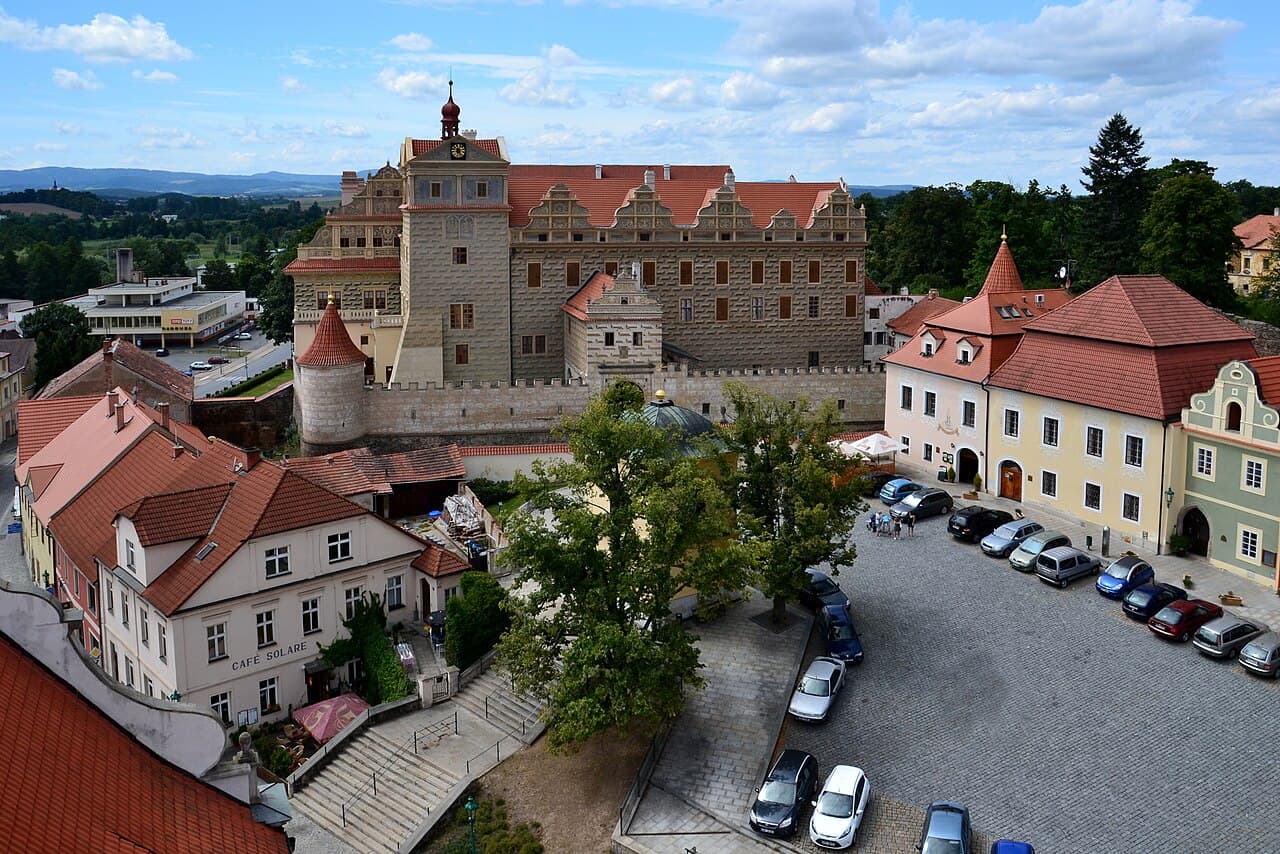
Horšovský Týn Castle
Horšovský Týn Castle stands as a remarkable testament to Central European medieval and Renaissance architecture, located in the town of Horšovský Týn in the modern Czech Republic. This castle's history spans from prehistoric human settlements through its evolution as a significant episcopal stronghold and later a Renaissance noble residence. Its strategic position on a rocky promontory, protected by moats and surrounded by a large landscaped park, reflects its longstanding importance both militarily and culturally.
The site of Horšovský Týn Castle has been inhabited since prehistoric times, with archaeological evidence revealing human activity from the Mesolithic, Eneolithic, and late Hallstatt periods. The earliest fortifications date to the younger hillfort period, but the castle as known today was established in the 13th century by the Prague bishops. The original structure was a wooden episcopal court, destroyed by fire and uncovered during excavations in 2002. Around the mid-1200s, Bishop Jan III of Dražice initiated the construction of a stone castle that replaced the earlier wooden buildings, marking the beginning of the castle's medieval phase.
Medieval origins and episcopal significance
The first written record of the castle dates from the 1280s, when Bishop Tobiáš of Bechyně founded the adjoining town, laying the foundation for Horšovský Týn’s development as an episcopal seat. The castle was a prominent episcopal fortress and played a critical role during the Hussite Wars in the early 15th century. It remained under the control of the Prague diocese and successfully withstood two major sieges in 1422 and 1431, defended by the burgrave Zdeněk of Drštka. This resilience highlights the castle's strategic and defensive capabilities during a turbulent period in Bohemian history.
Despite its strong defenses, the castle's ownership changed multiple times in the decades following the Hussite Wars. In 1426, it was pledged to Emperor Sigismund and later passed to the Ronšperk family before reverting to the Prague chapter. The estate was subsequently mortgaged to Dobrohost of Ronšperk and his descendants, reflecting a period of unstable control and shifting political alliances.
Renaissance transformation and lobkowicz ownership
The castle entered a new phase in 1539 when Jan Younger Popel of Lobkowicz acquired it from Emperor Ferdinand I. Shortly after, a devastating fire in 1547 destroyed large parts of the castle and the surrounding town. This catastrophe prompted a comprehensive Renaissance reconstruction that lasted until 1616, transforming the castle into a grand residence that reflected the tastes and ambitions of the Lobkowicz family.
The Lobkowicz family significantly expanded the estate, incorporating 28 villages, two manors, and the former Starý Herštejn castle into their holdings. The Renaissance rebuilding introduced a new eastern wing featuring a fortified foregate with two round bastions and a gate passage. The façade of this wing is distinguished by its stepped gables and a hipped roof concealing an attic once used as servants’ quarters. Inside, the first floor houses a large hall with fragments of 16th-century wall paintings, offering a glimpse into the artistic decoration of the period.
Architectural features of the renaissance period
The northern wing combined practical and residential functions, with the first floor supported by an intricate wooden truss system and the second floor containing a black kitchen designed to contain smoke and vaulted living rooms adorned with lunette vaults. Decorative painting fragments in these rooms are believed to be linked to Bohunka of Rožmberk, a member of a prominent noble family, highlighting the castle’s refined Renaissance interiors.
Defensive features from this period included a covered shooting gallery along the walls, supported by blind arcades fitted with artillery embrasures, except on the eastern side. The southern wing, constructed during Vilém of Lobkowicz's ownership, housed horse stables below and a riding hall above. The second floor contained three large halls accessible via an arcaded gallery, blending functional and representative spaces.
Baroque and neo-renaissance enhancements under the trauttmansdorff family
Following the Bohemian Revolt in the early 17th century, the castle and its lands were confiscated in 1622 and purchased by Count Maxmilián of Trauttmansdorff. The Trauttmansdorff family maintained ownership until the mid-20th century, overseeing important enhancements around 1880. These improvements included the construction of a dedicated burgrave’s apartment, glazed arcaded corridors, and the decoration of facades with sgraffito and paintings designed by the noted architect Josef Schulz.
Architectural layout and fortifications
The castle complex exemplifies the prestigious “kastel” type common in Central Europe during the Middle Ages, with a layout reminiscent of royal palaces from the reign of King Přemysl Otakar II. The castle’s fortifications include stone walls, corner towers, and moats protecting the northern and eastern sides. Notable surviving towers include the southwest square tower, historically used as a treasury, and the northern square tower. Additional towers crown the presbytery above the chapel and the northeast corner, underscoring the castle’s defensive strength.
The main entrance was located in the western palace, accessed through a passage with three gates protected by a parkán (outer ward) connected directly to the town square. Extensive cellars carved into the rock beneath the castle, some dating back to the Gothic period, include original vaulted ceilings from the 13th century, linking to the castle’s episcopal origins.
Holy trinity chapel and gothic heritage
The oldest surviving part of the castle is the Holy Trinity Chapel, a Romanesque single-nave building from the early 13th century situated in the southeast corner. Dated roughly between 1260 and 1270, the chapel features a polygonal apse and impressive six-part rib vaults supported by slender pillars and wall consoles. It originally included a central star-shaped vault, destroyed in the 1547 fire but remaining a distinctive element of the chapel’s architectural history.
Landscaped park and cultural significance
The castle is complemented by a substantial naturalistic park designed in the late 18th and early 19th centuries. This landscaped garden includes fountains, a well, a statue of Neptune, a Loreto chapel, a ballroom, and a gloriette pavilion. These elements integrate refined outdoor spaces with the historical castle setting, enhancing the site’s cultural and heritage significance.
Current status and cultural monument designation
Since 1995, Horšovský Týn Castle has been recognized as a national cultural monument, reflecting its long and varied history that spans from a medieval episcopal fortress to a Renaissance residence with later Baroque and Neo-Renaissance adaptations. The castle today stands as a well-preserved example of Central European castle architecture, offering insight into the region’s medieval, Renaissance, and early modern periods.
Frequently asked questions (FAQ)
- How do I get to Horšovský Týn Castle?
- To reach Horšovský Týn Castle, you can use public transport options such as trains or buses that connect to the town of Horšovský Týn. The castle is located within walking distance from the town center, making it easily accessible for visitors.
- What is the historical significance of Horšovský Týn Castle?
- Horšovský Týn Castle is a significant historical site in Czechia, originally built in the 13th century as a royal residence. Over the centuries, it has served various functions, reflecting the rich history of the region, including its role in the noble families' lives and as a military stronghold.
- When was Horšovský Týn Castle constructed?
- The construction of Horšovský Týn Castle began in the 13th century, with various modifications and expansions made throughout the following centuries. Its architectural evolution showcases the different styles that emerged from the Gothic to the Renaissance period.
- Can I take guided tours of Horšovský Týn Castle?
- Yes, guided tours are available at Horšovský Týn Castle, providing visitors with in-depth knowledge of its history and architecture. Tours typically last about an hour and are conducted in multiple languages to accommodate international visitors.
- Why is Horšovský Týn Castle considered an architectural gem?
- Horšovský Týn Castle is regarded as an architectural gem due to its blend of Gothic and Renaissance styles, which are evident in its intricate facades and well-preserved interiors. The castle's design reflects the artistic sensibilities of its time and showcases the craftsmanship of historical builders.
- Is it possible to visit Horšovský Týn Castle year-round?
- Yes, Horšovský Týn Castle is open for visitors year-round, although opening hours may vary depending on the season. It is advisable to check the official website for specific visiting hours and any seasonal events that may be taking place.
- What are the ticket prices for Horšovský Týn Castle?
- Ticket prices for Horšovský Týn Castle are generally affordable, with discounts available for children, students, and seniors. Special pricing may apply for guided tours, so it’s best to check the castle's official website or at the ticket office for the most accurate information.
- When is the best time to visit Horšovský Týn Castle?
- The best time to visit Horšovský Týn Castle is during the spring and early autumn months when the weather is mild and the surrounding landscape is picturesque. Additionally, these seasons usually see fewer crowds, allowing for a more enjoyable and intimate experience.
- What nearby attractions can I explore while visiting Horšovský Týn Castle?
- While visiting Horšovský Týn Castle, you can also explore the charming town of Horšovský Týn, which features beautiful squares and historical buildings. Nearby attractions include the scenic countryside, offering opportunities for hiking and cycling, as well as other historical sites in the region.
Photo gallery

Information
Website
Visit websiteSources & official resources
Verify the information above using these authoritative references.
Loading map...
Visitor reviews
No reviews yet. Been here? Write the first review and help other travelers!
Write the first reviewVisited this castle? Share your experience
Your review helps other travelers and adds first-hand knowledge to our encyclopedia.


