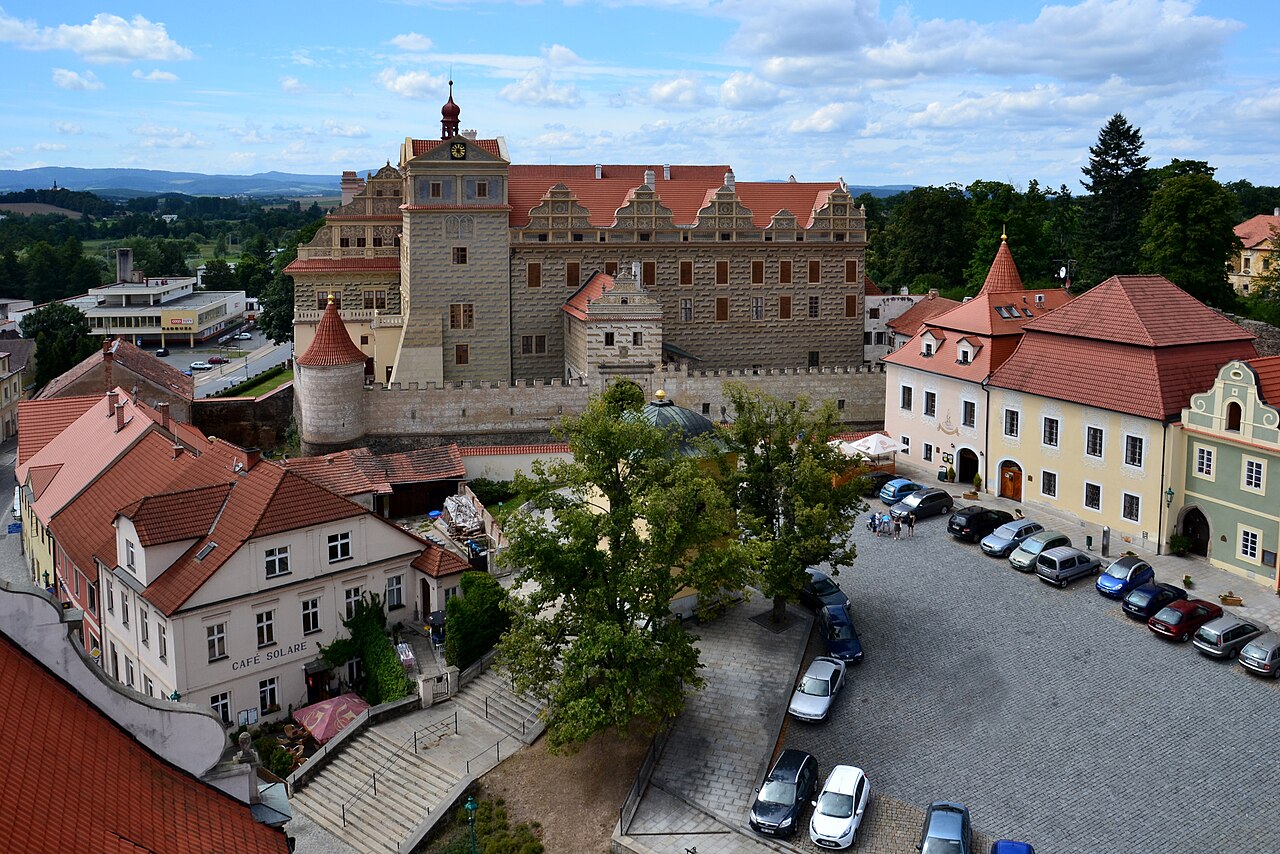
Chod Castle
Chod castle stands as a significant medieval hill castle in the southwestern Czech town of Domažlice. Founded in the mid-13th century by King Ottokar II Přemysl, this fortress was established alongside the town itself to serve as a royal administrative center and residence for the burgraves charged with overseeing the unique Choden people. These free peasants played a crucial role in guarding the Bohemian border against incursions from the neighboring Bavarian Nordgau region. The castle's strategic location and design reflect its primary function as a frontier defense stronghold in the High Medieval period.
Historical significance and royal patronage
The castle's origins in the 1260s mark it as a key element in the border defense system of the Kingdom of Bohemia. It worked in tandem with the Bavarian castle at Cham, which similarly employed free peasant guards, underscoring the unique military and social arrangement in this borderland. Throughout the 14th century, Chodský hrad hosted prominent rulers such as King John of Bohemia (John of Luxembourg), who favored the castle for its hospitality and strategic importance. His son, Charles IV, also frequented the castle, further cementing its status as a royal residence and administrative hub.
For several centuries, the castle maintained its military and administrative functions, playing a central role in managing the border region and supporting the local Choden community. However, by the early 16th century, the castle's original defensive role began to wane, and it gradually declined in importance.
Architectural features and layout
Chod castle is characterized by an oblong ground plan that integrates with the town's ramparts, particularly on the south and west sides. These sides were fortified by the town's defensive walls, which included a distinctive roll-shaped tower built upon a square base, serving as a key defensive element. The castle complex originally comprised three main palace wings arranged around a rectangular courtyard, with the rectangular corner oriented away from the town, enhancing its defensive posture.
Defensive features likely included a moat and a parkán—an outer ward or fortified enclosure—on the side opposite the rectangular corner, which featured a quarter-circular section. The southern side of the castle was protected by a wall running close to the Zubřina river, utilizing the natural terrain for strategic defense.
The castle's underground spaces reveal a fascinating architectural evolution, combining earlier Gothic masonry with extensive 18th-century brick vaulting. These cellars, now serving as a lapidarium, display a collection of stone fragments, including architectural details, milestones, and ornamental Baroque pedestal elements uncovered during archaeological excavations and later construction phases.
Transformation and changing functions through the centuries
After a major fire in 1592 that severely damaged the castle, its military and administrative roles diminished. Ownership disputes in the 17th century between the nobleman Wolf Maximilian Laminger von Albenreuth and the town of Domažlice culminated in the castle's transfer to municipal control in 1671. Subsequently, between 1726 and 1728, the castle underwent a significant transformation under the direction of the renowned architect Kilian Ignaz Dientzenhofer. It was rebuilt as a four-winged building serving as a salt warehouse, reflecting the changing economic and administrative needs of the region.
Throughout the 19th century, the castle's function shifted further, housing municipal offices and later a school from 1850. The early 20th century saw another major change when the castle became home to the Choden Museum, established in 1883. This institution focused on preserving the local ethnographic heritage, folk traditions, and the history of the Choden people, ensuring the castle's continued cultural relevance.
Despite suffering another fire in 1995 that destroyed much of the roof and interior, restoration efforts completed by 1998 allowed the castle to reopen as a museum in 1999. Since 1964, the site has been protected as a cultural monument, highlighting its enduring historical and architectural importance.
Current remains and visitor experience
Today, visitors to Chodský hrad can explore the surviving parts of the castle, including sections of the outer defensive walls and the round tower that stands on a square base. The castle courtyard features the lapidarium, showcasing stone artifacts and religious items such as Calvaries and fragments from the nearby church in Valtýř, linking the site to the broader cultural landscape of the region.
The castle's underground cellars, accessible to the public, comprise two vaulted chambers with brick paving. These spaces are part of a larger network of subterranean cellars beneath Domažlice, some of which required stabilization after partial collapses in the 1960s. The lapidarium also includes an installation representing a traditional Choden wedding, highlighting the unique cultural heritage of the castle's early defenders.
Visitors can also ascend the tower, which offers insights into the castle's defensive past and panoramic views of the surrounding landscape. The castle's location near the Zubřina stream and its integration with the old town's fortifications provide a vivid context for understanding its historical role as a border fortress.
Architectural legacy and cultural significance
Chod castle exemplifies the evolution of a medieval fortress adapting to changing political, military, and economic circumstances over several centuries. Its transformation from a royal stronghold to a salt warehouse, municipal building, school, and finally a museum reflects the dynamic history of the Bohemian borderlands. The preservation of its architectural elements, combined with the cultural exhibits housed within, make it a vital site for understanding the region's medieval heritage and the unique status of the Choden people.
The castle's protection as a cultural monument since 1964 ensures ongoing conservation efforts and highlights its importance as a symbol of regional identity and historical continuity. Its blend of Gothic and Baroque architectural features, along with the contributions of architect Kilian Ignaz Dientzenhofer, provide valuable insights into the architectural developments in Bohemia from the Middle Ages through the early modern period.
Frequently asked questions (FAQ)
- How do I get to Chod castle in Domažlice?
- Chod castle is located in the southwestern part of Domažlice, near the town center. It is accessible by car and public transport, with parking available nearby and walking routes from the town square.
- What are the main historical periods represented at Chod castle?
- Chod castle primarily reflects the High Medieval period, with significant architectural transformations during the Baroque period in the 18th century. Visitors can see Gothic masonry alongside Baroque vaulting and later modifications.
- When was Chod castle converted into a museum?
- The castle became home to the Choden Museum in 1883, focusing on local ethnographic heritage and history. It reopened after restoration in 1999 following a fire in 1995.
- Can I visit the underground cellars and lapidarium?
- Yes, the underground cellars are open to visitors and feature a lapidarium with stone fragments and religious artifacts. The cellars provide insight into the castle's architectural history and local culture.
- What are the opening hours and ticket prices for Chod castle?
- Chod castle is open daily from 9:00 to 17:00. Admission costs €3 for adults and €1.5 for children, making it an affordable cultural attraction.
- Is the castle accessible for visitors with mobility issues?
- While the main areas of the castle are accessible, some parts such as the tower and underground cellars may have limited access due to historic structural constraints. Visitors with mobility issues are advised to check in advance.
Information
Opening hours
9:00-17:00, daily
Ticket prices
€3 adult, €1.5 child
Current owner
Municipality of Domažlice
Website
Visit websiteSources & official resources
Verify the information above using these authoritative references.
Loading map...
Visitor reviews
No reviews yet. Been here? Write the first review and help other travelers!
Write the first reviewVisited this castle? Share your experience
Your review helps other travelers and adds first-hand knowledge to our encyclopedia.