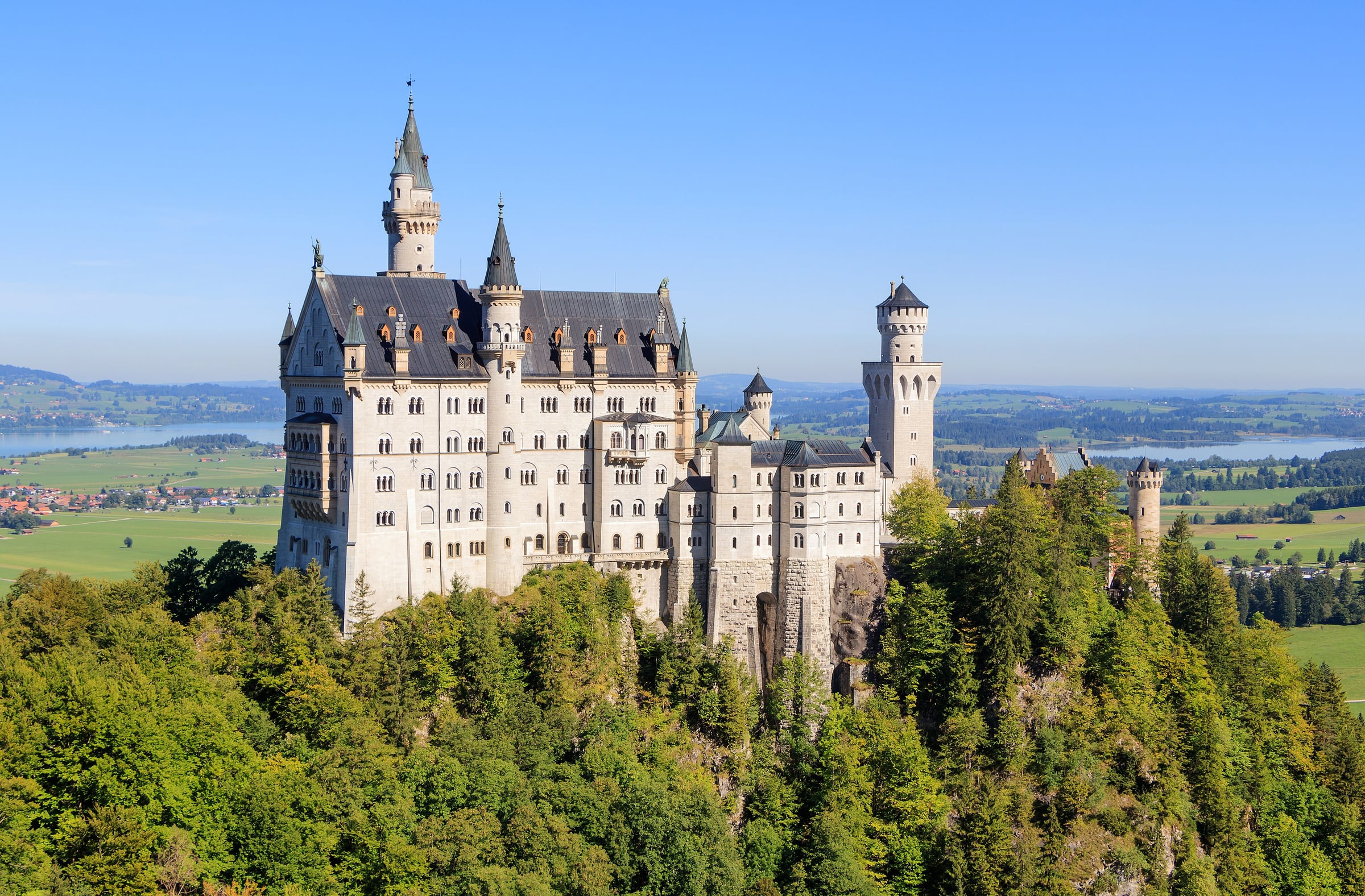
Hohenschwangau Castle stands as a remarkable example of 19th-century neo-Gothic architecture nestled in the picturesque region of Bavaria, Germany. Located near the Austrian border and overlooking the serene Alpsee lake, this castle holds a significant place in Bavarian history, especially as the childhood residence of King Ludwig II of Bavaria. Although often associated with Ludwig II's legacy, the castle was actually constructed by his father, King Maximilian II of Bavaria, between 1833 and 1857.
The origins of Hohenschwangau Castle trace back to the 12th century when the original fortress was built by the knights of Schwangau. These knights were initially vassals of the House of Welf and later the Hohenstaufen dynasty. The original Schwangau fortress, which once stood on a nearby rock where the famous Neuschwanstein Castle now rises, fell into ruin after the extinction of the Schwangau knights in the 16th century. The castle's strategic and scenic location attracted the attention of the Wittelsbach family, Bavaria's ruling dynasty, who acquired the property in the early 19th century.
Historical evolution and ownership
The castle underwent several transformations over the centuries. The present-day Hohenschwangau Castle was first mentioned in records from 1397 under the name "Schwanstein," a name later switched with Neuschwanstein in the 19th century. Between 1440 and 1521, the castle was owned by the Lords of Schwangau, who sold and reacquired it several times before finally selling it to Johann Paumgartner, a wealthy Augsburg merchant, in the early 16th century. Paumgartner commissioned the Italian architect Lucio di Spazzi to reconstruct the castle's interior while preserving the exterior walls and towers, resulting in a Renaissance-style floor plan that remains today.
After Paumgartner's death, the castle passed to the Wittelsbach dukes of Bavaria, who used it as a hunting lodge and retreat for royal family members. The castle was plundered by Austrian troops in 1743 during the War of the Austrian Succession but remained an important royal property. In 1803, during the German mediatization, the county of Schwangau was incorporated into the Electorate of Bavaria. The castle changed hands until Crown Prince Maximilian II reacquired it in 1832, initiating a comprehensive restoration and rebuilding project.
19th-century reconstruction and neo-Gothic style
The restoration of Hohenschwangau Castle began in 1833 under the direction of architect Domenico Quaglio, who embraced the neo-Gothic style that was fashionable in Europe during the Romantic period. Quaglio's work included the castle's distinctive towers, battlements, and decorative elements that evoke medieval chivalry and legend. After Quaglio's death in 1837, architects Joseph Daniel Ohlmüller and Georg Friedrich Ziebland continued the project, completing it by 1857.
The castle's interiors are richly decorated with over 90 wall paintings that depict the history of Schwangau, medieval German romances, and legends such as Parzival and the story of Lohengrin, the Knight of the Swan. These themes were a source of inspiration for the composer Richard Wagner, who was a close friend of Ludwig II and frequently stayed at the castle. The romantic ambiance of Hohenschwangau profoundly influenced Ludwig II's artistic vision and his later patronage of Wagner's operas.
Royal residence and cultural significance
Hohenschwangau served as the summer and hunting residence for King Maximilian II, his wife Queen Marie of Prussia, and their sons Ludwig II and Otto. The castle's location amidst the Bavarian Alps provided an idyllic setting for the royal family. Queen Marie established an alpine garden featuring plants collected from across the Alps, enhancing the castle's natural beauty.
After King Maximilian's death in 1864, Ludwig II ascended the throne and made Hohenschwangau his primary residence until he began construction of his own nearby castle, Neuschwanstein, in 1869. Despite his preference for solitude, Ludwig cherished his childhood home, often retreating there in the absence of his mother. Following Ludwig's death in 1886, the castle remained inhabited by Queen Marie until her passing in 1889, and later by Prince Regent Luitpold of Bavaria, who modernized the castle with electric lighting and an elevator in the early 20th century.
20th-century history and modern use
During both World Wars, Hohenschwangau Castle escaped damage, preserving its historical and architectural integrity. In 1923, the Bavarian parliament recognized the former royal family's right to reside in the castle. From 1933 to 1939, Crown Prince Rupprecht of Bavaria used it as a summer residence. The castle remains a private residence for his descendants, currently owned by Franz, Duke of Bavaria.
Today, Hohenschwangau Castle is a major tourist attraction, drawing over 300,000 visitors annually. It offers a unique glimpse into Bavarian royal history, 19th-century neo-Gothic architecture, and the cultural milieu that shaped one of Bavaria's most enigmatic monarchs, King Ludwig II. Visitors can explore its richly decorated halls, admire the stunning alpine surroundings, and appreciate the castle's role in the broader story of Bavarian heritage and Romanticism.
Architectural features and layout
Exterior design and fortifications
The castle's exterior is characterized by its neo-Gothic towers, battlements, and pointed arches that evoke medieval fortresses. The design incorporates elements typical of Romantic-era castles, emphasizing picturesque aesthetics over military functionality. Positioned on a hill above the Alpsee lake, the castle commands panoramic views of the surrounding Bavarian Alps and the nearby Neuschwanstein Castle.
Interior decoration and artistic themes
The interior spaces are lavishly adorned with murals and frescoes that narrate legendary tales and regional history. The great hall features scenes from the life of King Maximilian I Joseph, while private chambers depict romantic legends such as the Knight of the Swan. The artistic program reflects the 19th-century fascination with medieval chivalry, Germanic myths, and the burgeoning Romantic movement.
Gardens and landscape
Queen Marie's alpine garden surrounding the castle showcases an impressive collection of mountain flora, enhancing the castle's integration with its natural environment. Walking paths and terraces offer visitors tranquil spots to enjoy the scenic beauty that inspired the Wittelsbach family.
Frequently asked questions (FAQ)
- How do I get to Hohenschwangau Castle?
- Hohenschwangau Castle is located near Füssen in Bavaria, Germany. The most convenient way to reach the castle is by car, with ample parking available nearby. Alternatively, you can take a train to Füssen, followed by a short bus ride or a scenic walk to the castle.
- What is the historical significance of Hohenschwangau Castle?
- Hohenschwangau Castle was the childhood residence of King Ludwig II of Bavaria and holds great historical importance as a symbol of the Bavarian royal heritage. Built in the 19th century, the castle showcases a blend of medieval and romantic architectural styles. It served as a base for King Ludwig II's later constructions, including the famous Neuschwanstein Castle.
- When was Hohenschwangau Castle built?
- Construction of Hohenschwangau Castle began in 1832 and was completed in 1846. The castle was built on the ruins of an older fortress and reflects the romantic ideals of the time. It was designed primarily by King Maximilian II for his family and visitors.
- Can I visit Hohenschwangau Castle year-round?
- Yes, Hohenschwangau Castle is open to visitors throughout the year, although opening hours may vary by season. The peak visiting season is from April to October, when guided tours are offered more frequently. In winter, access may be limited, so it’s advisable to check the official website for current hours.
- Why is Hohenschwangau Castle popular among tourists?
- Hohenschwangau Castle is popular for its stunning architecture, breathtaking views of the surrounding Alps, and rich history tied to King Ludwig II. Visitors are captivated by its beautifully decorated rooms and the enchanting landscape. Its proximity to the iconic Neuschwanstein Castle also adds to its allure.
- Is it possible to take photographs inside Hohenschwangau Castle?
- Photography inside Hohenschwangau Castle is generally not allowed to preserve the artwork and decorations. However, you are welcome to take photos of the exterior and the surrounding gardens. Be sure to enjoy the picturesque views while exploring the castle grounds.
- What are the ticket prices for Hohenschwangau Castle?
- Ticket prices for Hohenschwangau Castle vary depending on the type of tour you choose. As of the latest updates, adult tickets typically range from €12 to €15, while discounted tickets are available for children and students. It's recommended to purchase tickets in advance, especially during peak tourist seasons.
- What are the opening hours for Hohenschwangau Castle?
- The opening hours for Hohenschwangau Castle vary by season, with longer hours during the summer months from April to October. Generally, the castle opens around 9 AM and closes around 5 PM, but it's advisable to check the official website for any changes or specific tour times before your visit.
- What nearby attractions can I visit while at Hohenschwangau Castle?
- While visiting Hohenschwangau Castle, you can also explore Neuschwanstein Castle, which is just a short hike away. The beautiful Alpsee lake offers opportunities for hiking and picnicking. Additionally, the charming town of Füssen is nearby, featuring shops, restaurants, and historical sites to enjoy.
Information
Website
Visit websiteSources & official resources
Verify the information above using these authoritative references.
Loading map...
Visitor reviews
No reviews yet. Been here? Write the first review and help other travelers!
Write the first reviewVisited this castle? Share your experience
Your review helps other travelers and adds first-hand knowledge to our encyclopedia.