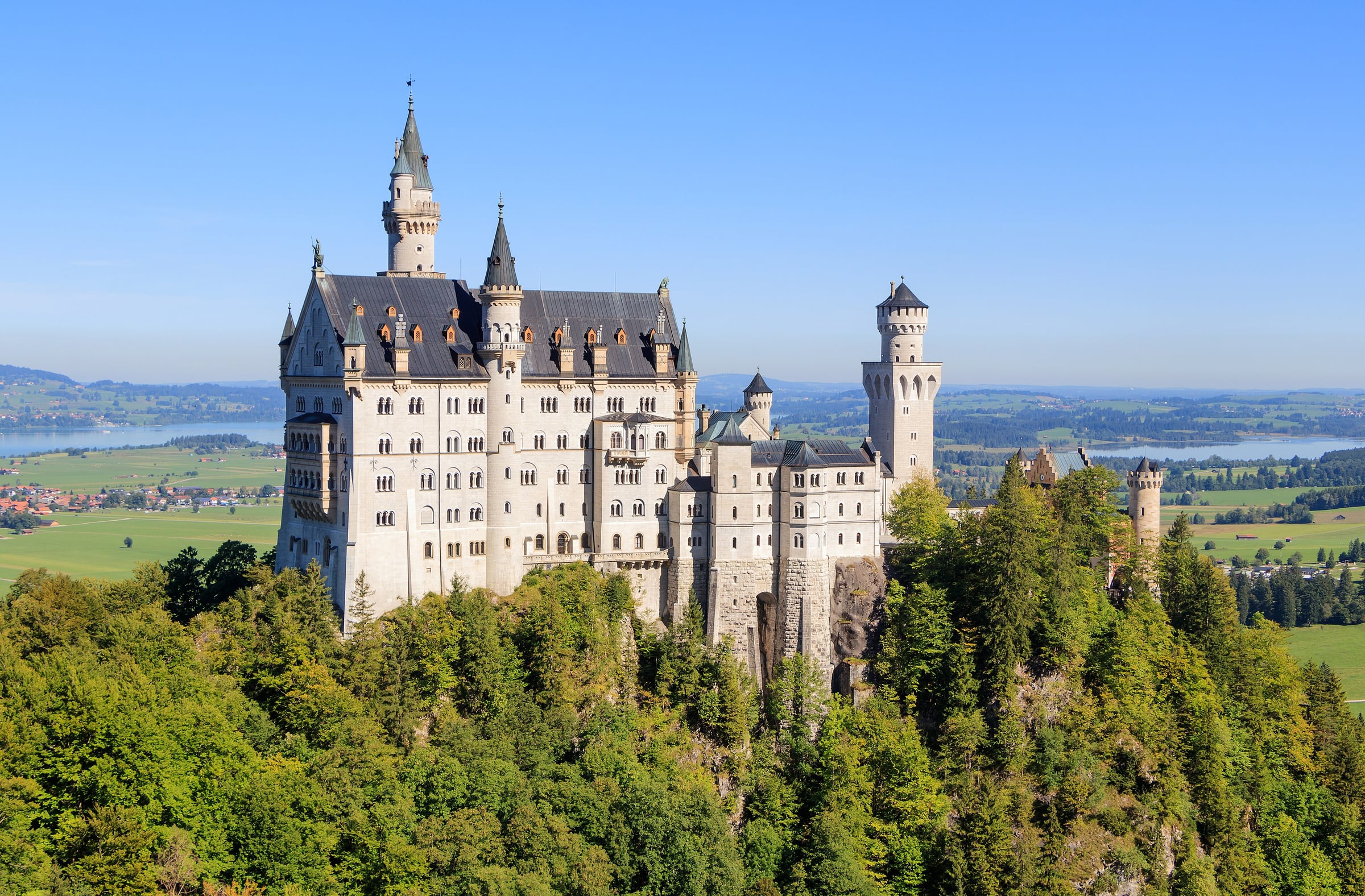
Füssen Castle
The High Castle of Füssen, locally known as Hohes Schloss, stands majestically on a rocky promontory overlooking the historic town of Füssen in Bavaria, Germany. This imposing fortress is one of the largest and best-preserved Gothic castle complexes in the region, renowned for its striking architecture and rich history as the summer residence and stronghold of the prince bishops of Augsburg. The castle's origins trace back to the Roman Empire, with the earliest fortifications established in the 1st century AD to secure the strategic Roman road, Via Claudia Augusta.
The current castle structure primarily dates from the 13th to 15th centuries, embodying the architectural and defensive advancements of the High and Late Medieval periods. Over the centuries, the castle evolved through significant expansions and renovations, notably under Bishop Friedrich II von Zollern in the late 15th century and Prince-Bishop Johann Christoph von Freyberg around 1680. These enhancements transformed the fortress into a refined residence while maintaining its military functionality.
Historical significance and development
The site originally hosted a Roman fortification established by the III Italic Legion in the 1st century AD, serving as a military outpost and supply center along the vital Via Claudia Augusta. Following the decline of Roman rule, a Germanic settlement emerged nearby, and by the 8th century, the bishops of Augsburg had founded the monastery of Saint Mang on the site, marking the hill's transition into a religious and administrative hub.
In 1183, the castle hill was transferred under the control of the monastery of Gaisberg with restrictions against secular construction or noble ownership. However, after the fall of the Hohenstaufen dynasty in the late 13th century, ownership disputes arose between the Augsburg bishops and the dukes of Bavaria. Duke Ludwig II's attempt to assert control by building a fortress was halted by an imperial court ruling in 1292.
By the early 14th century, the castle hill was pawned to Bishop Friedrich I, who redeemed it in 1322 and established the castle as the official residence of the Augsburg bishopric. By 1363, the castle was integrated into the town's defensive walls, functioning as a citadel protecting Füssen.
Renaissance and baroque expansions
The late 15th century saw substantial expansion under Bishop Friedrich II von Zollern, who introduced tall towers and extended the fortress, resulting in much of the castle's present form. The 1680 renovations by Prince-Bishop Johann Christoph von Freyberg focused on interior enhancements, improving comfort and decorative elements without significantly altering the exterior.
Architectural features and layout
The High Castle is a quintessential example of a late Gothic fortress complex, built along the eastern slope of a ridge above Füssen’s old town. Its elongated trapezoidal layout follows the natural contours of the rocky hill, centering around a horseshoe-shaped main building that encloses a trapezoidal courtyard open to the east.
The main structure consists of three-story wings adorned with decorative bartizans—small turret-like projections with pinnacles—that enrich the facades. A massive bergfried or keep rises on the western side, historically serving as a prison and the castle’s defensive stronghold. The northeast corner features the Stork Tower with its sharply pitched gable roof, once housing servants and workers.
Access is exclusively from the east, where a deep, man-made moat called the Halsgraben protects the western approach. This moat was significantly enlarged during the expansions led by Bishop Friedrich II von Zollern. Additional fortifications include a southern outer ward or zwinger, whose walls were lowered in the 19th century but remain integral to the castle’s defense.
The castle's exterior is covered in white plaster, serving as a canvas for intricate illusionistic paintings dating from around 1499. These artworks depict architectural motifs, detailed window frames topped with pinnacles, and numerous heraldic oriel windows. The painter, likely Fidelis Eichele from Hechingen, created these masterful trompe-l'œil effects that enhance the castle's visual grandeur.
Construction materials and interior details
Locally quarried Alpine limestone forms the primary building material, complemented by brick and river gravel. Sandstone is used selectively for portals and window frames, offering durability and aesthetic contrast against the plastered walls.
The interior retains significant late Gothic features. The northern wing houses two notable "French rooms" with wooden ceilings. A ground-floor hall supported by five square columns adjoins the second-floor Knight’s Hall (Rittersaal), famous for its vibrant painted carved ceiling attributed to the sculptor Jörg Lederer. Many smaller chambers preserve original elements such as stucco ceilings, tiled stoves, and intricately carved portals and window frames.
The castle chapel, projecting from the eastern facade, features a polygonal choir typical of ecclesiastical architecture, symbolizing the castle’s dual role as a fortress and a religious residence.
Later uses and cultural significance
In the late 18th century, the castle served as a hospital under Austrian control during the wars of that period and was later occupied by French troops during the Napoleonic Wars, though it escaped damage. The 19th century brought restoration efforts and plans to convert the castle into a summer residence for Crown Prince Maximilian II, which were ultimately abandoned in favor of Schloss Hohenschwangau.
From 1862, parts of the castle were used for judicial purposes and private housing. After World War I, it gradually transformed into a museum and cultural center. Since 1931, it has housed a branch of the Bavarian State Painting Collections, specializing in late Gothic art from the Swabian region, including works by Jörg Lederer.
Mid-20th-century restorations focused on preserving the castle’s illusionistic paintings and repairing the chapel and other interior features, ensuring the castle remains a vital cultural landmark.
Integration with town fortifications
The High Castle is integrated into Füssen’s medieval town walls, including an adjoining half-round defensive tower overlooking the zwinger. The main gate tower incorporates a historic clock salvaged from a demolished city gate in Augsburg, linking the fortress to the wider regional heritage.
Frequently asked questions (FAQ)
- How do I visit the High Castle of Füssen?
- The High Castle of Füssen is open to visitors, typically offering access to its courtyards, galleries, and select interior rooms. Check local tourism websites for current opening hours and guided tour availability to plan your visit.
- What is the historical significance of the High Castle of Füssen?
- The castle served as the summer residence and fortress of the prince bishops of Augsburg and played a strategic role in regional defense and administration from the Roman era through the late medieval period.
- What architectural styles are featured in the High Castle of Füssen?
- The castle predominantly showcases Gothic architecture with late medieval fortifications and Renaissance-era expansions, including decorative bartizans, a bergfried keep, and illusionistic facade paintings.
- Is the High Castle of Füssen accessible for visitors with mobility issues?
- Due to its medieval hilltop location and historic structure, access may be challenging for visitors with mobility impairments. Some areas might have uneven surfaces and stairs; contacting the castle administration in advance is recommended.
- When is the best time to visit the High Castle of Füssen?
- Spring through early autumn offers pleasant weather and extended visiting hours, making it an ideal time to explore the castle and its scenic surroundings.
- Are there nearby attractions to visit along with the High Castle?
- Füssen's old town, the nearby <strong>Neuschwanstein Castle</strong>, and the <strong>Forggensee lake</strong> are popular attractions that complement a visit to the High Castle, providing a rich cultural and natural experience.
Information
Website
Visit websiteSources & official resources
Verify the information above using these authoritative references.
Loading map...
Visitor reviews
No reviews yet. Been here? Write the first review and help other travelers!
Write the first reviewVisited this castle? Share your experience
Your review helps other travelers and adds first-hand knowledge to our encyclopedia.