Hohensalzburg Castle
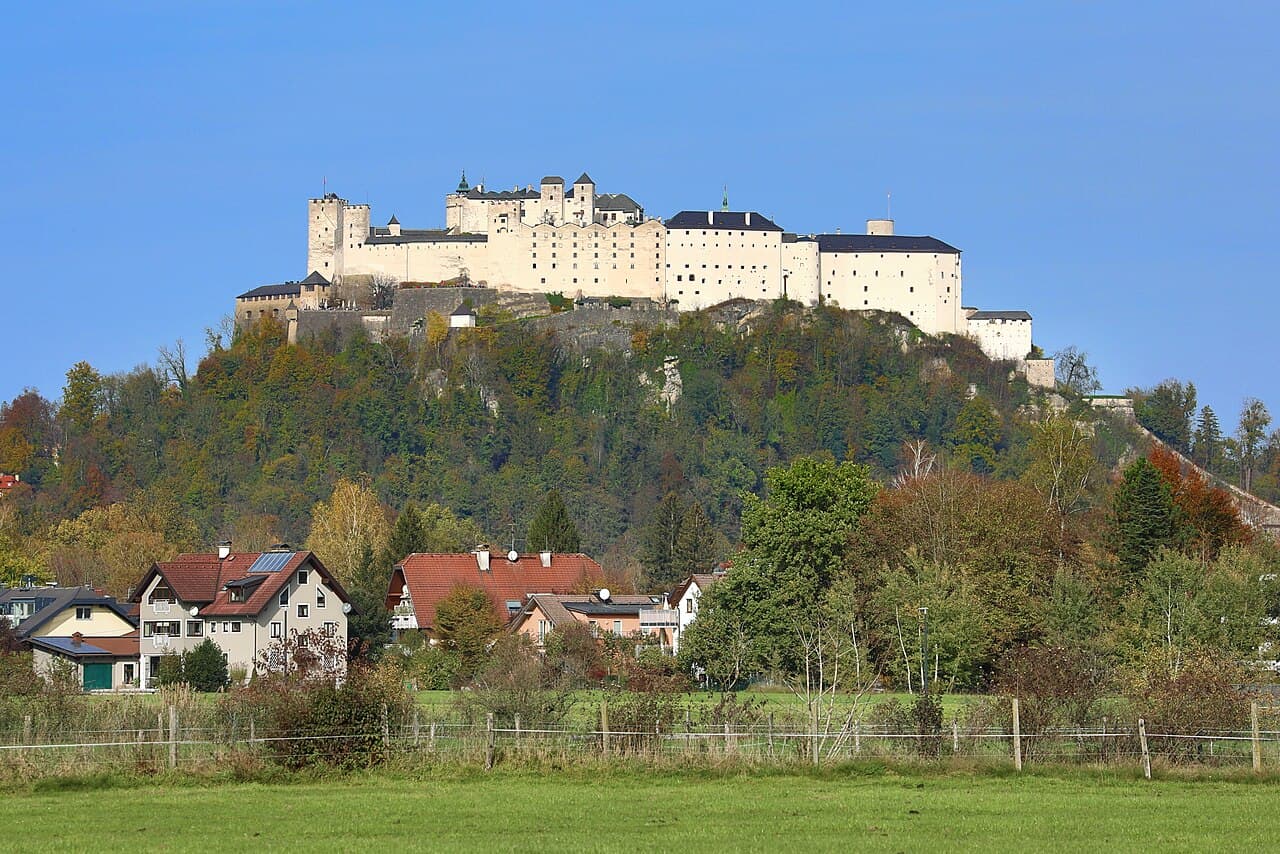
Hohensalzburg Castle, known locally as Festung Hohensalzburg, is a monumental medieval fortress perched atop the Festungsberg hill overlooking the historic city of Salzburg in Austria. It stands as one of the largest and best-preserved castles in Europe, with an extensive complex covering over 7,000 square meters of built area and more than 14,000 square meters including its ramparts. Founded in 1077 by Archbishop Gebhard von Helfenstein during the turbulent period of the Investiture Controversy, the castle was conceived primarily as a defensive stronghold and a symbol of the prince-archbishops’ power within the Holy Roman Empire.
The castle’s name, Hohensalzburg, translates to "High Salt Castle," reflecting its strategic role in securing the valuable salt trade that was vital to Salzburg’s wealth and influence. The fortress was built on a site with fortifications dating back to Roman times, making it a long-standing bastion of control over the region. Over centuries, the castle evolved from a simple fortification into a sprawling complex featuring multiple wings, curtain walls, bastions, towers, and richly decorated princely apartments.
Early history and medieval expansion
The initial construction phase under Archbishop Gebhard von Helfenstein included a residential tower, a small chapel, and a surrounding defensive wall. Following Gebhard’s exile, subsequent archbishops such as Berthold von Moosburg and Konrad von Abenberg continued development between 1106 and 1147, completing the early fortifications and establishing the castle’s foundational structure.
During the 12th and 13th centuries, the castle was expanded significantly as Salzburg’s archbishops gained independence from the Duchy of Bavaria under Eberhard II. This period saw the construction of a robust outer ring wall and the enlargement of the main residential tower known as the Hohen Stock. The castle’s defenses were continually improved to protect the growing principality and its valuable salt resources.
Fortification enhancements in the 15th and 16th centuries
The advent of gunpowder and artillery in the late medieval period necessitated major upgrades to Hohensalzburg’s defenses. In the 1460s, Prince-Archbishop Burkhard II von Weisspriach added four round artillery towers and bastions to withstand cannon fire, marking the castle’s transition into a modern fortress.
Between 1495 and 1519, Archbishop Leonhard von Keutschach transformed the castle into a late Gothic princely residence. He expanded the upper floors, installed magnificent state apartments including the Golden Hall and the Golden Chamber, and constructed a large cistern to secure water supply during sieges. The castle’s chapel was rebuilt with a richly ornamented star vault ceiling, and the interior was adorned with coffered ceilings, gilded decorations, and intricate woodwork.
Leonhard also commissioned the Salzburger Stier, a massive mechanical organ housed in the Krautturm (powder tower), built in 1502. This organ is considered one of the oldest functioning mechanical organs in the world and adds a unique cultural dimension to the fortress.
The castle during conflicts and sieges
Hohensalzburg Castle’s only significant siege occurred during the German Peasants' War of 1525, when miners, farmers, and townspeople attempted to overthrow the prince-archbishop. Despite a prolonged siege lasting nearly two months, the fortress held firm, demonstrating its formidable defensive capabilities.
During the Thirty Years’ War, Archbishop Paris von Lodron further fortified the castle and the city of Salzburg. He added artillery bastions, strengthened gatehouses, and constructed the Lodronbogen, the first defensive arch at the castle. Later, in 1681, the Feuerbastei bastion was built, representing the last major defensive enhancement of the fortress.
The castle surrendered without resistance to French troops under General Jean Victor Marie Moreau during the Napoleonic Wars in 1800, marking the end of clerical rule in Salzburg and the transition of the city into a military stronghold within the Austrian Empire.
Architectural features and princely apartments
The fortress is a complex of interconnected wings, courtyards, and defensive structures built primarily from local dolomite stone. Its imposing ring walls and artillery towers reflect the evolution of military architecture from Romanesque to late Gothic styles adapted for gunpowder weaponry.
The prince-archbishops’ apartments on the upper floors showcase exquisite late Gothic interior design. The Golden Hall served as a grand reception and banqueting room, richly decorated with coffered ceilings and gold embellishments. The Golden Chamber is the most lavishly furnished room, featuring intricately carved benches adorned with motifs of vines, grapes, and animals, and walls that were once covered with gold-embossed leather tapestry.
The bedchamber reveals the intimate living quarters of the archbishops, complete with elaborate wood paneling and a primitive toilet facility concealed behind a door, showcasing early innovations in sanitary design.
The castle chapel, rebuilt under Leonhard von Keutschach, features a star-vaulted ceiling and richly decorated stucco work. It includes openings in the north wall allowing the archbishop to attend services privately from adjacent chambers.
Unique artifacts and cultural heritage
The Salzburger Stier organ housed in the Krautturm is a remarkable mechanical instrument with over 200 pipes, powered by a large cylinder mechanism. It is a rare surviving example of early 16th-century musical technology.
Within the Prince's Cellars lies the Salzburg Marionette Museum, displaying historic marionettes from the famous Salzburg Marionette Theatre. The collection includes puppets used in performances of The Sound of Music and Mozart’s The Magic Flute, as well as puppets depicting historical events such as the 1525 peasants’ uprising.
Modern history and tourism
After serving as a military barracks, prison, and storage depot through the 19th and early 20th centuries, Hohensalzburg Castle was officially decommissioned as a military site in 1861. It gained prominence as a tourist destination with the opening of the Festungsbahn funicular railway in 1892, which provides convenient access from Salzburg’s city center to the fortress.
Extensive restoration and stabilization efforts throughout the 20th century have preserved the castle’s structural integrity and historic interiors. Today, it is one of Austria’s most visited monuments, attracting nearly a million visitors annually.
The castle offers panoramic views of the Salzburg basin and surrounding mountain ranges, including the Tennengebirge and Hahnsberg. Visitors can explore its courtyards, museums, and special exhibition areas, including restricted sections such as the old bakery, wine cellar, and bastions accessible only via guided tours.
Hohensalzburg Castle remains a symbol of Salzburg’s rich history, architectural heritage, and cultural significance, embodying centuries of political power, military innovation, and artistic achievement.
Frequently asked questions (FAQ)
- How do I get to Hohensalzburg Castle?
- Hohensalzburg Castle is easily accessible by taking the funicular railway from the city center of Salzburg. Alternatively, visitors can hike up the hill, which provides a scenic route and stunning views of the surrounding area.
- What is the historical significance of Hohensalzburg Castle?
- Hohensalzburg Castle is one of the best-preserved medieval castles in Europe and has stood since the 11th century. It served as a fortress and residence for the archbishops of Salzburg, playing a crucial role in the region's political and religious history.
- When was Hohensalzburg Castle built?
- Construction of Hohensalzburg Castle began in 1077 under Archbishop Gebhard von Helfenstein, with expansions added over the centuries. The castle's impressive architecture showcases various styles that reflect its long history.
- Can I take guided tours of Hohensalzburg Castle?
- Yes, guided tours are available and provide in-depth information about the castle's history, architecture, and artifacts. Audio guides are also offered for those who prefer to explore at their own pace.
- Why is Hohensalzburg Castle a popular tourist attraction?
- Hohensalzburg Castle is popular due to its stunning panoramic views of Salzburg, rich history, and well-preserved architecture. Visitors can also enjoy exhibitions, a museum, and beautiful courtyards within the castle.
- Is it possible to host events at Hohensalzburg Castle?
- Yes, Hohensalzburg Castle offers unique venues for events such as weddings, corporate gatherings, and private celebrations. The breathtaking backdrop and historic atmosphere make it a memorable location for any occasion.
- What are the opening hours of Hohensalzburg Castle?
- Hohensalzburg Castle is typically open daily from 9 AM to 5 PM, with extended hours during the summer months. It's advisable to check the official website for any changes in hours or special closures before planning your visit.
- What are the ticket prices for Hohensalzburg Castle?
- Ticket prices vary depending on age and type of entry, with discounts often available for children, students, and seniors. A combination ticket for the funicular ride and castle entrance offers great value for visitors.
- When is the best time to visit Hohensalzburg Castle?
- The best time to visit Hohensalzburg Castle is during the spring and fall when the weather is mild and the tourist crowds are smaller. However, summer visits offer vibrant greenery and numerous events but can be busier.
- Are there any nearby attractions to Hohensalzburg Castle?
- Yes, nearby attractions include the historic Old Town of Salzburg, Mirabell Palace, and Salzburg Cathedral. These sites complement a visit to Hohensalzburg Castle, providing a full day of exploration in this charming city.
Photo gallery

Information
Sources & official resources
Verify the information above using these authoritative references.
Loading map...
Visitor reviews
No reviews yet. Been here? Write the first review and help other travelers!
Write the first reviewVisited this castle? Share your experience
Your review helps other travelers and adds first-hand knowledge to our encyclopedia.