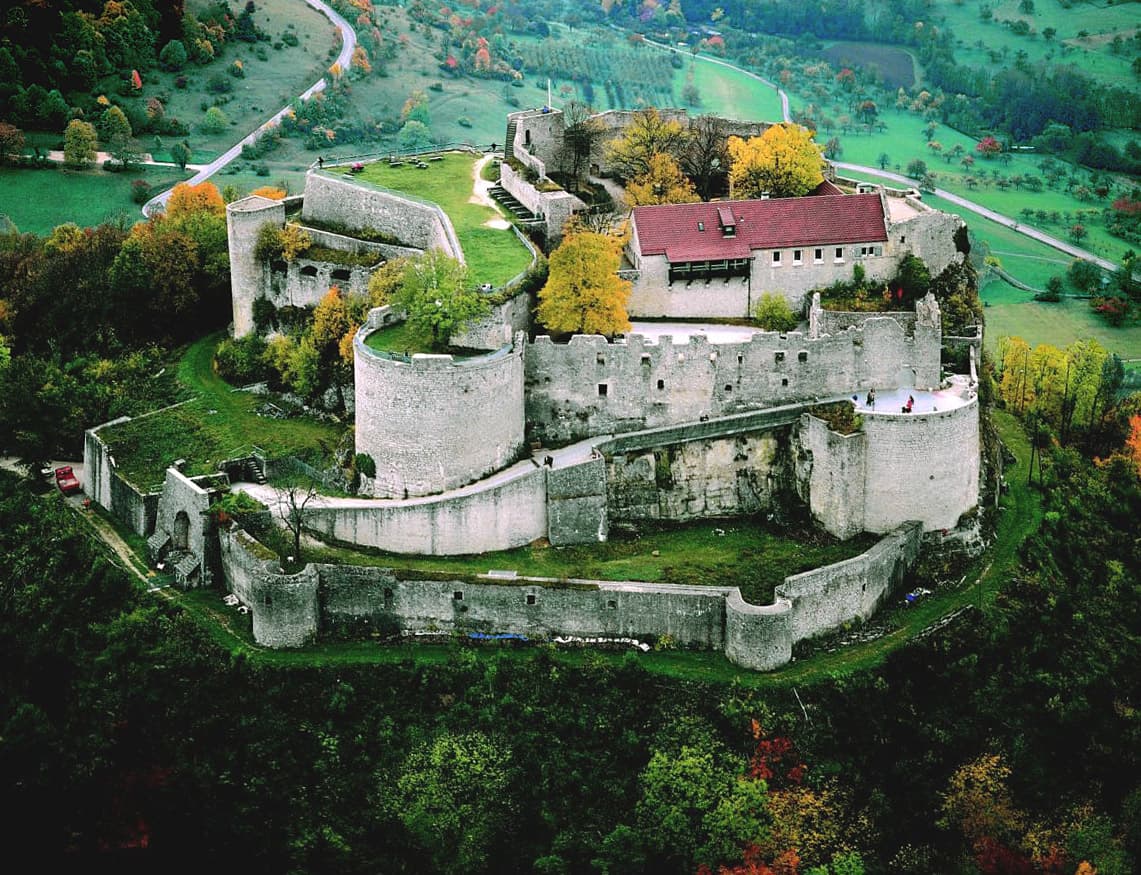
Hohenneuffen Castle
Hohenneuffen Castle stands as a monumental relic of medieval military architecture perched on a prominent limestone hill in the northern foothills of the Swabian Alb in Germany. This high medieval hill castle, built in the 12th century, occupies a strategic vantage point at approximately 743 meters (2437 feet) above sea level, commanding sweeping views across the surrounding landscape. Its location atop a large late Jurassic rock formation provided natural defensive advantages that were expertly augmented by successive generations of fortifications.
The castle's origins trace back to a fortified settlement during the late Iron Age La Tène period (450–1 BCE), linking it to the extensive Celtic oppidum network exemplified by the nearby Heidengraben. This early strategic importance set the stage for the medieval fortress constructed between 1100 and 1120 by Mangold von Sulmetingen, who adopted the name von Neuffen. The Neuffen family, including the renowned Minnesänger Gottfried von Neifen, were recorded as owners by 1198. Control passed to the Lords of Weinsberg in the late 13th century, and subsequently to the Counts of Württemberg in 1301.
Medieval construction and architectural evolution
The original castle was designed as a hill castle with typical medieval defensive features, including thick curtain walls, towers, and a keep. Over the centuries, the fortress was repeatedly expanded and modernized to meet evolving military threats. In the 15th century, major fortification works enhanced the castle's defenses, reflecting the increasing use of artillery in warfare.
The most significant architectural transformation occurred in the mid-16th century under Duke Ulrich of Württemberg. He commissioned extensive upgrades that introduced Renaissance military architecture elements, such as barbicans—outer defensive walls protecting the main gate—and round towers designed for improved fields of fire. Bastions projecting from the walls allowed defenders to cover adjacent curtain walls with cannon fire, while casemates, vaulted chambers built into the walls, provided protected gun emplacements. Additional structures included stables for horses, an arsenal for weapon storage, and two cisterns for water supply, ensuring the castle could withstand prolonged sieges.
Defensive features and layout
The castle's complex layout integrates natural rock formations with man-made fortifications. The barbican served as the first line of defense, funneling attackers into a narrow approach. The round towers offered elevated vantage points for archers and artillery, while the bastions provided overlapping fields of fire. The casemates were innovative for their time, allowing defenders to operate cannons safely behind thick stone walls. The presence of arsenal and stables within the castle walls illustrates the self-sufficiency required during sieges.
Historical significance and military engagements
Hohenneuffen Castle played a pivotal role in regional conflicts throughout its active history. It famously resisted capture during the Reichskrieg (imperial war) of 1312, underscoring its reputation as a nearly impregnable fortress. In 1519, the castle surrendered to the Swabian League, a powerful regional alliance, yet it successfully withstood a siege during the Peasants’ War of 1524.
Its most grueling military ordeal occurred during the Thirty Years’ War, when it endured a prolonged 15-month siege, finally surrendering in November 1635 under negotiated terms that were later violated. These episodes highlight the castle's strategic importance and robust defenses.
Throughout its history, the castle also served as a state prison for notable figures such as Count Friedrich von Helfenstein (died 1502), Abbot Georg Fischer (1512), Konrad Breuning (tortured and executed in 1517), Matthäus Enzlin (17th century), and Joseph Süß Oppenheimer, imprisoned in 1737 before his execution in 1738.
Decline, preservation, and modern use
In the 18th century, Duke Karl Alexander planned to modernize the fortress based on contemporary French military fortification principles, but his successor, Karl Eugen, abandoned these costly plans. From 1793, the castle was decommissioned and partially dismantled, with demolition accelerating after 1803 as local residents repurposed the stones for other buildings.
Preservation efforts began in 1830, and by the 1860s, the ruins were made accessible to the public. One building in the upper bailey was converted into a restaurant in 1862, which remains operational today alongside a beer garden and kiosk. The castle grounds now serve as a cultural venue hosting medieval markets, concerts, and other events, connecting visitors with its rich heritage.
In 2014, a Staufer stele was installed near the Friedrich bastion to commemorate the historical link between the Neuffen family and the Staufer dynasty, a prominent royal house of medieval Germany.
Lighting and recreational activities
The castle's outer walls are illuminated on weekends and holidays, continuing a tradition renewed in 1984 that dates back to an original lighting installation from the 1950s. Additionally, the site features a 9.3-kilometer mountain running course starting in nearby Linsenhofen and finishing at the castle, with an elevation gain of approximately 438 to 483 meters, attracting sports enthusiasts and tourists alike.
Architectural remains and visitor experience
Today, visitors to Hohenneuffen Castle can explore the extensive ruins, including accessible casemates and the remains of the barbican, bastions, and round towers. The castle's elevated position offers panoramic views of the Swabian Alb region, enhancing its appeal as a historical and scenic destination.
The combination of natural geological features and sophisticated Renaissance-era military architecture makes Hohenneuffen a compelling example of a hill castle that evolved to meet the demands of changing warfare technologies. Its preservation as a ruin with public access, cultural events, and amenities like a restaurant and beer garden ensures that this historic fortress remains a vibrant part of the region's cultural landscape.
Frequently asked questions (FAQ)
- How do I get to Hohenneuffen Castle?
- Hohenneuffen Castle is located near the town of Neuffen in Baden-Württemberg, Germany. It is accessible by car and public transportation, with parking available nearby and hiking trails leading up to the castle.
- What are the opening hours of Hohenneuffen Castle?
- The castle is open daily from 10:00 to 18:00, allowing visitors ample time to explore the ruins and enjoy the surrounding landscape.
- Is there an entrance fee to visit Hohenneuffen Castle?
- Access to Hohenneuffen Castle is free of charge, making it an accessible destination for all visitors.
- Can I visit the interior casemates of the castle?
- Yes, some of the castle's casemates are accessible to the public, providing insight into the defensive architecture and military history of the fortress.
- Are there facilities for food and drink at the castle?
- The castle grounds include a restaurant, beer garden, and kiosk, offering refreshments and meals for visitors during their visit.
- What historical events is Hohenneuffen Castle known for?
- Hohenneuffen Castle is notable for its resilience during the Reichskrieg of 1312, the Peasants' War siege in 1524, and a lengthy 15-month siege during the Thirty Years' War, reflecting its strategic military significance.
- Is the castle suitable for families and children?
- Yes, the castle is family-friendly with open spaces to explore, cultural events like medieval markets, and safe access to certain areas such as the casemates.
Photo gallery

Information
Opening hours
10:00-18:00, daily
Ticket prices
Free
Current owner
Municipality
Website
Visit websiteSources & official resources
Verify the information above using these authoritative references.
Loading map...
Visitor reviews
No reviews yet. Been here? Write the first review and help other travelers!
Write the first reviewVisited this castle? Share your experience
Your review helps other travelers and adds first-hand knowledge to our encyclopedia.



