Hochosterwitz Castle
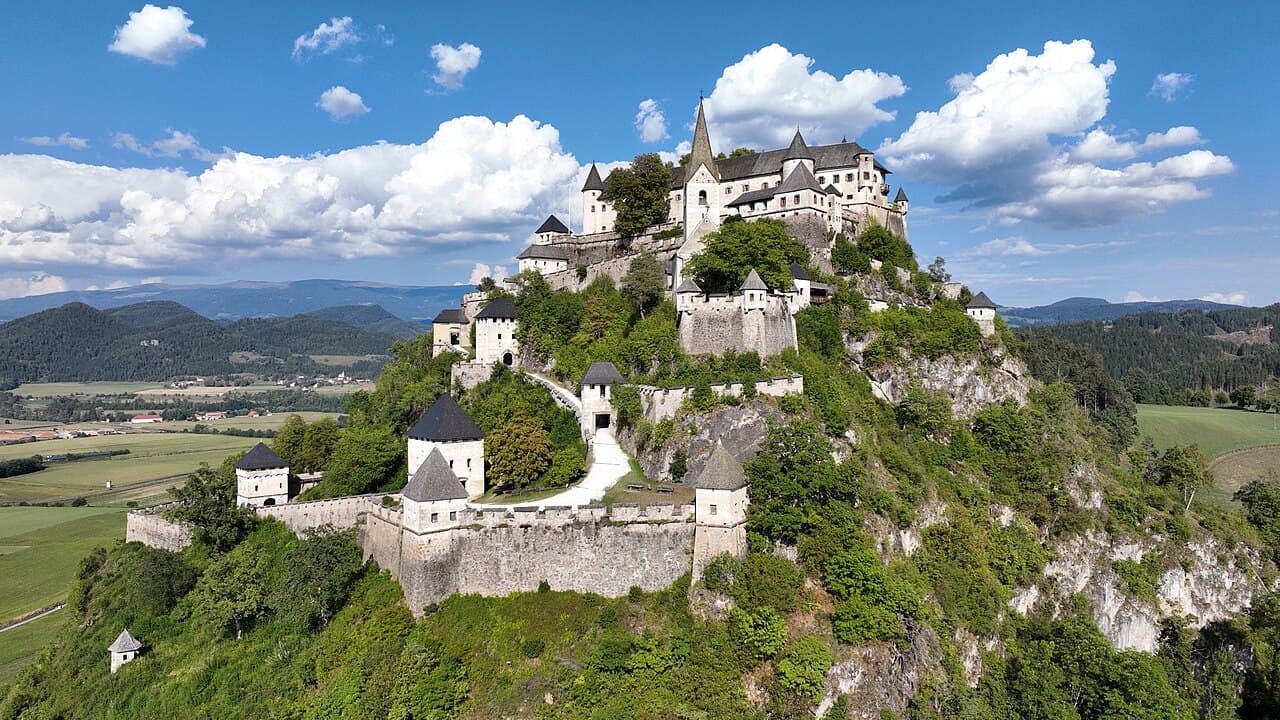
Hochosterwitz Castle stands as one of Austria's most impressive medieval castles and is a prominent landmark in the region of Carinthia. Perched atop a 172-metre high dolomite rock near Sankt Georgen am Langsee, the fortress dominates the surrounding landscape, visible from up to 30 kilometres away on clear days. Its strategic position atop a conical hill has made it a formidable defensive site since its earliest days.
The castle's origins trace back to the 9th century, with the first written mention in an 860 deed by King Louis the German, who donated properties in the area to the Archdiocese of Salzburg. Archaeological evidence reveals continuous settlement on the site from the early Bronze Age, with artifacts from the Hallstatt and La Tène cultures, as well as Roman relics, indicating its long-standing strategic importance.
Historical development and ownership
Initially under the control of the Archbishopric of Salzburg, the castle was granted as a fief in the 11th century to the House of Sponheim, who entrusted it to the Schenken von Osterwitz family. This family held the hereditary office of cupbearers to the Dukes of Carinthia from 1209. The castle's history is intertwined with regional power struggles, including the Investiture Controversy.
The decline of the Osterwitz family came in the 15th century when Georg von Osterwitz was captured during a Turkish raid and died in captivity in 1476 without heirs. Consequently, the castle reverted to Emperor Frederick III in 1478. The following decades saw damage from repeated Turkish incursions.
In 1509, Emperor Maximilian I granted the castle as a pledge to Matthäus Lang von Wellenburg, then Bishop of Gurk and later Archbishop of Salzburg, who initiated significant restoration and fortification efforts. Around 1541, Ferdinand I bestowed the castle on Christof Khevenhüller, the Carinthian governor, and in 1571, Baron George Khevenhüller purchased it outright. Between 1570 and 1586, he transformed Hochosterwitz into an impregnable Renaissance fortress with the construction of 14 fortified gates and an arsenal, a unique feature in citadel architecture.
Architectural features and fortifications
Hochosterwitz Castle is a classic example of a hill castle built to maximize natural defenses. The castle complex is accessed via a 620-metre long fortified road that ascends the rock, passing through 14 massive gates. Each gate was ingeniously designed with defense mechanisms such as drawbridges, iron-barred shutters, murder holes, and arrow slits, forcing attackers to confront each barrier under heavy defensive fire.
The gates are richly decorated with marble and limestone reliefs, inscriptions, and heraldic emblems, many depicting Georg II von Khevenhüller in full armor alongside religious motifs. The gates include the Fähnrichtor (Flag Bearers’ Gate), Wächtertor (Guard Gate), Nautor (Ship Gate), Engelstor (Angel Gate), Löwentor (Lion Gate), and others, each with unique defensive and artistic features.
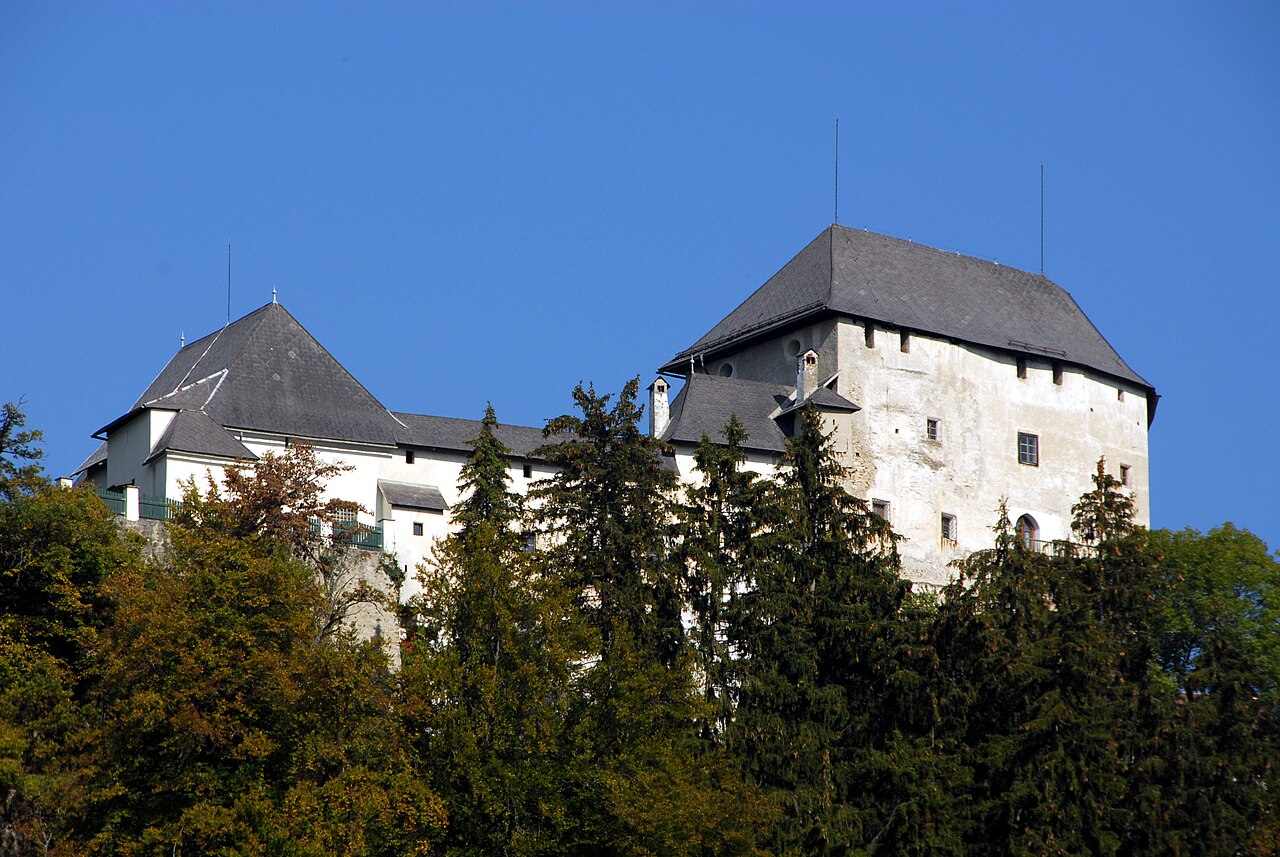
The castle's core features a square bergfried (keep), residential palas buildings, and a small chapel dedicated to St. Nicholas, dating back to at least the late 14th century. The chapel contains a barrel-vaulted ceiling painted with portraits of the apostles and a Baroque altar depicting the Holy Family. Surrounding the core is a curtain wall with battlements and arrow slits.
A notable element is a 20-meter deep cistern that collects rainwater, essential for sustaining the castle during sieges. Below the main fortress lies the church of St. John Nepomuk, accessible through the thirteenth gate, featuring an Italian-style portal adorned with busts of the twelve apostles and Christ, along with a Baroque high altar. Since 1607, it has served as the burial site for the princely Khevenhüller-Metsch family.
Cultural significance and legends
The castle is steeped in local legend, including a famous tale of a siege by Countess Margaret of Tyrol. According to the story, the castle defenders cleverly deceived the besieging army by slaughtering their last ox, filling its hide with grain, and throwing it over the walls to suggest abundant supplies, causing the attackers to retreat. While historically unverified, this legend highlights the castle's reputation for impregnable defense.
Hochosterwitz has been a cultural symbol of resilience and strategic ingenuity in Carinthian history. Its preservation and continuous ownership by the Khevenhüller family since the 16th century underscore its importance as a heritage site.
Modern access and visitor experience
The castle is open to the public annually from Easter to the end of October. Visitors can explore the 620-metre long pathway through the 14 gates, each featuring informative diagrams explaining the defensive mechanisms employed. The castle houses a museum with collections of prehistoric artifacts, paintings, weapons, and armor, including a remarkable 2.4-metre tall suit of armor once worn by Burghauptmann Schenk.
Access to the summit is facilitated by a modern inclined elevator installed in 2017, replacing a previous funicular. This elevator provides barrier-free access, overcoming nearly 100 meters in height along a steep slope of 60 degrees, making the castle accessible to visitors with limited mobility.
The castle's elevated position offers panoramic views of the surrounding Carinthian landscape, including mountain ranges and valleys, enhancing the visitor experience with both historical insight and natural beauty.
Museum and collections
The castle museum showcases the Khevenhüller family's history and the region's cultural heritage. Exhibits include medieval weapons, armor, historical documents, and artworks spanning several centuries. Notably, the giant suit of armor measuring 2.4 meters tall exemplifies the castle's martial legacy and the prominence of its former occupants.
Architectural style and preservation
Hochosterwitz Castle exemplifies Renaissance military architecture with its extensive fortifications designed to counter the evolving threats of the 16th century, particularly the Turkish invasions. The castle's mannerist style gates blend functionality with artistic ornamentation, featuring intricate reliefs and heraldry. The overall condition of the castle is well preserved, with original structures and defensive features largely intact due to continuous maintenance by the Khevenhüller family.
Frequently asked questions (FAQ)
- How do I get to Hochosterwitz Castle?
- Hochosterwitz Castle is located in Sankt Georgen am Langsee, Austria, about 20 kilometers from Klagenfurt. You can reach it by car or public transport; there are bus services that connect to the nearby town. Once you arrive, a well-marked hiking trail leads up to the castle.
- What is the historical significance of Hochosterwitz Castle?
- Hochosterwitz Castle is one of the most impressive medieval castles in Austria, with origins dating back to the 9th century. It played a crucial role in defending the region against invasions and has a rich history tied to the noble families of Carinthia. The castle’s strategic position on a hilltop showcases its importance in historical military architecture.
- When was Hochosterwitz Castle built?
- The construction of Hochosterwitz Castle began in the 9th century, and it was significantly expanded in the 16th century. Over the years, it has undergone various renovations, preserving its architectural integrity and historical features. Today, it stands as a testament to the medieval defensive structures of the time.
- Can I visit Hochosterwitz Castle year-round?
- Yes, Hochosterwitz Castle is open to visitors year-round, though the best time to visit is during the spring and summer months when the weather is pleasant. Keep in mind that some areas of the castle may be closed during the winter due to snow. Always check the official website for seasonal hours and any special events.
- Why is Hochosterwitz Castle considered an architectural marvel?
- Hochosterwitz Castle is renowned for its impressive defensive architecture, featuring 14 gates that visitors must pass through to reach the main courtyard. The castle's design reflects the ingenuity of medieval builders, combining functionality with aesthetic appeal. Its well-preserved structures, including towers and walls, offer a glimpse into the architectural styles of the period.
- Is it possible to take guided tours of the castle?
- Yes, guided tours are available at Hochosterwitz Castle, providing visitors with an in-depth understanding of its history and architecture. These tours are conducted in multiple languages and are a great way to enhance your experience. Check the schedule ahead of time to ensure you don’t miss out on this informative opportunity.
- What are the ticket prices for Hochosterwitz Castle?
- Tickets to Hochosterwitz Castle are reasonably priced, with discounts available for students and seniors. Children under a certain age can often enter for free or at a reduced rate. It’s advisable to purchase your tickets at the entrance or online to avoid long queues.
- What are the opening hours of Hochosterwitz Castle?
- Hochosterwitz Castle typically opens around 9 AM and closes in the late afternoon, with extended hours during peak tourist season. Exact hours can vary based on the time of year, so it’s best to check the official website for the most accurate information. Planning your visit according to the opening hours ensures a more enjoyable experience.
- Are there any nearby attractions to visit?
- Yes, in addition to Hochosterwitz Castle, the surrounding area offers several attractions, including beautiful hiking trails and the picturesque Langsee Lake. The nearby town of Sankt Georgen is also worth exploring, with charming shops and local restaurants. Consider extending your visit to experience the natural beauty and culture of the Carinthia region.
Photo gallery

Information
Website
Visit websiteSources & official resources
Verify the information above using these authoritative references.
Loading map...
Visitor reviews
No reviews yet. Been here? Write the first review and help other travelers!
Write the first reviewVisited this castle? Share your experience
Your review helps other travelers and adds first-hand knowledge to our encyclopedia.