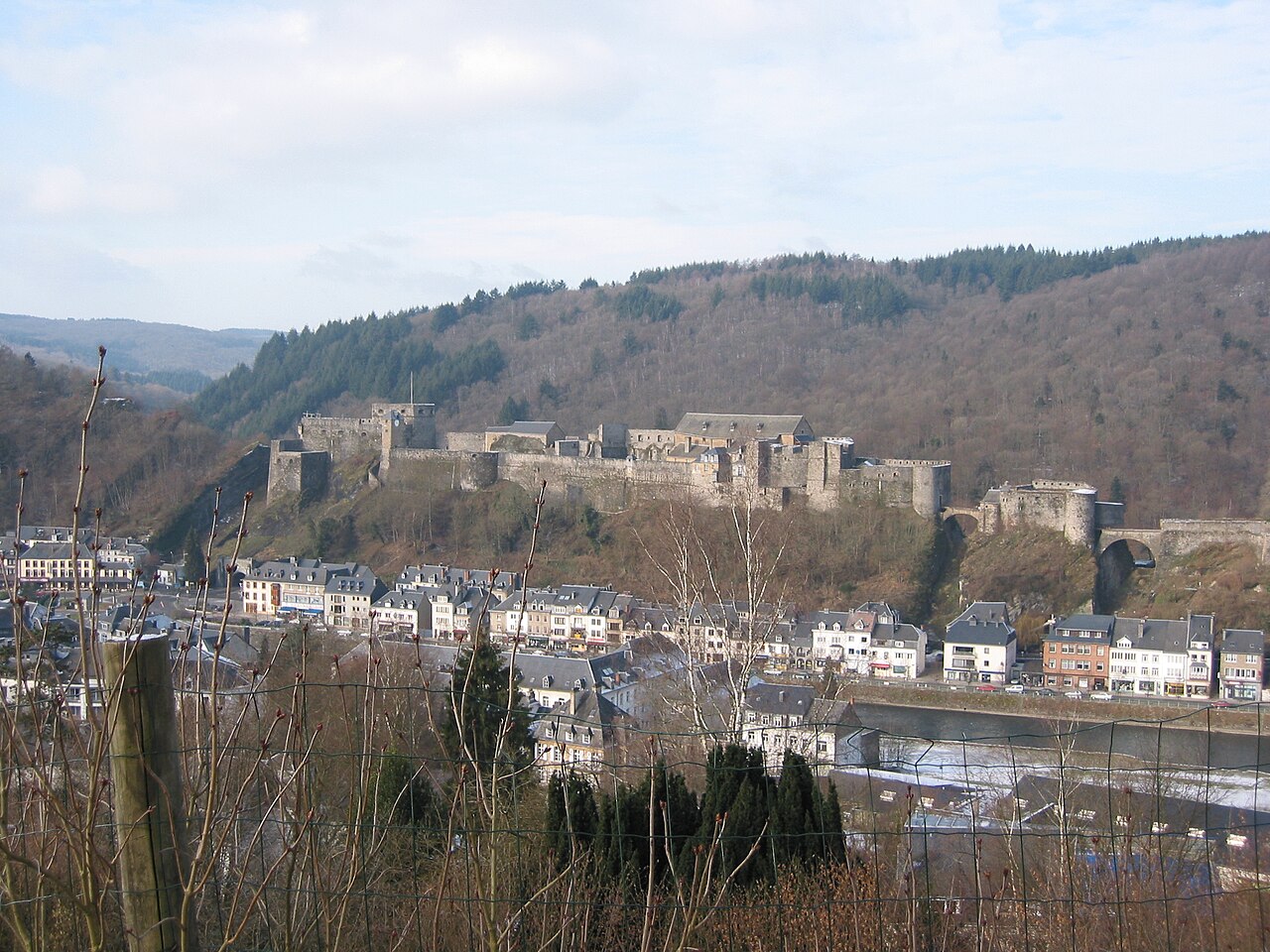
Herbeumont Castle
Herbeumont Castle, also called Château d'Herbeumont, is a remarkable medieval fortress perched atop a rocky outcrop overlooking the village of Herbeumont in the province of Luxembourg, within Belgium's Wallonia region. This hill castle commands a strategic position above the Semois Valley, offering sweeping views of the river and its winding meanders. Its location was chosen for defensive advantage, controlling a key crossroads where routes from France converged before continuing toward Neufchâteau.
The castle's origins trace back to 1268, when Jean (Jehan) de Rochefort of the House of Walcourt established the fortress as an independent lordship. Built rapidly in a single phase after 1268, the castle's initial design followed the principles of contemporary medieval military architecture inspired by French models from the reign of Philip II. Its irregular trapezoidal plan incorporated seven corner towers and a large square-shaped donjon (keep) integrated into the gatehouse, surrounded by curtain walls enclosing a spacious courtyard. The fortress was constructed on a natural schist hill that was carefully leveled to support the heavy stone structures, with steep cliffs dropping over a hundred meters to the river below, making it accessible only from one side and highly defensible.
Medieval origins and strategic importance
Herbeumont Castle was built to assert control over this vital border region, serving as a seat of power for the local nobility. Its elevated position enabled surveillance of the narrow valley and the medieval roads, crucial for military and economic dominance. Over the centuries, the castle passed through several noble families: initially the Orjo family until 1420, then the La Marck-Rochefort lineage until 1544, followed by the Stolberg family from 1544 to 1574, and finally the Löwenstein family until the late 18th century.
Architectural features of the original fortress
The fortress's trapezoidal layout was punctuated by seven towers strategically positioned at corners and along walls to maximize defensive coverage. The keep was a formidable stone structure serving as the last refuge during sieges and was incorporated into the main gate building, enhancing the security of the entrance. The curtain walls connected the towers and enclosed a large courtyard, which housed simple accommodations for the garrison and lord's household. Access to the castle was deliberately designed to be narrow and steep, complicating any assault.
Renaissance modifications for artillery defense
By the 16th century, advances in military technology, especially the increasing use of artillery, necessitated significant changes to the castle's defenses. Herbeumont Castle was adapted to meet the challenges posed by cannon fire and siege warfare. New terraces were constructed to serve as cannon platforms, allowing defenders to mount artillery pieces effectively. The walls were thickened and reinforced to withstand bombardment, and additional towers were built to provide better coverage and protection.
These modifications reflected the broader shift in fortress design during the Renaissance, when traditional medieval castles were transformed into bastioned fortifications capable of resisting gunpowder weapons. Corner pavilions were added to guard against mining attacks, a common siege tactic involving tunneling under walls to cause collapses. These enhancements illustrate the castle's ongoing military significance during this turbulent period.
Political context and military conflicts
From 1545, Herbeumont Castle became part of the Terres wallonnes, a buffer zone within the Holy Roman Empire established to defend against French expansion. Its strategic location made it a frequent target during conflicts between France and the Empire. In 1558, French forces under the Duke of Nevers besieged the castle, marking its first recorded siege. The castle endured repeated damage during the Thirty Years' War (1618-1648), a protracted and devastating conflict involving many European powers.
The castle's military role diminished by the mid-17th century as warfare evolved and political boundaries shifted. In 1657, it was captured by Marshal de la Ferté’s French troops during the Franco-Spanish War. On orders from Louis XIV, the fortifications were deliberately dismantled to prevent further military use. The castle was set ablaze on August 21, 1657, effectively ending its operational life as a fortress.
Post-military history and preservation
Following its destruction, Herbeumont Castle fell into ruin but remained a prominent landmark overlooking the valley. The lordship passed through several noble families, with the Löwenstein family maintaining ownership until the late 18th century. Recognized for its cultural and historical significance, the castle was designated as part of Wallonia's exceptional heritage sites in 1993.
Restoration and consolidation efforts began in 1994 and continued through the early 21st century, culminating in significant renovation work completed in 2010. These initiatives focused on preserving the castle's characteristic 13th-century defensive architecture, stabilizing the ruins, and making the site accessible to the public. Today, visitors can explore the remains freely, appreciating the castle’s imposing position and the visible adaptations reflecting centuries of military evolution.
Architectural remains and visitor experience
The ruins of Herbeumont Castle retain many of their original features, including the foundations of the donjon, the layout of the curtain walls, and several corner towers. The terraces constructed in the Renaissance period for artillery defense are also discernible. The site’s elevated position on the schist hill provides breathtaking views over the Semois River and the surrounding landscape.
Visitors can observe the castle’s defensive design, including the steep access path and the arrangement of towers that once guarded the fortress. The combination of medieval and Renaissance architectural elements offers insight into the evolution of military fortifications over several centuries. Despite its ruined state, Herbeumont Castle remains a powerful symbol of the region’s history and heritage.
Heritage significance and cultural impact
Herbeumont Castle stands as a testament to the shifting tides of European military architecture and political power from the Middle Ages through the Renaissance. Its strategic location at a crossroads between France and the Holy Roman Empire underscores its importance in regional defense and diplomacy. The castle’s layered history, marked by noble ownership, sieges, and adaptations to changing warfare, reflects broader historical trends in fortification design and territorial control.
The preservation of Herbeumont Castle’s ruins allows for ongoing study and appreciation of medieval and Renaissance military architecture. It contributes to the cultural identity of the Wallonia region and serves as a significant tourist attraction, drawing visitors interested in history, architecture, and scenic landscapes.
Frequently asked questions (FAQ)
- What is the historical significance of Herbeumont Castle?
- Herbeumont Castle, dating back to the 11th century, played a crucial role in the defense of the region against invasions. Its strategic location allowed it to oversee the Semois Valley, making it an important military stronghold during the medieval period. Today, it stands as a testament to the architectural and historical heritage of Belgium.
- When was Herbeumont Castle built?
- Construction of Herbeumont Castle began in the early 11th century, with various modifications and expansions occurring over the centuries. The castle has witnessed numerous historical events, including sieges and battles, which have shaped its structure and layout. Its long history makes it a fascinating site for visitors interested in medieval architecture.
- What are the opening hours of Herbeumont Castle?
- Herbeumont Castle is generally open to visitors from April to October, with specific hours varying by day. It is advisable to check the official website before planning your visit, as hours may change due to special events or maintenance. Guided tours are often available, enhancing the visitor experience.
- Can I visit Herbeumont Castle year-round?
- While the castle is primarily open to visitors during the spring and summer months, there are occasional winter events that allow for limited access. It's best to verify the schedule on the castle's official website to see if any special winter tours or events are planned. Always check for updates before your visit.
- Is it possible to access Herbeumont Castle with limited mobility?
- Access to Herbeumont Castle can be challenging for those with limited mobility due to its hilly terrain and uneven surfaces. The castle's historical nature means that there are limited facilities for accessibility. It's recommended to contact the castle's administration beforehand to inquire about specific accommodations.
- What is the best time to visit Herbeumont Castle?
- The best time to visit Herbeumont Castle is during the spring and summer months, from April to October, when the weather is pleasant and the gardens are in full bloom. Visiting during this period allows you to enjoy guided tours and various events hosted by the castle. Autumn also offers beautiful foliage, making it a picturesque time for photography.
- What are the ticket prices for Herbeumont Castle?
- Ticket prices for Herbeumont Castle vary depending on the season and any special events. Generally, an adult ticket costs around €8, while discounted rates are available for children and seniors. It's advisable to check the official website for the most current pricing and any available packages.
- Are there any nearby attractions to visit along with Herbeumont Castle?
- Yes, the area surrounding Herbeumont Castle boasts several attractions, including the scenic Semois River and charming villages like Bouillon and Rochehaut. Nature enthusiasts can explore beautiful hiking trails in the Ardennes region. Combining your visit to the castle with these nearby sites can provide a richer experience of the local culture and landscape.
Information
Sources & official resources
Verify the information above using these authoritative references.
Loading map...
Visitor reviews
No reviews yet. Been here? Write the first review and help other travelers!
Write the first reviewVisited this castle? Share your experience
Your review helps other travelers and adds first-hand knowledge to our encyclopedia.