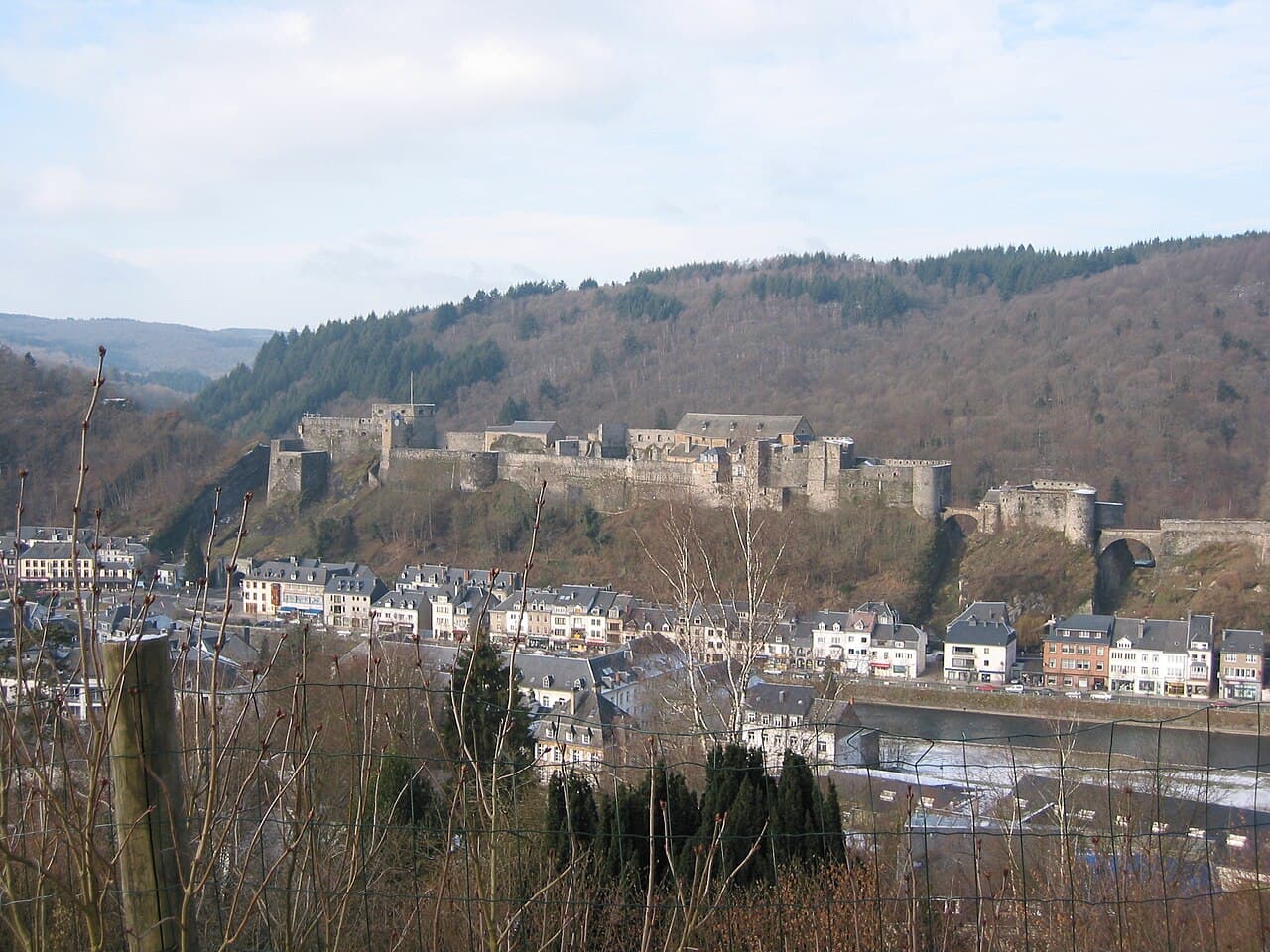
Bouillon Castle
Bouillon Castle, locally known as Château-Fort de Bouillon, is a remarkable hill castle perched on a rocky spur above the town of Bouillon in the Luxembourg province of Wallonia, Belgium. This historic fortress commands a strategic position within a sharp bend of the Semois River, overlooking the natural passage between Upper and Lower Lotharingia, a route historically significant for military invasions and trade.
The castle's origins trace back to the early medieval period, with the first documented mention dating to 988 AD. However, archaeological and historical evidence suggest that fortifications existed on the site since the 8th century, possibly even earlier during the Gallo-Roman era. The initial fortification was likely a motte-and-bailey structure, typical of early medieval military architecture, built atop a natural rocky ridge to maximize defense.
Early history and godfrey of bouillon
The castle gained prominence in the 11th century when it came under the control of the noble House of Ardenne. Between 1050 and 1067, Godfrey II with the Beard constructed the stone castle that largely defines the current site. The centerpiece was a massive donjon or keep, measuring approximately 26 by 13 meters, which included a chapel dedicated to Saint John. This keep was a formidable defensive and residential structure, embodying the Romanesque architectural style prevalent at the time.
Godfrey of Bouillon, a key figure in medieval history and a leader of the First Crusade, inherited the castle from his uncle Godfrey III, Duke of Lower Lorraine. In 1096, to finance his crusading expedition, Godfrey sold Bouillon Castle to Otbert, Prince-Bishop of Liège. This transaction was pivotal, as it transferred the castle's ownership to the Prince-Bishopric of Liège, where it remained for nearly six centuries.
Medieval fortifications and ownership transitions
Throughout the Middle Ages, Bouillon Castle was a critical military fortress guarding the southern borders of the Prince-Bishopric of Liège. Its strategic location made it a coveted prize, leading to numerous sieges and battles. The castle was designed with multiple defensive layers, including thick stone walls, towers, battlements, and a deep well approximately 65 meters deep to sustain inhabitants during prolonged sieges.
In 1141, the original motte was destroyed during a siege led by Bishop Alberon II of Liège and Henry I, Count of Namur. Despite this, the castle's stone fortifications endured and were continually upgraded to meet evolving military technologies.
In 1415, the Prince-Bishop John III appointed the House of La Marck as castellans of Bouillon Castle. This family, known for their ambition and political influence, eventually assumed the title of Dukes of Bouillon in the early 16th century. The castle passed through marriage to the La Tour d'Auvergne family in 1574, who maintained control for several generations.
Renaissance and vauban's transformation
The 16th and 17th centuries saw significant architectural and military enhancements at Bouillon Castle. During the Italian War of 1551–1559, the castle was occupied by French forces under Henry II to prevent Habsburg expansion. Bishop George of Austria initiated major renovations, including the construction of the "Austrian Tower" at the entrance, designed by the renowned military engineer Alessandro Pasqualini. This tower exemplifies Renaissance military architecture with its robust design and artillery embrasures.
In 1676, during the Franco-Dutch War, King Louis XIV of France captured Bouillon Castle. Recognizing its strategic importance, he commissioned the famed military engineer Sébastien Le Prestre de Vauban to modernize the fortress. Vauban transformed Bouillon into a first-class bastioned fortress, adding earth-filled walls and nine bastions, three of which survive today. These adaptations reflected the shift in military technology towards artillery warfare and the need for angled bastions to deflect cannon fire.
Modern history and preservation
The French Revolutionary Army invaded the Duchy of Bouillon in 1794, briefly establishing the Republic of Bouillon before annexing the territory to France in 1795. Following Napoleon's defeat, the 1815 Congress of Vienna assigned Bouillon to the Grand Duchy of Luxembourg. During Dutch rule, the medieval donjon was demolished in 1824 to make way for military barracks, significantly altering the castle's silhouette.
After the Belgian Revolution of 1830, Bouillon became part of Belgium. The castle's military use declined, and it was downgraded in 1853. During the 1870 Battle of Sedan, the fortress served as a Prussian military hospital, highlighting its continued strategic relevance even in modern conflicts.
Today, Bouillon Castle stands as one of Belgium's most significant and well-preserved medieval fortresses. Visitors can explore its extensive passageways, subterranean chambers, and defensive structures, including the 13th-century Salle Godefroy de Bouillon, the 16th-century Tour d’Autriche, torture chambers, dungeons, and the deep well shaft. The castle offers panoramic views of the town and the Semois River, making it a popular tourist destination.
Architectural features and layout
Bouillon Castle occupies a rocky ridge approximately 280 to 340 meters long and up to 40 meters wide, rising about 50 meters above the river. The fortress is divided into three main sections connected by bridges spanning natural chasms in the rock, demonstrating sophisticated medieval engineering to adapt to the challenging terrain.
The original motte featured a 9-meter diameter artificial mound surrounded by a ditch and outer rampart. The wooden tower atop the motte was replaced by the stone donjon built by Godfrey II. The donjon included three floors: a cellar, an armory, and the chapel of Saint John. Although demolished in the 19th century, its foundations remain a key archaeological feature.
The castle's defenses were enhanced over centuries to include numerous gun slits, arrow loops, and thick walls designed to withstand sieges and artillery bombardment. Vauban's bastions added angular earthworks and artillery platforms, integrating the castle into the broader defensive network of the region.
Subterranean chambers and passageways
One of Bouillon Castle's distinctive features is its extensive network of underground passages and chambers carved into the rock. These include storage cellars, cisterns for water collection, dungeons, and torture chambers. The 65-meter deep well shaft was vital for sustaining the castle's inhabitants during long sieges, ensuring a continuous water supply.
The ducal palace and salle godefroy de bouillon
The castle's main courtyard leads to the ducal palace, which houses the 13th-century Salle Godefroy de Bouillon, a grand hall named after the famous crusader. This hall served as a ceremonial and administrative center during the castle's medieval heyday, reflecting the castle's dual role as a military fortress and noble residence.
Cultural significance and tourism
Bouillon Castle is not only a monument of military architecture but also a symbol of the region's rich history and cultural heritage. Its association with Godfrey of Bouillon and the First Crusade enhances its historical prestige, attracting scholars and visitors interested in medieval history and crusader lore.
Today, the castle operates as a museum and tourist attraction, offering guided tours that explore its architectural evolution, military significance, and the lives of its former inhabitants. The castle's well-preserved structures and dramatic setting provide visitors with an immersive experience of medieval fortification and noble life.
Visitors can enjoy panoramic views of the Semois River valley from the castle's towers, explore the labyrinthine passageways, and learn about the castle's role in European history through exhibitions and interpretive displays.
Frequently asked questions
- When was Bouillon Castle built? The castle's origins date back to the early medieval period, with the first mention in 988 AD and construction likely beginning in the 8th century.
- Who was Godfrey of Bouillon? Godfrey was a medieval nobleman and leader of the First Crusade who inherited Bouillon Castle and sold it to finance his crusade.
- What architectural styles are present at Bouillon Castle? The castle features Romanesque elements in the original keep, Renaissance additions like the Austrian Tower, and 17th-century Vauban-style bastioned fortifications.
- Is the castle open to visitors? Yes, Bouillon Castle is open to the public with guided tours available, showcasing its historical and architectural features.
- What are the main attractions inside the castle? Visitors can explore the ducal palace, Salle Godefroy de Bouillon, Tour d’Autriche, underground dungeons, torture chambers, and the deep well shaft.
- How did Vauban influence the castle's design? Vauban transformed Bouillon into a modern fortress with bastioned earthworks and artillery defenses during the late 17th century.
- Where is Bouillon Castle located? It is situated in Bouillon, Luxembourg province, Wallonia, Belgium, on a rocky ridge above the Semois River.
Frequently asked questions (FAQ)
- What is the historical significance of Bouillon Castle?
- Bouillon Castle, dating back to the 10th century, is a remarkable example of medieval military architecture. It played a crucial role in the Crusades, serving as a stronghold for Godfrey of Bouillon, one of the leaders of the First Crusade. The castle's rich history makes it a notable site for understanding the feudal era in Belgium.
- When was Bouillon Castle built?
- Bouillon Castle was originally constructed in the year 988, making it one of the oldest castles in Belgium. Over the centuries, it has undergone various renovations and expansions, reflecting different architectural styles and the castle's evolving role in history.
- Can I visit Bouillon Castle?
- Yes, Bouillon Castle is open to visitors throughout the year. Guests can explore its impressive ramparts, towers, and exhibitions that showcase its history and significance. Guided tours are also available for a more in-depth experience.
- What are the opening hours for Bouillon Castle?
- Bouillon Castle typically opens at 9:30 AM and closes at 6:00 PM during the peak season, with reduced hours in the off-season. It's advisable to check the official website for any changes in hours due to special events or holidays before planning your visit.
- Is it possible to access Bouillon Castle with a wheelchair?
- While Bouillon Castle has made efforts to improve accessibility, some areas may be challenging for wheelchair users due to the castle's historical structure and uneven terrain. It is recommended to contact the castle administration in advance for information on accessible routes and facilities.
- What are the ticket prices for Bouillon Castle?
- Entry tickets for Bouillon Castle are reasonably priced, with discounts available for children, students, and seniors. Family packages are also offered, making it an affordable outing for groups. Check the official website for the most current pricing and any special promotions.
- When is the best time to visit Bouillon Castle?
- The best time to visit Bouillon Castle is during the spring and early fall when the weather is pleasant and the tourist crowds are manageable. Summer can be busy, but it also offers various events and activities. Regardless of the season, the castle's scenic surroundings provide a beautiful backdrop year-round.
- Are there any nearby attractions to Bouillon Castle?
- Yes, Bouillon is surrounded by several attractions, including the scenic Semois River, perfect for outdoor activities like hiking and kayaking. Nearby, visitors can also explore the picturesque village of Bouillon and its charming shops and restaurants, enhancing your overall experience in the area.
Photo gallery

Information
Sources & official resources
Verify the information above using these authoritative references.
Loading map...
Visitor reviews
No reviews yet. Been here? Write the first review and help other travelers!
Write the first reviewVisited this castle? Share your experience
Your review helps other travelers and adds first-hand knowledge to our encyclopedia.



