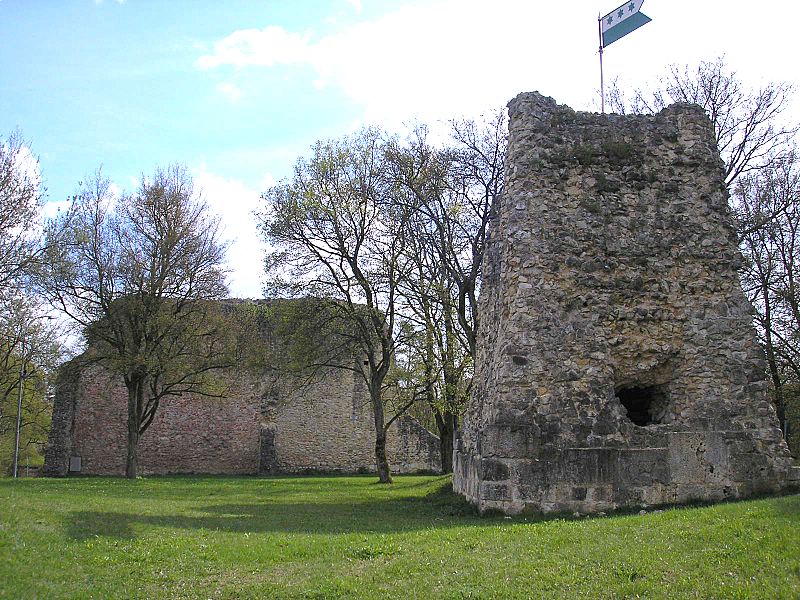
Hellenstein Castle
Hellenstein Castle is a prominent historic fortress located in Heidenheim an der Brenz, Germany. Originally constructed in the 12th century, this castle served as the residence of the Lords of Hellenstein before passing through several noble families over the centuries. It stands as a significant example of High Medieval fortification that evolved into a Renaissance residence reflecting the changing architectural and political landscape of southern Germany.
Early history and medieval origins
The castle's origins date back to the 12th century, when it was first built as a defensive stronghold for the Lords of Hellenstein. This initial phase established the castle's core medieval structures, including thick defensive walls and a strategic hilltop location overseeing the surrounding region. The castle remained under the Hellenstein family until 1273, when their male line ended. Subsequently, the castle changed hands multiple times during the next eighty years, reflecting the turbulent feudal politics of the period.
Transition to the counts of helfenstein and württemberg rule
In 1351, the castle was acquired by the counts of Helfenstein, who controlled it for nearly a century until 1448. Their tenure saw maintenance and modest enhancements typical of late medieval castles. Eventually, in 1503, the castle came under the control of the dukes of Württemberg, marking a new chapter in its history. This transition coincided with broader political consolidation in the region.
Destruction and renaissance rebuilding
On August 5, 1530, Hellenstein Castle suffered a devastating fire that destroyed much of the medieval structure. Recognizing the castle's strategic and symbolic importance, Ulrich I of Württemberg ordered its reconstruction. The rebuilding process, spanning from 1537 to 1544, introduced Renaissance architectural elements, blending defensive features with more refined residential spaces. This reconstruction included the strengthening of walls and the addition of new towers.
Expansion under duke frederick i and henry schickhardt
When Duke Frederick I ascended to the ducal throne in 1593, he commissioned a significant expansion of the castle to demonstrate the power and prestige of the Württemberg dynasty. A planning commission appointed master builder Henry Schickhardt in 1595 to oversee the project. Under Schickhardt's direction, the castle's walls were extended, and two large, ornately decorated towers were constructed adjacent to the new main gate. These additions exemplify Renaissance military architecture combined with representational grandeur.
The expansion also included the installation of a modern water system capable of lifting water 90 meters to the castle, a remarkable engineering feat for the period. This system was essential for sustaining the castle during sieges and daily use.
Sieges, legends, and water systems
During the Thirty Years' War (1618–1648), the castle sustained damage, including the destruction of its innovative water supply system. To restore water access, a deep well called the Kindlesbrunnen was excavated between 1666 and 1670. This 78-meter well became the subject of local folklore, with a legend claiming that babies were pulled from the well rather than delivered by storks, giving the well its name meaning 'baby fountain.'
In 1704, during the War of the Spanish Succession, a French force of 10,000 men evaluated the castle's defenses but ultimately decided that an assault would be too costly, sparing the castle from attack. This episode highlights the castle's formidable defensive reputation.
Artistic patronage and notable visitors
In the late 16th and early 17th centuries, Hellenstein Castle reached its cultural zenith. Frederick I commissioned the Bavarian court painter Friedrich Sustris in 1593 to decorate the round tower's walls and ceilings with intricate paintings. The castle also hosted many prominent historical figures, including Albrecht von Wallenstein in 1630, Prince Eugene of Savoy in 1702, Archduke Charles of Austria in 1796, and Napoleon Bonaparte in 1805, underscoring its political and military significance.
Decline, partial demolition, and preservation efforts
By the mid-18th century, the castle's strategic importance waned, and financial constraints prevented further renovations. In 1810, the upper floor of the tower battery was dismantled and sold as building material, resulting in the loss of Friedrich Sustris's valuable paintings. The following decade saw plans to demolish the entire old castle, with parts of it removed to supply stone for industrial use.
Preservation efforts began in 1837 when a royal commission prohibited further removal of stones. In 1901, the former castle church was converted into a museum by the Folk and Ancient History Society of Heidenheim. Over the 20th century, the castle was gradually restored and expanded as a cultural institution.
Modern use as a museum complex
Today, Hellenstein Castle operates as a museum complex that attracts visitors interested in history, art, and technology. The castle houses two distinct museums accessible with separate or combined tickets. The Museum für Kutschen Chaisen Karren, located in the old Fruchtkasten, showcases the evolution of transportation before the automobile and was honored in 1987 by the Europäischen Museums Forum for its outstanding design.
The castle museum features a theatre presenting films on Heidenheim's history, alongside exhibits of local ancient artifacts, religious art, antique toys, and the Indian Collection of Alfred Meebold, offering a diverse cultural experience within the historic walls.
Architectural features and layout
The castle complex combines medieval fortifications with Renaissance expansions. Key architectural elements include the thick defensive walls, multiple towers including the two large decorated gate towers, and the extensive water supply systems. The juxtaposition of medieval and Renaissance styles reflects the castle's long history and adaptation to changing military and residential needs.
The castle's elevated position provides commanding views over Heidenheim and the Brenz valley, reinforcing its original strategic purpose. The Kindlesbrunnen well remains a notable engineering and cultural landmark within the castle grounds.
Frequently asked questions (FAQ)
- When was Hellenstein Castle originally built?
- Hellenstein Castle was originally constructed in the 12th century as a medieval fortress for the Lords of Hellenstein.
- What architectural styles are featured at Hellenstein Castle?
- The castle features a blend of High Medieval fortifications and Renaissance architectural elements from its 16th-century reconstruction and expansion.
- Can visitors tour museums inside Hellenstein Castle?
- Yes, the castle houses multiple museums, including the Museum für Kutschen Chaisen Karren and a castle museum with historical exhibits, open during the summer season.
- What is the Kindlesbrunnen well, and why is it significant?
- The Kindlesbrunnen is a 78-meter deep well dug in the 17th century to restore the castle's water supply, famous for a local legend about babies being pulled from it.
- Who was Henry Schickhardt in relation to Hellenstein Castle?
- Henry Schickhardt was the master builder commissioned by Duke Frederick I in 1595 to expand and modernize Hellenstein Castle with new towers and fortifications.
Information
Opening hours
Summer season, daily
Ticket prices
Separate or combination tickets available for museums
Current owner
City of Heidenheim
Loading map...
Visitor reviews
No reviews yet. Been here? Write the first review and help other travelers!
Write the first reviewVisited this castle? Share your experience
Your review helps other travelers and adds first-hand knowledge to our encyclopedia.