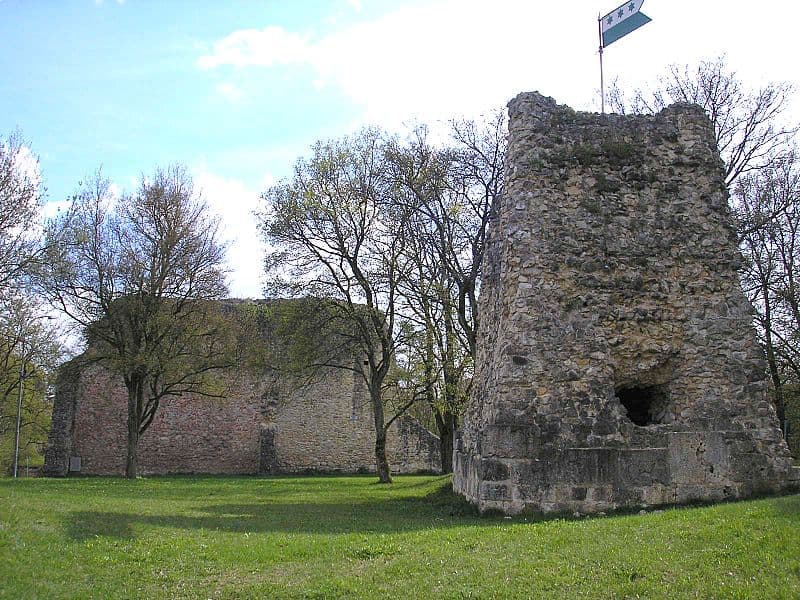
Güssenburg Castle
Güssenburg Castle stands as a significant example of a late medieval hill castle located near the municipality of Hermaringen, Germany. Constructed around 1346 on the site of an earlier fortification, it was the ancestral seat of the noble House of Güssenberg, a family that played a prominent role in the region's feudal history. The castle's strategic position atop Schloßberg hill, approximately 500 meters above sea level and overlooking the Brenz valley, provided both natural and enhanced defensive advantages, making it an ideal stronghold and administrative center.
The origins and historical significance of Güssenburg Castle
The earliest records of the family associated with Güssenburg date back to the 12th century, with mentions of the ministeriales class, unfree knights serving powerful noble houses. The Güssenberg family, later known as Güss von Güssenberg, first appear in documents from 1171 and 1216, indicating their rising influence in the region. By the early 14th century, the castle had become a symbol of their power and control over the surrounding territories.
In 1328, the fief controlling the area passed to the Counts of Helfenstein, although the Güssen family retained ownership of the castle itself. Around 1346, significant expansions were undertaken, including the enhancement of the main tower and the construction of robust outer walls. These developments reflected the family's consolidation of power in the Brenz valley.
Following the extinction of the Güssen von Güssenburg line around 1366, the castle passed to a related branch, the Güssen von Haunsheim, who sold it in 1372 to the Counts of Helfenstein. Under Helfenstein control, Güssenburg served as the administrative seat for their regional holdings, with a vogt or bailiff stationed there until 1448.
The castle's destruction and subsequent history
The castle's military and administrative importance ended abruptly in 1449 during the Städtekreig, a conflict involving several Imperial cities. Troops from Ulm, Giengen, and Lauingen attacked and destroyed Güssenburg, and it was never rebuilt. This marked the end of its role as a noble residence and regional power center.
In 1709, the ruins and the surrounding farmland were inherited by the local community of Hermaringen. The site remained largely neglected until the 20th century, when conservation efforts began. Initial clearing and stabilization took place in the early 1970s, followed by extensive restoration work led by a local Castle Society between 1981 and 1998. These efforts aimed to preserve the castle's remains and promote its historical significance.
Architectural features and layout of the castle ruins
Defensive structures and fortifications
Güssenburg Castle occupies a naturally defensible position on Schloßberg hill, with steep slopes on the north, west, and east sides. The castle's main enclosure is formed by a keep and thick curtain walls creating an irregular rectangular area approximately 45 by 70 meters in size. The curtain walls, constructed from a combination of finely cut ashlar stone and rough rubble, reach up to 3.4 meters thick, demonstrating the emphasis on strong fortifications.
A notable feature is a wooden post embedded in the masonry, dated by dendrochronology to around 1350, providing precise evidence of the construction period. On the south side, a wide dry moat separates the castle from the flat hilltop, adding a critical defensive barrier without reliance on water.
Inner defenses and castle core
Approximately 25 meters behind the curtain wall lies a nearly level inner ditch, which served as an additional obstacle for attackers. Beyond this lies the remains of the inner castle, including debris from former buildings, defensive barriers, and the ruins of the square keep.
The keep itself stands about six meters high today, with only the brick core exposed after the outer stone facing has mostly collapsed. Inside the keep, a small chamber measuring roughly two by two meters contains a decorative arrangement of 26 small square stone blocks in orderly layers, a rare detail indicating the care and craftsmanship invested in the castle's construction.
Historical context and regional importance
Güssenburg Castle was more than a mere residence; it played a vital role in the administration of the grafschaft or fief of the Count. Its central location allowed the castle to function as the seat for the count's vogt or bailiff until the mid-15th century. This administrative function underscores the castle's importance in the feudal hierarchy and governance of the region.
The castle's destruction during the Städtekreig reflects the turbulent political landscape of the time, with growing conflicts between imperial cities and noble families. The loss of Güssenburg marked a shift in regional power dynamics, eventually leading to the consolidation of control under the House of Württemberg.
Preservation and cultural heritage today
Today, the ruins of Güssenburg Castle are a protected historical site, maintained through ongoing conservation efforts. The work done in the late 20th century by the local Castle Society has helped stabilize the ruins, making them accessible for visitors interested in medieval architecture and regional history.
The castle remains offer a tangible connection to the past, showcasing typical late medieval defensive architecture and the lifestyle of a noble family deeply intertwined with the feudal structures of medieval Germany. Visitors can explore the site to appreciate the layered defenses, the remnants of the living quarters, and the commanding views that once made Güssenburg a formidable stronghold.
Frequently asked questions (FAQ)
- How do I get to Güssenburg Castle in Hermaringen?
- Güssenburg Castle is located on Schloßberg hill near Hermaringen in Baden-Württemberg, Germany. Visitors can reach the site by car or local transport to Hermaringen, followed by a short hike uphill to the castle ruins.
- What is the historical significance of Güssenburg Castle?
- Güssenburg Castle was the ancestral seat of the House of Güssenberg and served as an administrative center for regional counts. It was destroyed in 1449 during the Städtekreig and remains an important medieval ruin.
- Is it possible to visit the interior of the keep at Güssenburg Castle?
- The keep at Güssenburg Castle is partially preserved as a ruin. While visitors can explore the exterior remains and surrounding walls, the interior chamber is limited and primarily accessible for viewing rather than entry due to safety concerns.
- When was the castle destroyed and why?
- Güssenburg Castle was destroyed in 1449 during the Städtekreig, a conflict involving troops from Ulm, Giengen, and Lauingen. The castle was never rebuilt after this attack.
- Are there any guided tours available at Güssenburg Castle?
- Guided tours may be available through local heritage organizations or the Castle Society that manages the site. It is recommended to check with Hermaringen's tourist information for current offerings.
Photo gallery

Information
Website
Visit websiteSources & official resources
Verify the information above using these authoritative references.
Loading map...
Visitor reviews
No reviews yet. Been here? Write the first review and help other travelers!
Write the first reviewVisited this castle? Share your experience
Your review helps other travelers and adds first-hand knowledge to our encyclopedia.



