Haut-Barr Castle
Haut-Barr Castle, also known as Château du Haut-Barr or Hohbarr in German, is a remarkable medieval fortress perched on three narrow sandstone spurs atop a mountain southwest of the town of Saverne, in the Bas-Rhin department of France. This strategic location within the region historically known as Northern Alsace or the Middle Vosges offers commanding views over the Zorn valley and the Plain of Alsace. Because of its panoramic vantage point, the castle earned the enduring nickname "the Eye of Alsace" from the people of Strasbourg, highlighting its importance for regional surveillance and defense.
The castle was originally constructed in the 12th century by the Bishops of Strasbourg as a fortress and episcopal residence to control key mountain routes linking the regions of Lorraine and Alsace. The first documented mention of the castle dates to 1112, under the names Borre or Borra, which evolved into the German Hohenbarr and later Hohbarr, before becoming Haut-Barr in French.
Architectural evolution and strategic significance
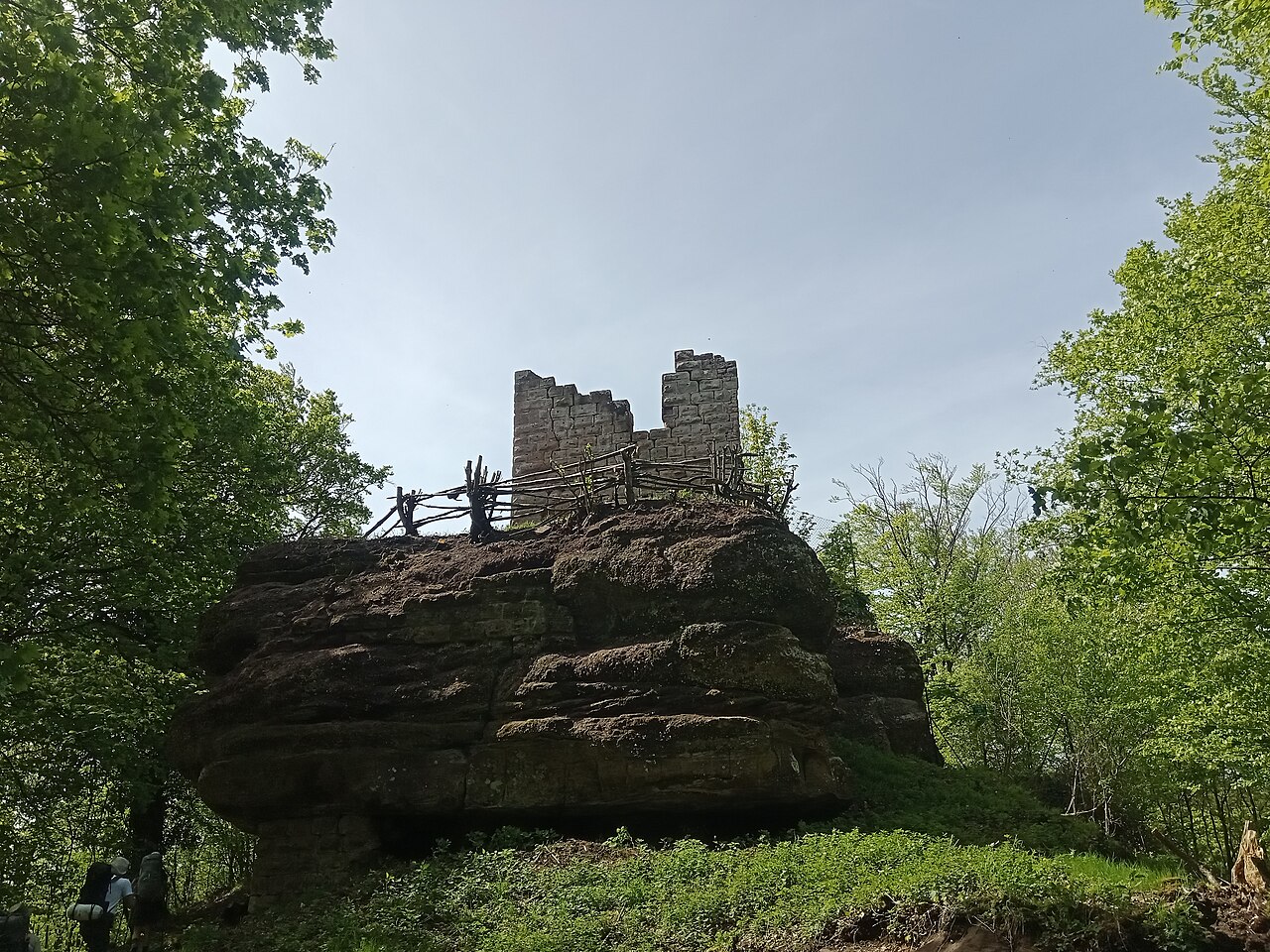
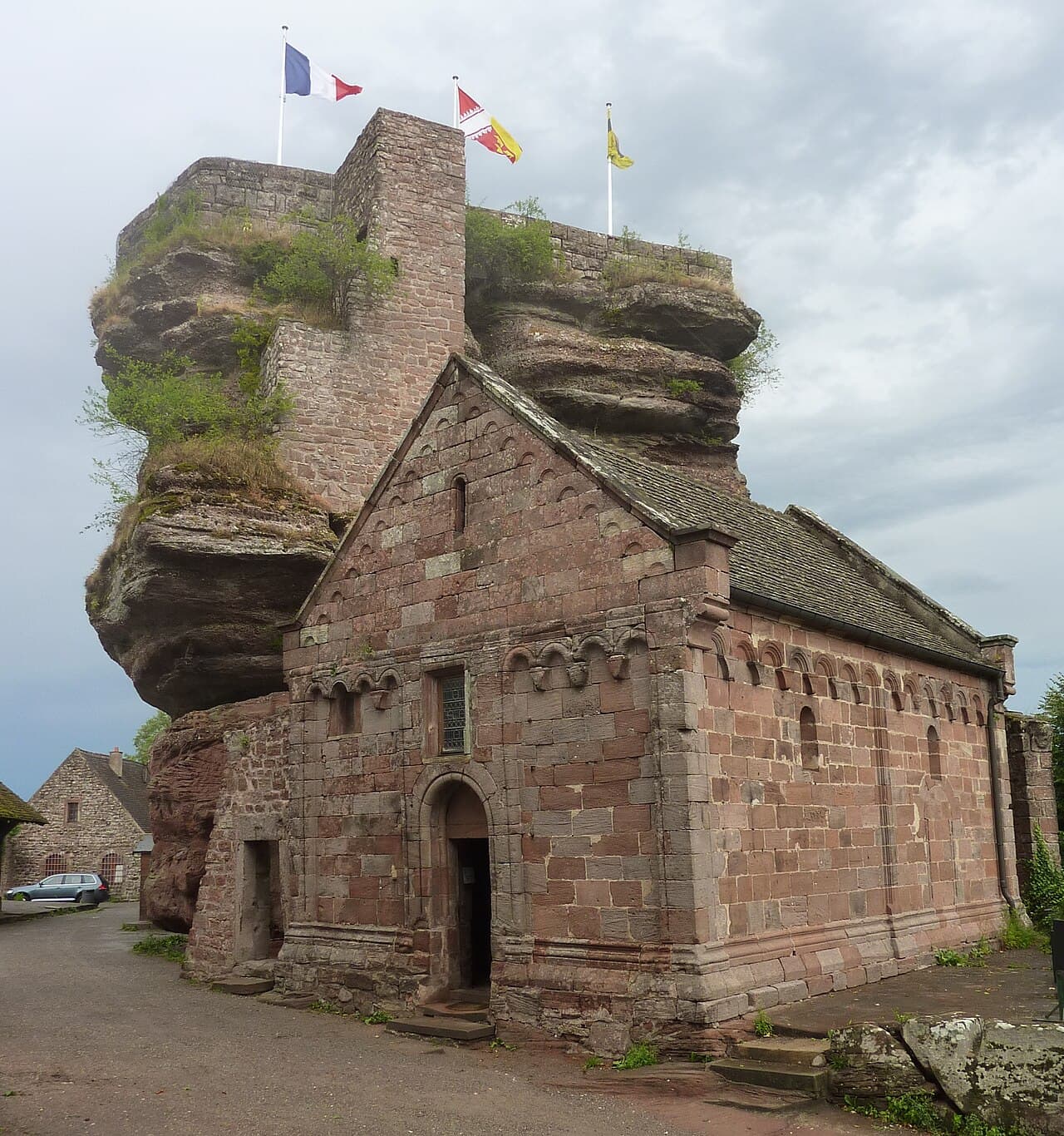
Haut-Barr Castle was built on a sandstone ridge approximately 250 meters long and 15 meters high, comprising three main sandstone rock formations rising over 20 meters. The central rock, the largest, extends about 80 meters but narrows midway, connected by a bridge to the smaller southern rock known as Markfels. To the north lies another sandstone outcrop, separated by a natural divide. This unique geological setting provided natural defensive advantages, enhanced by the castle's construction using locally quarried Vosges sandstone.
The masonry of the castle reflects its long history of construction and renovation. Early Romanesque elements, characterized by large, finely cut stone blocks and rounded arches, are visible in the castle chapel dedicated to St. Nicholas. This chapel notably combines a Romanesque nave with a later Gothic choir, featuring pointed arches and more delicate stonework, illustrating the architectural transition over centuries.
Significant modifications occurred in the 14th century and again in 1583 under Bishop Johann IV von Manderscheid-Blankenheim, who adapted the castle to the evolving demands of warfare, including the use of firearms. Between 1581 and 1586, the castle was reinforced with modern fortifications suitable for gunpowder weaponry, reflecting the military innovations of the High Medieval period transitioning into the early modern era.
Historical context and military role
Throughout the Middle Ages, Haut-Barr served as both a stronghold and residence for the bishops of Strasbourg. In 1394, the castle was pledged to the noble Egenolf von Lützelburg and his associates, although episcopal control continued. The castle's strategic location allowed it to command important mountain passes and oversee the surrounding valleys, making it a key asset in regional power struggles.
Following the Thirty Years' War and the Peace of Westphalia in 1648, Haut-Barr was among the castles ordered to be dismantled to reduce military threats in the region. It was partially destroyed in 1649. However, the outbreak of the War of the Spanish Succession in 1701 prompted its restoration and reuse as a military fortress. The castle remained in use until around 1770, after which it was gradually abandoned, although parts of it were inhabited until the French Revolution.
Later uses and preservation
In 1798, the elevated site of Haut-Barr was utilized for a Chappe telegraph tower, an early form of semaphore communication used for rapid message transmission across distances. This tower was originally near a natural bridge called the Devil's Bridge within the castle grounds but was relocated in 1810 to the nearby village of Haegen for safety reasons. A reconstructed version of the telegraph tower now stands at Haut-Barr, commemorating this innovative phase of its history.
The ruins of Haut-Barr have been owned by the French state since 1878 and were protected as a historic monument beginning in 1874. Today, the castle is freely accessible to visitors, with a cafe-restaurant located within the walls, making it a popular destination for both locals and tourists. Visitors can enjoy spectacular views of the surrounding countryside, including sights of nearby castles such as Greifenstein Castle across the Zorn valley and Grand-Geroldseck Castle just 500 meters to the south.
Architectural features and archaeological finds
The castle's construction utilized the natural sandstone formations extensively, with buildings and fortifications carved directly into the rock or built upon it. The geological composition includes a lower layer of fine-grained sandstone topped by a harder quartz pebble conglomerate known locally as poudingue savernien, which forms natural overhangs enhancing the castle's defenses.
The masonry techniques vary across different periods, with Romanesque precision in the earliest parts, Gothic stonework in later additions, and Renaissance style repairs that briefly returned to large block construction. The 18th-century modifications used smaller, irregular stones, often reusing materials from earlier phases.
Among the archaeological discoveries are signal horns or calling trumpets, suggesting the use of sound signals for communication or defense within the castle's military operations. The castle's strategic placement and robust fortifications made it a formidable defensive site throughout its active centuries.
The chapel of st. nicholas
The castle chapel is a significant architectural highlight, combining a Romanesque nave with a Gothic choir. The nave's rounded arches and sturdy walls contrast with the choir's pointed arches and refined detailing, reflecting the evolution of ecclesiastical architecture from the 12th to the 14th centuries.
Panoramic views and landscape context
Haut-Barr's elevated position at 460 meters above the valley floor offers sweeping views across the Alsace plain and the Zorn valley. This vantage point was crucial for its historical role as a lookout and defensive site. The castle's nickname, "Oculus Alsatiae" or "eye of Alsace," emphasizes its visual dominance in the region.
Visitors today can appreciate these views, which connect Haut-Barr to a network of other medieval fortifications in the Vosges region, illustrating the strategic military landscape of the area.
Frequently asked questions (FAQ)
- How do I get to Haut-Barr Castle?
- Haut-Barr Castle is located on Rue du Haut-Barr in Saverne, France. It is accessible by car, with parking available near the site, and also reachable by local public transport followed by a short walk.
- What is the best time to visit Haut-Barr Castle?
- The castle is open daily from dawn to dusk. Spring and autumn offer pleasant weather and fewer crowds, making these seasons ideal for visiting Haut-Barr Castle.
- Is Haut-Barr Castle wheelchair accessible?
- Due to its location on sandstone spurs and the nature of the ruins, Haut-Barr Castle is not fully wheelchair accessible. Visitors should be prepared for uneven terrain and some steep paths.
- Can I visit the chapel of St. Nicholas inside the castle?
- Yes, the chapel of St. Nicholas is part of the castle ruins and can be visited. It showcases a blend of Romanesque and Gothic architectural elements and is a highlight for visitors interested in medieval ecclesiastical architecture.
- Are there guided tours available at Haut-Barr Castle?
- Guided tours are occasionally available, often organized by local tourist offices or heritage associations. It is recommended to check in advance for scheduled tours to enhance your visit with historical insights.
Photo gallery

Photo by Geak (Diskussion)•Public domain
Information
Opening hours
Open daily, dawn to dusk
Ticket prices
Free
Current owner
French state
Website
Visit websiteAddress
Rue du Haut-Barr, Saverne, Bas-Rhin, France
Sources & official resources
Verify the information above using these authoritative references.
Loading map...
Visitor reviews
No reviews yet. Been here? Write the first review and help other travelers!
Write the first reviewVisited this castle? Share your experience
Your review helps other travelers and adds first-hand knowledge to our encyclopedia.