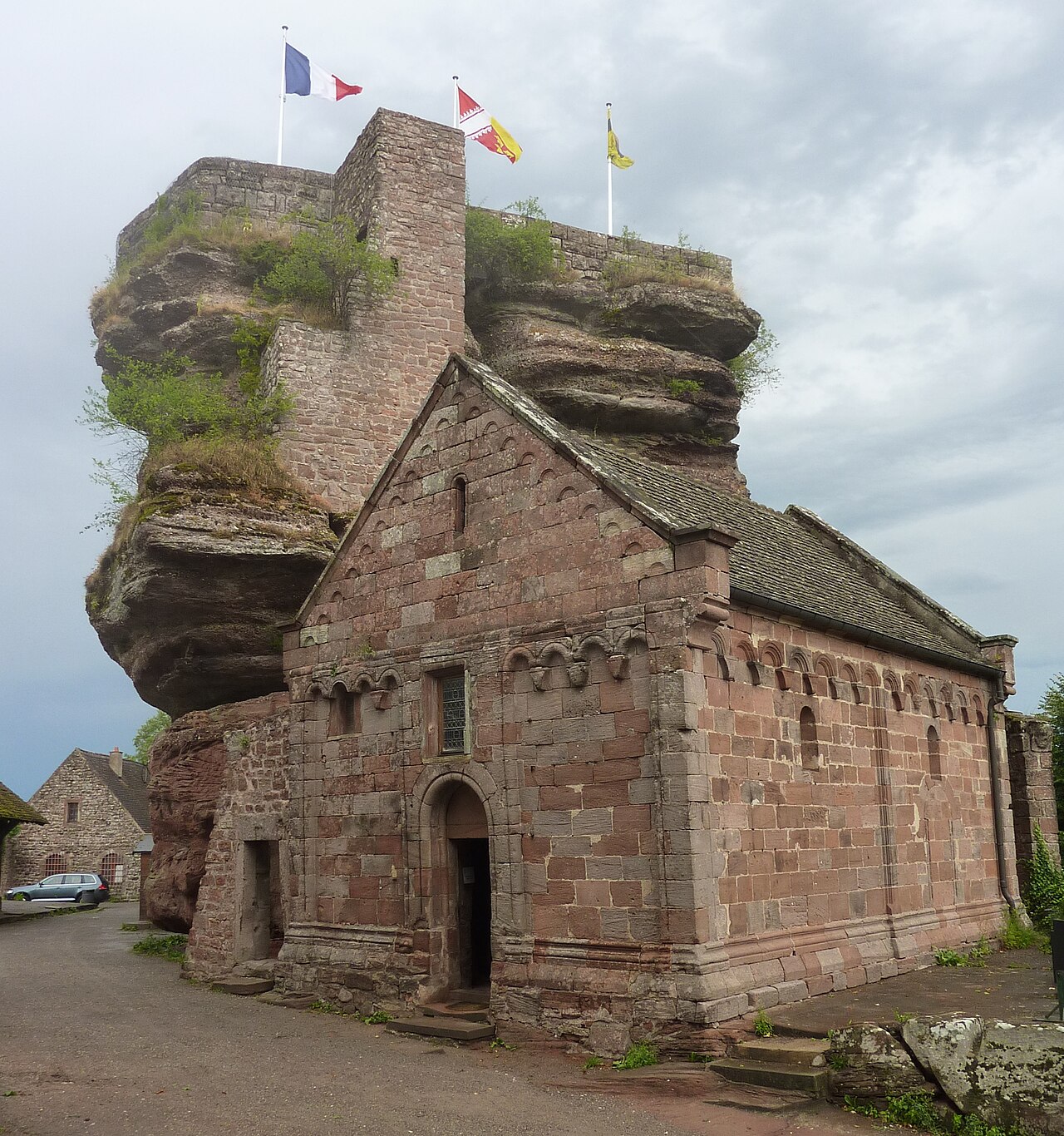
Grand-Geroldseck Castle

Grand-Geroldseck Castle in Haegen, France
Haegen, Grand-Est, France
High Medieval (11th–13th c.)
Ruins

Grand-Geroldseck Castle, locally known as Château du Grand-Geroldseck, is a significant medieval fortress perched on a mountain west of the village of Haegen, in the Bas-Rhin department of France. This region, part of the Northern Alsace or the Middle Vosges, is renowned for its rich history and numerous medieval castles. Grand-Geroldseck stands as one of the oldest castles in the northern Vosges, embodying the architectural and feudal traditions of the High Medieval period.

Constructed in the early 12th century by the noble Geroldseck family, the castle was strategically established to protect the interests of the Marmoutier Abbey. The Geroldsecks were loyal vassals to the Bishop of Metz and served as avoués, or protectors, of the abbey's territories. The castle's location on a raised platform allowed it to fulfill dual roles: a fortified defensive position and a feudal residence. Its design reflects the typical medieval military architecture of the time, combining strong defensive features with residential functions.

Historical significance and ownership

The Geroldseck family maintained control of the castle until around 1361. At that point, the property was divided among several relatives, resulting in co-ownership. This division likely led to internal conflicts, as evidenced by the construction of a second castle, Petit-Geroldseck, approximately 200 meters south of Grand-Geroldseck. Built in the late 13th or early 14th century, Petit-Geroldseck was presumably an effort by some family members to distance themselves from others.

By the late 15th century, Grand-Geroldseck had fallen into disrepute as a den of robber knights. Such outlaw activity prompted its destruction in 1471. Petit-Geroldseck was likely already abandoned by this time. Following its destruction, Grand-Geroldseck was never rebuilt and was documented as a ruin by 1507. The castle's keep suffered further damage when it was struck by lightning in 1718, causing partial collapse.

Architectural features and layout

The imposing square keep

The most prominent surviving feature of Grand-Geroldseck Castle is its square keep, which rises approximately 22 meters high. Constructed around 1200, the keep's walls are an impressive three meters thick and are faced with embossed stone, a testament to the craftsmanship of the period. This massive tower served as both a last refuge during attacks and a symbol of the lord's power.

Residential and defensive structures

The castle was built on a natural platform, which enhanced its defensive capabilities. The remains of the lord's residence cellars are still visible, indicating the presence of substantial living quarters within the castle complex. Additionally, the castle featured a barbican, an outer defensive gateway designed to protect the entrance from invaders. The cellars have already been consolidated by volunteers, preserving these important architectural elements for visitors today.

Preservation and current status

Today, Grand-Geroldseck Castle remains a ruined medieval fortress undergoing ongoing efforts to consolidate and stabilize its structures. These efforts are largely driven by dedicated volunteers committed to preserving this historical monument. Visitors can freely explore the site, which offers a glimpse into medieval military architecture and feudal life.

The castle's location is notable for its proximity to other historic sites, situated only about 800 meters south of the well-known Haut-Barr Castle. This proximity makes it an attractive destination for those interested in exploring the medieval heritage of the Alsace region.

Architectural evolution and alterations

Throughout its history, Grand-Geroldseck Castle underwent several modifications, particularly during the 13th, 14th, and 15th centuries. These changes reflect the evolving needs of its inhabitants and the shifting military technologies of the time. The castle's architecture showcases a blend of defensive innovations and residential comforts, characteristic of feudal castles in the region.

The castle's embossed stone facing on the keep walls is a distinctive feature, highlighting the aesthetic as well as functional aspects of medieval fortifications. The thick walls not only provided formidable defense but also conveyed the lord's status and wealth.

Visiting Grand-Geroldseck Castle

Visitors to Grand-Geroldseck Castle can enjoy exploring the ruins freely, appreciating the historic square keep and the remains of the feudal residence. The site offers panoramic views of the surrounding Vosges landscape, enhancing the visitor experience. The castle's location near Haut-Barr Castle allows for a combined visit to two significant medieval sites within a short walking distance.

Efforts to maintain and consolidate the ruins ensure that Grand-Geroldseck remains accessible and safe for visitors, while preserving its historic character. The castle stands as a poignant reminder of the feudal era in Alsace and the strategic importance of the northern Vosges region during the Middle Ages.

Frequently asked questions (FAQ)

What is the historical significance of Grand-Geroldseck Castle?
Grand-Geroldseck Castle dates back to the 12th century and is one of the most important historical sites in the Alsace region. It played a crucial role in local defense and served as a residence for noble families throughout its history.
When was Grand-Geroldseck Castle built?
The castle was constructed in the early 12th century, with its foundations laid around 1130. Over the centuries, it underwent various renovations and expansions, reflecting different architectural styles.
What are the opening hours for Grand-Geroldseck Castle?
Grand-Geroldseck Castle is typically open to visitors from April to October, daily from 10 AM to 6 PM. During the off-season, it is advisable to check the official website for specific opening days and hours.
Can I access Grand-Geroldseck Castle with a wheelchair?
Access to Grand-Geroldseck Castle may be challenging due to its historical architecture and uneven terrain. While some areas may be accessible, visitors are encouraged to contact the castle administration in advance to discuss accessibility options.
What is the best time to visit Grand-Geroldseck Castle?
The best time to visit Grand-Geroldseck Castle is during the spring and early autumn months when the weather is mild and the surrounding scenery is particularly beautiful. These seasons also offer fewer crowds compared to the summer peak tourist months.
Are there any nearby attractions to visit after Grand-Geroldseck Castle?
Yes, there are several nearby attractions, including the picturesque town of La Petite Pierre and the scenic Vosges mountains. Additionally, visitors can explore the charming vineyards and other historical sites in the Alsace region.
How much do tickets cost for Grand-Geroldseck Castle?
Tickets for Grand-Geroldseck Castle are generally priced around €5 for adults, with reduced rates for children and seniors. Family tickets and group rates may also be available, so it's worth checking the official website for any special offers.
How do I get to Grand-Geroldseck Castle?
Grand-Geroldseck Castle is accessible by car, and there is parking available nearby. Alternatively, public transportation options are available, with local buses connecting to the surrounding areas, though a short hike may be required from the nearest stop.

Information

Hill Castle

Loading map...

Visitor reviews

No reviews yet. Been here? Write the first review and help other travelers!

Write the first review

Visited this castle? Share your experience

Your review helps other travelers and adds first-hand knowledge to our encyclopedia.
Write a review

(5/5)

0/2000 characters

Your review will be visible after admin approval

Nearby castles

0.5 km
Petit-Geroldseck Castle — France castle

Petit-Geroldseck Castle

Haegen, France

Petit-Geroldseck Castle, also known as Château du Petit-Geroldseck, is a ruined medieval castle perched on a mountain west of the village of Haegen in the Bas-Rhin department of Alsace, France. This region, part of the Northern Alsace or Middle Vosges, is known for its rugged terrain and rich history of fortified structures. The castle's strategic location atop a rocky outcrop provided commanding views over the surrounding landscape, important for defense and surveillance during the Late Medieval period. Historical background and origins The castle was constructed in the 14th century, with some sources suggesting initial building phases possibly beginning in the late 13th century. It was first documented in 1349, indicating its significance during that era. The builders were co-owners of the nearby Grand-Geroldseck Castle, situated only about 500 meters to the north. This proximity suggests a familial or feudal division of property, where the Petit-Geroldseck served as a separate but related stronghold. The decision to erect a new castle so close to Grand-Geroldseck likely reflected social or political motivations to establish distinct residences or control over different parts of the territory. Architectural features and layout Although now largely in ruins, archaeological evidence and remaining structures provide insight into the castle's original design. Petit-Geroldseck was a relatively small fortress, typical of Late Medieval hill castles in the region. Its construction utilized local stone, with defensive walls adapted to the uneven mountain terrain. The castle likely included a keep or donjon, residential quarters, and basic defensive elements such as curtain walls and battlements. The limited size and resources suggest it was intended as a fortified residence rather than a major military fortress. Defensive advantages Its elevated position on a mountain ridge offered natural protection, reducing the need for extensive artificial defenses. The steep slopes around the site would have hindered attackers, while the castle's walls and towers provided vantage points for archers and lookouts. The proximity to Grand-Geroldseck Castle may have allowed for mutual support in times of conflict. Decline and abandonment Petit-Geroldseck's history is closely linked to that of Grand-Geroldseck. In 1471, Grand-Geroldseck was destroyed after becoming a refuge for robber knights, a fate common to many castles that fell into disrepute during the late Middle Ages. By this time, Petit-Geroldseck was probably already abandoned, as it was described as a ruin by 1507. The reasons for its abandonment are not fully documented but may relate to changing military technology, political shifts, or the consolidation of noble estates. Present condition and visitation Today, Petit-Geroldseck Castle remains a ruined archaeological site accessible to the public without restrictions. Visitors can explore the remnants of the castle's walls and foundations while enjoying panoramic views of the surrounding Vosges landscape. The site is often visited in conjunction with nearby Grand-Geroldseck Castle, offering a glimpse into the medieval history of the region. Heritage status The castle has been listed as a monument historique by the French Ministry of Culture since 1898, recognizing its cultural and historical importance. Preservation efforts focus on maintaining the ruins and preventing further deterioration, allowing visitors to appreciate the site's historical significance. Geographical and cultural context Located in the Alsace region, Petit-Geroldseck Castle is part of a network of medieval fortifications that reflect the area's turbulent history at the crossroads of French and Germanic influences. The castle's position in the Middle Vosges places it within a landscape characterized by dense forests, rocky hills, and strategic mountain passes that were crucial for controlling trade routes and territorial boundaries during the medieval period. Nearby attractions Visitors to Petit-Geroldseck often combine their visit with the nearby Grand-Geroldseck Castle ruins and other regional castles such as Château du Haut-Barr and Château de Fleckenstein. The area also offers hiking trails, natural parks, and cultural sites that enrich the historical experience.

Late Medieval (14th–15th c.)
Details
0.8 km
Haut-Barr Castle — France castle

Haut-Barr Castle

Saverne, France

Haut-Barr Castle, also known as Château du Haut-Barr or Hohbarr in German, is a remarkable medieval fortress perched on three narrow sandstone spurs atop a mountain southwest of the town of Saverne, in the Bas-Rhin department of France. This strategic location within the region historically known as Northern Alsace or the Middle Vosges offers commanding views over the Zorn valley and the Plain of Alsace. Because of its panoramic vantage point, the castle earned the enduring nickname "the Eye of Alsace" from the people of Strasbourg, highlighting its importance for regional surveillance and defense. The castle was originally constructed in the 12th century by the Bishops of Strasbourg as a fortress and episcopal residence to control key mountain routes linking the regions of Lorraine and Alsace. The first documented mention of the castle dates to 1112, under the names Borre or Borra, which evolved into the German Hohenbarr and later Hohbarr, before becoming Haut-Barr in French. Architectural evolution and strategic significance Haut-Barr Castle was built on a sandstone ridge approximately 250 meters long and 15 meters high, comprising three main sandstone rock formations rising over 20 meters. The central rock, the largest, extends about 80 meters but narrows midway, connected by a bridge to the smaller southern rock known as Markfels. To the north lies another sandstone outcrop, separated by a natural divide. This unique geological setting provided natural defensive advantages, enhanced by the castle's construction using locally quarried Vosges sandstone. The masonry of the castle reflects its long history of construction and renovation. Early Romanesque elements, characterized by large, finely cut stone blocks and rounded arches, are visible in the castle chapel dedicated to St. Nicholas. This chapel notably combines a Romanesque nave with a later Gothic choir, featuring pointed arches and more delicate stonework, illustrating the architectural transition over centuries. Significant modifications occurred in the 14th century and again in 1583 under Bishop Johann IV von Manderscheid-Blankenheim, who adapted the castle to the evolving demands of warfare, including the use of firearms. Between 1581 and 1586, the castle was reinforced with modern fortifications suitable for gunpowder weaponry, reflecting the military innovations of the High Medieval period transitioning into the early modern era. Historical context and military role Throughout the Middle Ages, Haut-Barr served as both a stronghold and residence for the bishops of Strasbourg. In 1394, the castle was pledged to the noble Egenolf von Lützelburg and his associates, although episcopal control continued. The castle's strategic location allowed it to command important mountain passes and oversee the surrounding valleys, making it a key asset in regional power struggles. Following the Thirty Years' War and the Peace of Westphalia in 1648, Haut-Barr was among the castles ordered to be dismantled to reduce military threats in the region. It was partially destroyed in 1649. However, the outbreak of the War of the Spanish Succession in 1701 prompted its restoration and reuse as a military fortress. The castle remained in use until around 1770, after which it was gradually abandoned, although parts of it were inhabited until the French Revolution. Later uses and preservation In 1798, the elevated site of Haut-Barr was utilized for a Chappe telegraph tower, an early form of semaphore communication used for rapid message transmission across distances. This tower was originally near a natural bridge called the Devil's Bridge within the castle grounds but was relocated in 1810 to the nearby village of Haegen for safety reasons. A reconstructed version of the telegraph tower now stands at Haut-Barr, commemorating this innovative phase of its history. The ruins of Haut-Barr have been owned by the French state since 1878 and were protected as a historic monument beginning in 1874. Today, the castle is freely accessible to visitors, with a cafe-restaurant located within the walls, making it a popular destination for both locals and tourists. Visitors can enjoy spectacular views of the surrounding countryside, including sights of nearby castles such as Greifenstein Castle across the Zorn valley and Grand-Geroldseck Castle just 500 meters to the south. Architectural features and archaeological finds The castle's construction utilized the natural sandstone formations extensively, with buildings and fortifications carved directly into the rock or built upon it. The geological composition includes a lower layer of fine-grained sandstone topped by a harder quartz pebble conglomerate known locally as poudingue savernien, which forms natural overhangs enhancing the castle's defenses. The masonry techniques vary across different periods, with Romanesque precision in the earliest parts, Gothic stonework in later additions, and Renaissance style repairs that briefly returned to large block construction. The 18th-century modifications used smaller, irregular stones, often reusing materials from earlier phases. Among the archaeological discoveries are signal horns or calling trumpets, suggesting the use of sound signals for communication or defense within the castle's military operations. The castle's strategic placement and robust fortifications made it a formidable defensive site throughout its active centuries. The chapel of st. nicholas The castle chapel is a significant architectural highlight, combining a Romanesque nave with a Gothic choir. The nave's rounded arches and sturdy walls contrast with the choir's pointed arches and refined detailing, reflecting the evolution of ecclesiastical architecture from the 12th to the 14th centuries. Panoramic views and landscape context Haut-Barr's elevated position at 460 meters above the valley floor offers sweeping views across the Alsace plain and the Zorn valley. This vantage point was crucial for its historical role as a lookout and defensive site. The castle's nickname, "Oculus Alsatiae" or "eye of Alsace," emphasizes its visual dominance in the region. Visitors today can appreciate these views, which connect Haut-Barr to a network of other medieval fortifications in the Vosges region, illustrating the strategic military landscape of the area.

High Medieval (11th–13th c.)
Details
1.9 km

Greifenstein Castle

Saverne, France

Greifenstein Castle, known locally as Château de Greifenstein, is a remarkable example of a high medieval castle complex situated on a wooded rocky ridge west of the town of Saverne in the Bas-Rhin department of France. Nestled in the region often referred to as Northern Alsace or the Middle Vosges, this castle group comprises two distinct castles, each with its own unique history and architectural significance, separated by a dramatic rock-cut ditch. Historical origins and early ownership The older and western castle, known as Grand-Greifenstein or Vorder-Greifenstein, dates back to the first half of the 12th century. It was likely constructed by the knight Meribodo de Greifenstein, a figure closely linked to the influential Lords of Ochsenstein, who owned the castle by 1217 and were probably related to Meribodo. This connection underlines the castle's importance as a feudal stronghold in the region during the high medieval period. The second castle and defensive features The younger castle, called Petit-Greifenstein or Hinter-Greifenstein, was built east of the original fortress, likely at the end of the 13th century or beginning of the 14th century. The two castles are separated by a significant rock-cut ditch, which was fortified with a flanking tower providing defensive coverage. This architectural arrangement illustrates the strategic military thinking of the time, emphasizing layered defense and control of access routes. Architectural highlights Grand-Greifenstein boasts the largest keep in Alsace, measuring approximately 13 meters on each side. This massive structure would have served as the last line of defense and a symbol of the lord's power. Between the two main castles stands a renovated tower, likely part of Grand-Greifenstein originally, which offers visitors a vantage point over the surrounding landscape. Defensive structures and layout The castle complex is situated on a rocky ridge, utilizing natural elevation for defense. The rock-cut ditch separating the two castles is a striking feature, enhancing the defensive capability by preventing direct assault between the two parts. The flanking tower guarding this ditch is restored and accessible, allowing visitors to appreciate the military architecture firsthand. Later history and decline By the early 16th century, the entire castle group came under the ownership of the Bishop of Strasbourg. The castle likely fell into ruin by the beginning of the Thirty Years' War (1618), as it was used as a quarry for building the episcopal palace in Saverne. Shortly after the war, its destruction was ordered by Henri de La Tour d'Auvergne, the Viscount of Turenne, marking the end of its military significance. Visiting Greifenstein Castle today Today, Greifenstein Castle is freely accessible to the public. Visitors can reach the site via a roughly 25-minute hike along a signposted path from the nearest road, making it a popular destination for hikers and history enthusiasts. The restored flanking tower is climbable, offering spectacular views of nearby castles such as Haut-Barr and Grand-Geroldseck across the Zorn valley. Panoramic views and surrounding landmarks From the castle terrace, visitors enjoy unimpeded views of the town of Saverne, the Château du Haut-Barr, the Château du Grand-Geroldseck, the Zorn valley, and the Saint-Vit chapel. These vistas highlight the castle's strategic location and its role in the network of medieval fortifications in the region. Access and directions To visit, travelers should leave Saverne via the D132 road towards Lutzelbourg, then turn right towards the Ramsthal lake. The path to the castle is maintained by the Club Vosgien and marked with a blue rectangle, ensuring easy navigation for visitors. Architectural and cultural significance Greifenstein Castle stands as an important example of a high medieval fortified complex in Alsace, illustrating the evolution of castle architecture from the 12th to the 14th century. The presence of two castles in close proximity, connected yet distinct, reflects the complex feudal and military history of the region. Its ruins offer valuable insights into medieval defensive strategies, construction techniques, and the lifestyle of the nobility during this period. The castle's enduring presence amid the natural beauty of the Middle Vosges also makes it a cherished cultural landmark, attracting visitors interested in history, architecture, and scenic hiking experiences.

High Medieval (11th–13th c.)
Details