Haut-Andlau Castle — France castle

Haut-Andlau Castle

Haut-andlau castle: medieval granite fortress in northern alsace
Andlau, Grand-Est, France
High Medieval (11th–13th c.)
Ruins

Haut-Andlau Castle, also known as Château d'Andlau or Burg Hoh-Andlau, is a striking medieval fortress ruin situated near the village of Andlau in the Bas-Rhin department of France. Nestled in the region often referred to as Northern Alsace or the Middle Vosges, the castle commands a strategic position atop a narrow granite ridge at an altitude of 451 meters. This elevated location offers commanding views over the valleys of Andlau and Kirneck, underscoring its historic role as a defensive stronghold and noble residence.

Constructed primarily from locally quarried granite blocks, Haut-Andlau Castle was built between 1246 and 1264, most likely under the direction of Eberhard d'Andlau, a member of the regional nobility. The castle's architecture reflects the military and residential needs of the period, combining robust defensive features with elements designed for habitation. It remained in the possession of the Counts of Andlau for several centuries, serving as a fortified family seat and notably continuing to be inhabited up to the time of the French Revolution, making it one of the last castles in the Vosges region to maintain occupancy during that era.

Architectural layout and defensive features

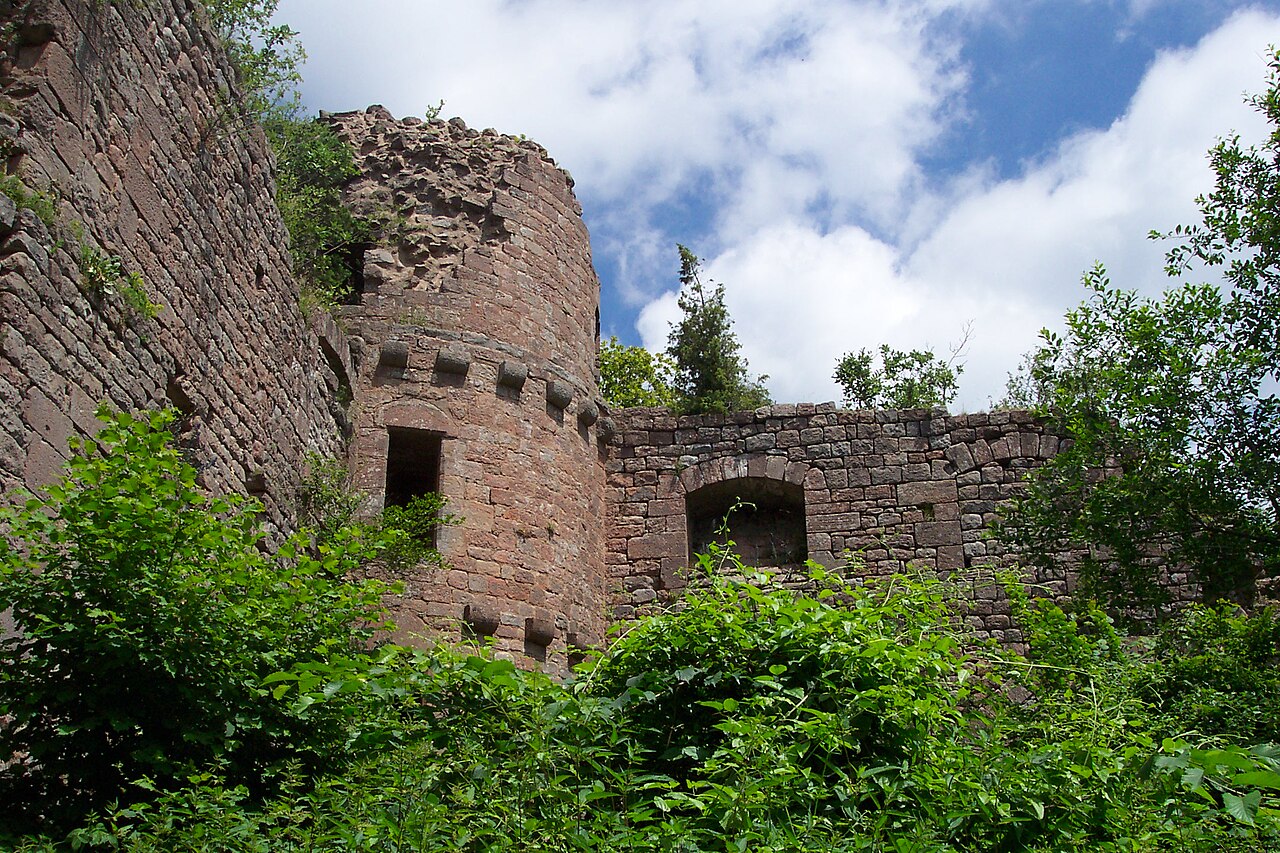
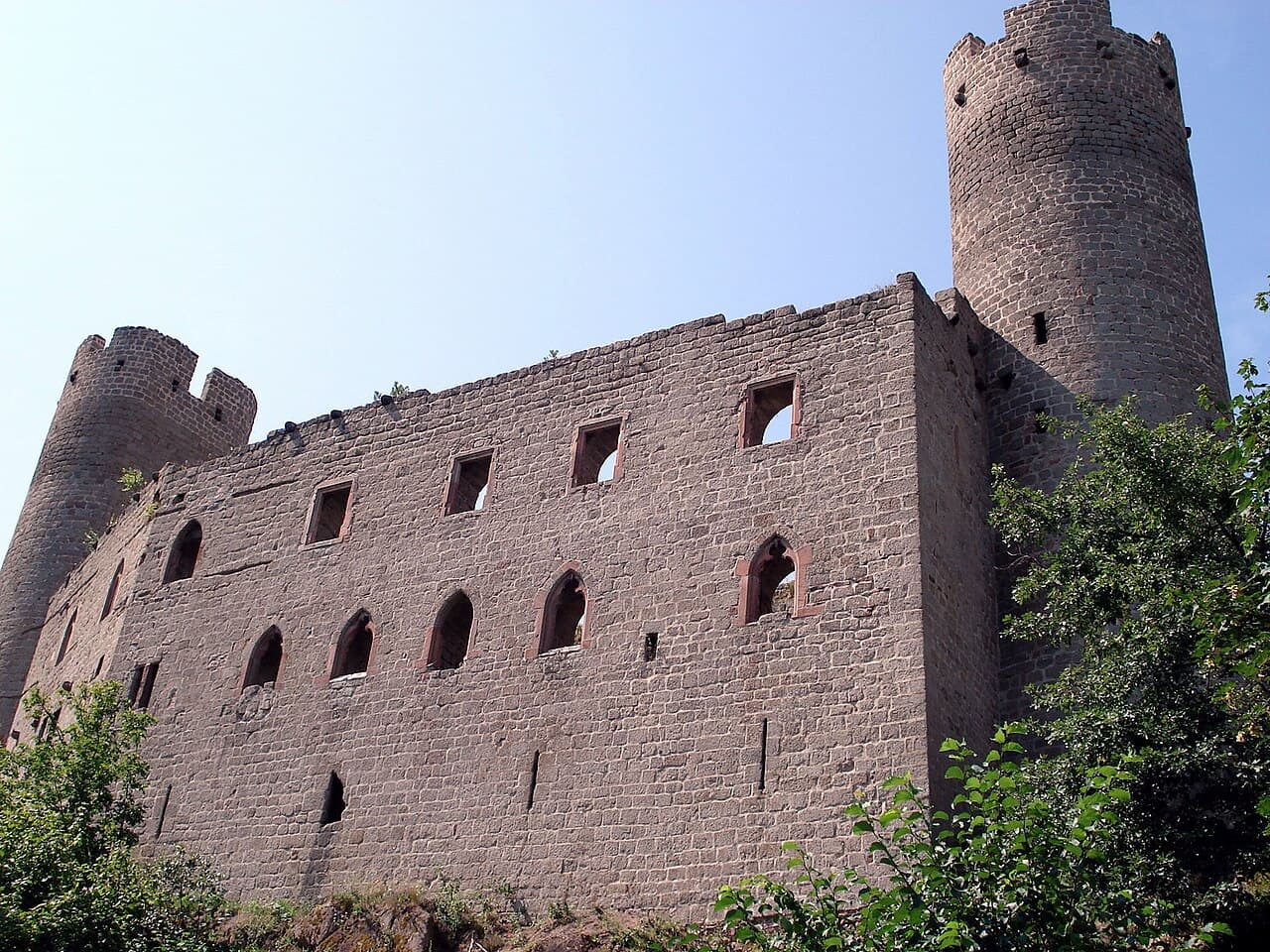
Haut-Andlau Castle is built on a narrow granite ridge approximately 25 meters wide and 80 meters long, oriented from south-southwest to north-northeast. The castle's upper part consists of a long, polygonal residential building measuring roughly 37 by 9 meters. This main structure is flanked at each end by two projecting round keeps, each about 10 meters in diameter, with walls less than 2 meters thick. These towers were originally topped with slate-capped spires, adding both a defensive and aesthetic element to the castle's silhouette.

The castle's lower courtyard or bailey underwent significant alterations during the 16th century to adapt to the evolving demands of warfare, particularly the use of firearms. This area housed industrial buildings and stables and features a 16th-century entrance gate, indicative of the period's architectural modifications. The castle's defensive scheme is further enhanced by a wide and deep moat carved directly into the granite rock surrounding the site on most sides, isolating it from potential attackers. To the east, a steep mountainside acts as a natural barrier, providing formidable protection and limiting access.

Construction materials and masonry

The castle's construction utilizes granite blocks excavated from the site itself, similar to the nearby Spesbourg Castle. The masonry is notable for its durability and the precision with which the granite was shaped and assembled. The lower floors feature narrow vertical arrow slits, designed for archers to defend the castle while remaining shielded. In contrast, the upper floors contain larger windows intended to illuminate the living quarters, reflecting the dual military and residential purpose of the fortress.

Historical timeline and significant events

The origins of Haut-Andlau Castle trace back to the mid-13th century when it was established by the d'Andlau family to control the strategic ridge and oversee the surrounding valleys. The castle witnessed several notable historical events throughout its existence. In 1633, it was occupied by Swedish troops during the Thirty Years' War, a period marked by widespread conflict across Europe.

Later, in 1678, following the incorporation of Alsace into France, the castle was plundered by the troops of the marshal of Créquy. Despite these upheavals, the castle remained in the hands of the Counts of Andlau until the French Revolution, after which it was confiscated as national property.

In 1796, the castle was sold to a private merchant who began dismantling it from 1806 onward, selling the stones piece by piece with little opposition from the local community. This dismantling severely damaged the structure, leading to its ruinous state. Recognizing the castle's cultural and historical value, Antoine-Henri d'Andlau repurchased the ruins in 1818, halting further destruction.

Restoration efforts commenced in 1856 and continued intermittently, with significant consolidation work carried out in the late 1920s following the castle's classification as a historic monument in 1926. These efforts were supported by the Club Vosgien, a regional hiking and cultural association dedicated to preserving Alsace's heritage. Despite these interventions, the castle has suffered from natural degradation, including a partial collapse of its enclosure in 1998.

In the 21st century, preservation initiatives have been revitalized. In 2000, the Association des Amis du château d’Andlau was founded by Guillaume d'Andlau to coordinate restoration and community engagement projects. Since 2005, multiple rehabilitation campaigns have been undertaken, supported by local and national funding, including heritage lottery grants awarded in 2019. The castle remains under the ownership of the Andlau family, symbolizing a continuous link between past and present.

Cultural significance and visitor experience

Today, Haut-Andlau Castle stands as a remarkable example of medieval military architecture adapted to the rugged terrain of the Vosges mountains. Its ruins offer visitors a tangible connection to the region's feudal past and the evolution of castle construction from the 13th century onward.

The site is accessible to the public, inviting exploration of its upper castle and bailey. While the two round keeps are currently inaccessible due to safety concerns, visitors can appreciate their imposing forms and the castle's overall layout. The proximity of the Spesbourg Castle, located within a 20-minute walk, provides an excellent opportunity for enthusiasts to explore multiple historic sites in a single outing.

Hiking trails maintained by the Club Vosgien enhance the visitor experience, offering scenic routes through the surrounding forests and valleys. Interpretive signage and guided tours, when available, provide insights into the castle's history, architecture, and the noble family who once called it home.

The combination of natural beauty, historical depth, and architectural interest makes Haut-Andlau Castle a significant heritage site in the Bas-Rhin department and a valued destination for cultural tourism in northern Alsace.

Frequently asked questions (FAQ)

How do I get to Haut-Andlau Castle?
Haut-Andlau Castle is located near the village of Andlau in the Bas-Rhin department of France. It can be reached by hiking trails maintained by the Club Vosgien, with parking available in Andlau village. The castle sits on a granite ridge, so be prepared for a moderate uphill walk.
What is the historical significance of Haut-Andlau Castle?
Haut-Andlau Castle was built in the mid-13th century by the Counts of Andlau to control strategic valleys. It remained inhabited until the French Revolution and witnessed important events such as occupation by Swedish troops in 1633 and plundering in 1678.
Can visitors enter the castle keeps?
Currently, the two round keeps at Haut-Andlau Castle are inaccessible to visitors due to safety concerns. However, visitors can explore the castle's upper residential building and bailey areas.
When is the best time to visit Haut-Andlau Castle?
The best time to visit Haut-Andlau Castle is during the late spring to early autumn months when hiking trails are accessible and weather conditions are favorable for outdoor exploration.
Is there an entrance fee to visit Haut-Andlau Castle?
Visiting Haut-Andlau Castle is free of charge. It is an open ruin accessible to the public year-round, though some areas may be restricted for safety reasons.
Are there other castles nearby worth visiting?
Yes, Spesbourg Castle is located within a 20-minute walk from Haut-Andlau Castle. Both sites offer rich historical insights and scenic hiking opportunities in the Vosges region.

Photo gallery

Haut-Andlau Castle
Click to view

Photo by Torsade de Pointes•Public domain

1 photo • Click any image to view in full screen

Information

Hill Castle

Current owner

Andlau family

Address

Near Maison Forestière de Hungerplatz, Andlau, Bas-Rhin, France

Sources & official resources

Verify the information above using these authoritative references.

Loading map...

Visitor reviews

No reviews yet. Been here? Write the first review and help other travelers!

Write the first review

Visited this castle? Share your experience

Your review helps other travelers and adds first-hand knowledge to our encyclopedia.
Write a review

(5/5)

0/2000 characters

Your review will be visible after admin approval

Nearby castles

1.1 km
Spesbourg Castle — France castle

Spesbourg Castle

Near Maison Forestière de Hungerplatz, France

Spesbourg Castle, also known as Château de Spesbourg or Spesburg, is a striking ruined fortress located northwest of the village of Andlau in the Bas-Rhin department of France, within the region known as Northern Alsace or the Middle Vosges. Perched on a rugged granite outcrop at an altitude of 452 meters, this castle commands panoramic views of the surrounding valley and forested hills, making it a prominent landmark in the area. The origins of Spesbourg Castle date back to the mid-13th century, with construction likely commencing shortly after 1246. It was built for Alexandre de Dicka, the solicitor (Vogt) of the Abbey of Andlau, a significant ecclesiastical institution in the region. Although the castle is not mentioned in historical records until 1310, architectural and documentary evidence supports its establishment in the late High Medieval period. The castle served both as a defensive stronghold and a residence, reflecting the dual military and administrative functions typical of medieval fortifications. Historical context and ownership By 1386, the castle had passed into the hands of the Lords of Andlau, an influential noble family in the region who consolidated their control over several local fortresses. The von Andlau family maintained ownership for several centuries, during which the castle underwent various modifications and expansions to adapt to evolving defensive needs and residential comforts. In the 16th century, the castle experienced significant turmoil. Local legend recounts that angry villagers set fire to the castle after one of the lords allegedly seduced a village girl, an event that contributed to the castle's decline. Additionally, the castle was abandoned after 1550, coinciding with broader shifts in military technology and political power that rendered many medieval fortresses obsolete. The castle also suffered damage during the Thirty Years' War (1618–1648), a devastating conflict that affected much of Central Europe, including Alsace. Following this period, Spesbourg fell further into ruin and was never fully restored. Architectural features and layout The castle's layout is characteristic of medieval fortifications, featuring a square keep—a central fortified tower that served as the last line of defense and the lord's residence. This keep is surrounded by two residential buildings enclosed within a high curtain wall that once provided formidable protection against attackers. Within the living quarters, particularly on the first floor, traces of murals remain, offering valuable insights into the castle's interior decoration and the artistic tastes of its inhabitants. These remnants suggest that the castle was not solely a military installation but also a place of some comfort and status. During the mid-16th century, the western residential building was demolished as part of a refitting effort, reflecting changing architectural needs or damage incurred. The bailey, or courtyard area, contains remains of buildings dating from the 16th century, indicating continued use and adaptation of the site during the Renaissance period. Construction materials and defensive elements The castle is constructed primarily from local granite, a durable stone that has helped preserve much of the structure despite centuries of exposure. The strategic placement on a granite rock provided natural defensive advantages, making the castle difficult to assault. Defensive features include the high curtain walls, battlements, and the elevated position, which afforded defenders clear lines of sight and the ability to repel attackers effectively. Although the keep is currently inaccessible to visitors due to safety concerns, it remains an imposing symbol of medieval military architecture. Current condition and visitor experience Today, Spesbourg Castle stands as a ruined fortress, partially preserved but evocative of its medieval past. The site is accessible to visitors who can explore the ruins, including the curtain walls and residential quarters, while the keep remains closed for safety reasons. The castle's proximity to the nearby Haut-Andlau Castle offers visitors a unique opportunity to experience two historically linked ruins within a short distance, enriching the cultural and historical context of the visit. Visitors to Spesbourg can enjoy hiking through the surrounding forested landscape of the Middle Vosges, combining natural beauty with historical exploration. The altitude and location provide scenic views, making it a favored destination for both history enthusiasts and nature lovers. Access and amenities The castle is located near the Maison Forestière de Hungerplatz, providing a convenient starting point for hikes and exploration. While there are no extensive visitor facilities on site, the ruins themselves offer a captivating glimpse into medieval and Renaissance fortification architecture. Cultural significance and heritage Spesbourg Castle is an important cultural landmark within the Alsace region, reflecting the area's complex feudal history and the architectural evolution from the High Medieval through the Renaissance periods. Its ruins stand as a testament to the turbulent history of the region, including noble power struggles, local folklore, and the impact of European conflicts such as the Thirty Years' War. The castle contributes to the rich tapestry of Alsace's heritage, attracting scholars, historians, and tourists interested in medieval architecture and the historical narratives embedded in the landscape.

High Medieval (11th–13th c.)
Details
1.7 km

Castle of Spesbourg

Andlau, France

The Castle of Spesbourg is a striking example of high medieval fortification perched strategically to dominate the Andlau valley and oversee the nearby abbeys. Constructed between 1246 and 1250, this castle's location was chosen for its commanding views and defensive advantages, reflecting the military and administrative priorities of the 13th century. Architectural design and construction The castle was built with a robust large square keep, a typical feature of medieval military architecture designed to serve as the last line of defense. Surrounding the keep was an inner courtyard, which would have housed essential functional spaces and provided a secure area for the castle's inhabitants. The use of local materials and construction techniques ensured the castle's imposing presence and durability. Its design reflects the practical needs of a fortress tasked with controlling a vital valley and protecting nearby religious institutions, such as the abbey of andlau. The castle's construction over approximately four years demonstrates the considerable resources and planning invested in its creation during the high medieval period. Historical significance and ownership The castle was likely commissioned by Alexander of Stahleck-Dicka, who served as a solicitor for the abbey of Andlau. This connection underscores the castle's role not only as a military stronghold but also as a symbol of the abbey's influence and territorial control. In 1386, ownership transferred to the Lords of Andlau, who maintained sole possession thereafter, signifying the castle's integration into local noble power structures. Events and decline A notable episode from the 15th century recounts a local uprising where villagers, enraged by a lord's misconduct, set the castle ablaze. This incident reflects the tensions between feudal lords and local populations during the period. Following the Hundred Years War, the castle gradually fell into disuse and was abandoned by the mid-16th century, a fate common to many medieval fortifications as military technology and political landscapes evolved. Restoration and current condition In recent decades, efforts have been made to restore the Castle of Spesbourg to improve accessibility and preserve its historical fabric. Visitors can observe fragments of mural frescoes on one of the surviving vaults, indicative of an unusual level of artistic refinement for the 14th century. These remnants provide valuable insight into the castle's cultural significance beyond its military function. The castle remains a partially preserved ruin, offering a tangible connection to the medieval past and serving as a cultural landmark within the region. Relation to nearby castles The Castle of Haut-Andlau, located nearby, complements the historical narrative of the area. Built in the mid-13th century by Eberhard d'Andlau, it features distinctive granite construction with an upper castle consisting of a long polygonal building flanked by circular towers, and a lower court or bailey modified in the 16th century. This castle experienced plundering in 1678 by troops under marechal de Crequy and changed hands during the French Revolution. After near destruction in the 19th century, it was partially saved by a member of the d'Andlau family. Today, it stands as largely a ruin, but together with the Castle of Spesbourg, it enriches the historical landscape of Andlau.

High Medieval (11th–13th c.)
Details
2.2 km
Château du Landsberg — France castle

Château du Landsberg

Heiligenstein, France

The Château du Landsberg stands as a remarkable example of high medieval military architecture nestled in the commune of Heiligenstein within the Grand-Est region of Alsace, France. Constructed primarily during the 12th and 13th centuries, this hill castle was strategically designed to serve as a formidable defensive stronghold protecting several important ecclesiastical sites in the surrounding area. The castle's origins trace back to the late 12th century, when its central keep and inner fortifications were established. Early in the 13th century, Conrad de Landsberg undertook significant expansions by adding an outer bailey and a complex system of defensive walls including a Zwinger — a narrow enclosed killing zone between two curtain walls designed to trap attackers. This layered fortification system was critical in safeguarding the nearby abbeys of Mont Sainte-Odile, Niedermunster, Truttenhausen, and Andlau, which were vital religious and cultural centers during the medieval period. Architectural features and defensive design The Château du Landsberg is notable for its well-preserved defensive layout despite its current ruined condition. The castle's Zwinger comprises two concentric sets of robust curtain walls that create a formidable barrier against invaders. The inner castle, dating from the late 12th century, includes remnants of a keep and residential quarters, while the outer castle, constructed in the early 13th century, provided additional layers of protection and space for garrison troops. The castle's elevated position on a hill enhanced its defensive capabilities, allowing defenders to monitor and control the surrounding landscape. The walls were built using local stone, featuring battlements and arrow slits that facilitated archers' defense. The complex also included a gatehouse and possibly a moat or dry ditch to deter attackers, although the latter features are less well documented. Historical context and significance The Château du Landsberg was constructed during a period of considerable political and religious tension in medieval Alsace. The castle's primary purpose was to protect the abbeys, which were wealthy and influential institutions vulnerable to raids and military conflicts. By securing these abbeys, the castle played a crucial role in maintaining regional stability and the power of the local nobility, particularly the Landsberg family. One of the castle's notable historical figures is Herrad of Landsberg, born around 1130 at the site. Herrad was an abbess of the Hohenburg Abbey (Mont Sainte-Odile) and is renowned for compiling the Hortus deliciarum, an illuminated encyclopedia of knowledge and theology during the 12th century. Her connection to the castle underscores its importance as a noble residence as well as a military fortress. Later modifications and current condition Throughout the 15th century, the castle underwent further modifications to adapt to evolving military technologies and needs. These later additions likely included reinforcement of walls and modernization of defensive structures to withstand artillery. Despite these efforts, the castle eventually fell into decline and is now in a state of ruins. Today, the Château du Landsberg remains a protected historical monument, having been listed as a monument historique by the French Ministry of Culture since 1965. Although privately owned, the site attracts visitors interested in medieval architecture and history. The ruins offer a glimpse into the complex defensive strategies of the high medieval period and the castle's role in protecting religious and feudal interests in Alsace. Visiting the castle Visitors to the Château du Landsberg can explore the extensive remains of the Zwinger and the two sets of defensive walls that characterize the site. The elevated position provides scenic views of the surrounding Alsace countryside. While the castle is privately owned and access may be limited, it remains an important cultural landmark in the region. Frequently asked questions When was Château du Landsberg built? The castle's central part was constructed in the late 12th century, with significant expansions in the early 13th century and further additions in the 15th century. What is the architectural style of Château du Landsberg? The castle exhibits characteristics of high medieval military architecture, with robust stone walls, a Zwinger, and defensive towers typical of the period. Is Château du Landsberg open to the public? The castle is privately owned, so public access may be restricted. Visitors should check local resources for visiting opportunities. What was the castle's purpose? It was built primarily to defend important abbeys in the region, including Mont Sainte-Odile and Niedermunster, from military threats. Who was Herrad of Landsberg? Born at the castle around 1130, Herrad was an abbess and scholar known for compiling the medieval encyclopedia Hortus deliciarum.

High Medieval (11th–13th c.)
Details