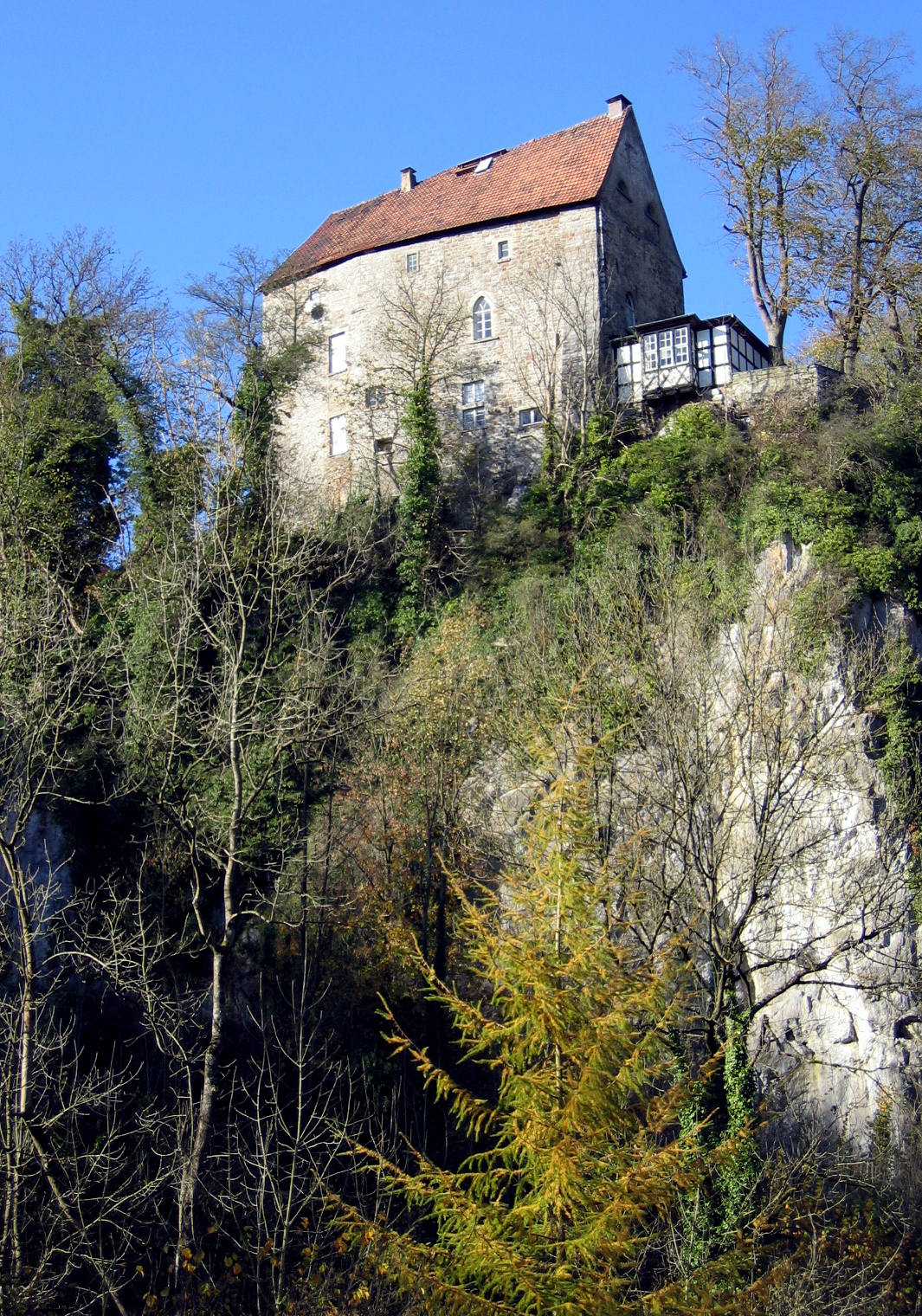
Haus Opherdicke
Haus Opherdicke stands as a remarkable example of a medieval moated castle transformed through centuries into a stately noble estate. Located in the municipality of Holzwickede, Germany, this historic estate traces its origins back to the 12th century, first documented in 1176 when ownership transferred to the Archbishop of Cologne. Originally constructed as a knight's water castle, its strategic position on a ridge of the Ardey Hills overlooking the Ruhr valley highlights its defensive and territorial significance within the medieval Holy Roman Empire.
Medieval origins and feudal ownership
The earliest records associate Haus Opherdicke with the noble ministerial family of Heinrich von Herreke, indicating its role within the feudal hierarchy. Over the following centuries, the estate passed through prominent noble lineages including the Edelherren von Grafschaft, the Herreke family, and later the Gruwel and Lappe families by marriage alliances. Around 1500, the von Fresendorf family acquired the estate, maintaining control through the early 18th century. The transition of ownership in 1719 to the von Hane zu Werve family continued the estate’s aristocratic legacy and regional influence.
Architectural transformation in the late 17th century
The most significant architectural evolution of Haus Opherdicke occurred between 1683 and 1687, when the original medieval water castle underwent extensive remodeling. This renovation redefined the castle's appearance and function, blending defensive features with the emerging early modern residential architecture. The redesign preserved the moat and water defenses characteristic of a Wasserschloss, while introducing more comfortable living quarters and stylistic elements that reflected contemporary tastes.
The estate's layout and auxiliary buildings
The remodeling also included the development of an enclosed courtyard surrounded by 18th and 19th-century farm and outbuildings. These structures served agricultural and operational purposes, reflecting the estate’s role as a working manor. The preservation of these ancillary buildings provides valuable insight into the economic and social functions of noble estates in the region during this period.
Landscape and gardens
The estate’s grounds feature a castle park designed in the style of an English garden, emphasizing naturalistic landscaping with winding paths and informal planting schemes. This garden is attributed to the renowned landscape architect Maximilian Friedrich Weyhe, whose work contributed significantly to the cultural heritage and aesthetic appeal of Haus Opherdicke. The park complements the architectural ensemble, creating a harmonious environment that blends nature and built heritage.
20th-century ownership and cultural reuse
Following centuries of noble ownership, the estate was sold in 1918 to Theodor Regenbogen, marking a shift from aristocratic to private hands. The manor had previously held privileges allowing participation in regional parliament until the dissolution of the Prussian monarchy in 1918, underscoring its political and administrative importance.
In 1980, the district of Unna acquired Haus Opherdicke, initiating comprehensive restoration efforts to preserve its historical integrity. A major restoration phase completed in 2011 enabled the estate’s adaptive reuse as a cultural venue. Today, it hosts exhibitions, musical events, and art collections such as the Frank Brabant gallery, enhancing its role as a center for cultural engagement.
The smithy and local history museum
Among the estate’s notable features is the former smithy building, originally a carriage shed converted in 1947. This smithy operated as a forge until 1990 and was later transformed into the Heimatstube local history museum in 2002. The museum displays tools from various trades and occasionally offers blacksmithing demonstrations, preserving traditional crafts and local heritage. Recent projects have included converting the old sheep barn into a space for art workshops, museum education, and storage, further expanding the estate’s cultural functions.
Architectural and historical significance
Haus Opherdicke exemplifies the evolution of a medieval moated castle into a noble estate balancing defensive architecture with residential comfort. Its location on the Ardey Hills ridge provided strategic oversight of the Ruhr valley, a vital area for trade and regional control. The late 17th-century remodeling reflects broader architectural trends transitioning from fortified castles to manor houses suited to aristocratic lifestyle and governance.
The preservation of the enclosed courtyard and surrounding agricultural buildings offers a rare glimpse into the operational aspects of a historic noble estate. The integration of a landscape park in the English garden style further enhances its cultural and aesthetic value, linking architecture with landscape design traditions of the 18th and 19th centuries.
Today, Haus Opherdicke stands as a well-preserved example of a hill castle with significant historical layers, from its medieval origins to its modern cultural role. Its restoration and adaptive reuse demonstrate successful heritage conservation, providing public access to an important site of regional history and architecture.
Frequently asked questions (FAQ)
- How do I visit Haus Opherdicke?
- Haus Opherdicke is open to visitors from Tuesday to Sunday, between 10:00 and 16:00. Tickets cost €5 for adults and €3 for children. It is advisable to check for any special events or closures before planning your visit.
- What is the historical significance of Haus Opherdicke?
- Haus Opherdicke is historically significant as a medieval moated castle that evolved into a noble estate. It reflects architectural and social changes from the 12th century through the early modern period, illustrating the region's feudal and aristocratic history.
- Can I see the smithy and local history museum at Haus Opherdicke?
- Yes, the former smithy building now functions as the Heimatstube local history museum. It features tools from various trades and occasionally hosts blacksmithing demonstrations, offering insight into traditional crafts and local heritage.
- Who designed the castle park at Haus Opherdicke?
- The castle park at Haus Opherdicke is attributed to Maximilian Friedrich Weyhe, a notable landscape architect known for his English garden designs. The park features naturalistic landscaping that complements the estate's historic architecture.
- Is Haus Opherdicke accessible for people with disabilities?
- While Haus Opherdicke strives to accommodate all visitors, some historic buildings and areas may have limited accessibility due to their age and preservation status. It is recommended to contact the site in advance for specific accessibility information.
Information
Opening hours
10:00-16:00, Tue-Sun
Ticket prices
€5 adult, €3 child
Current owner
District of Unna
Loading map...
Visitor reviews
No reviews yet. Been here? Write the first review and help other travelers!
Write the first reviewVisited this castle? Share your experience
Your review helps other travelers and adds first-hand knowledge to our encyclopedia.