
Hastings Castle
Hastings Castle stands as a significant Norman fortress perched on a dramatic sandstone cliff overlooking the English Channel in the town of Hastings, East Sussex, England. Established shortly after the pivotal Norman invasion of 1066, this castle played a crucial role in consolidating Norman control over the southeast coast of England. Its strategic location near the coast and proximity to the site of the Battle of Hastings mark it as a monument of great historical and military importance.
The castle's origins trace back to the immediate aftermath of William the Conqueror's landing at Pevensey Bay in September 1066. Recognizing the need for a strong defensive position, William quickly ordered the construction of a wooden motte-and-bailey castle on a pre-existing promontory fort on the cliff. This early fortress was rapidly assembled using timber, some of which was brought from Normandy, reflecting the urgency of securing the newly claimed territory. The castle served as a vital base during William's campaign, culminating in the decisive victory over King Harold Godwinson at the Battle of Hastings, fought approximately 10 kilometers north of the castle.
Transition from wood to stone fortification
Within a few years, around 1070, the wooden structure was replaced with a more durable stone castle under the direction of Robert, Count of Eu, who was granted the castle and the town of Hastings by William. This transition from wood to stone was typical of Norman military architecture, signaling a move towards permanent fortifications designed to assert long-term control. The stone castle was constructed using local sandstone, integrating the natural cliff formations into its defenses. Alongside the castle's fortifications, the collegiate church of St Mary was founded within the castle walls, serving both religious and administrative functions until its dissolution in the mid-16th century.
Medieval history and royal connections
Throughout the 12th and early 13th centuries, Hastings Castle remained an important royal stronghold. King William II, son of William the Conqueror, stayed at the castle in 1094, and significant building works were carried out during the reign of Henry II in the 12th century to strengthen its defenses. However, the castle's strategic importance fluctuated with the political climate. In 1216, King John ordered the castle to be partially dismantled to prevent it from falling into the hands of invading French forces during the First Barons' War. This act of slighting was a common medieval practice to deny enemy use of fortifications.
Shortly after, Henry III restored and refortified the castle as part of his efforts to reassert royal authority. In 1242, Henry III granted control of the castle and its lands to Peter of Savoy, the uncle of the queen, who managed the castle until his death in 1268. The castle briefly came under the control of the future King Edward I before reverting to Peter's heirs. This period saw the castle maintained as a symbol of royal power despite challenges.
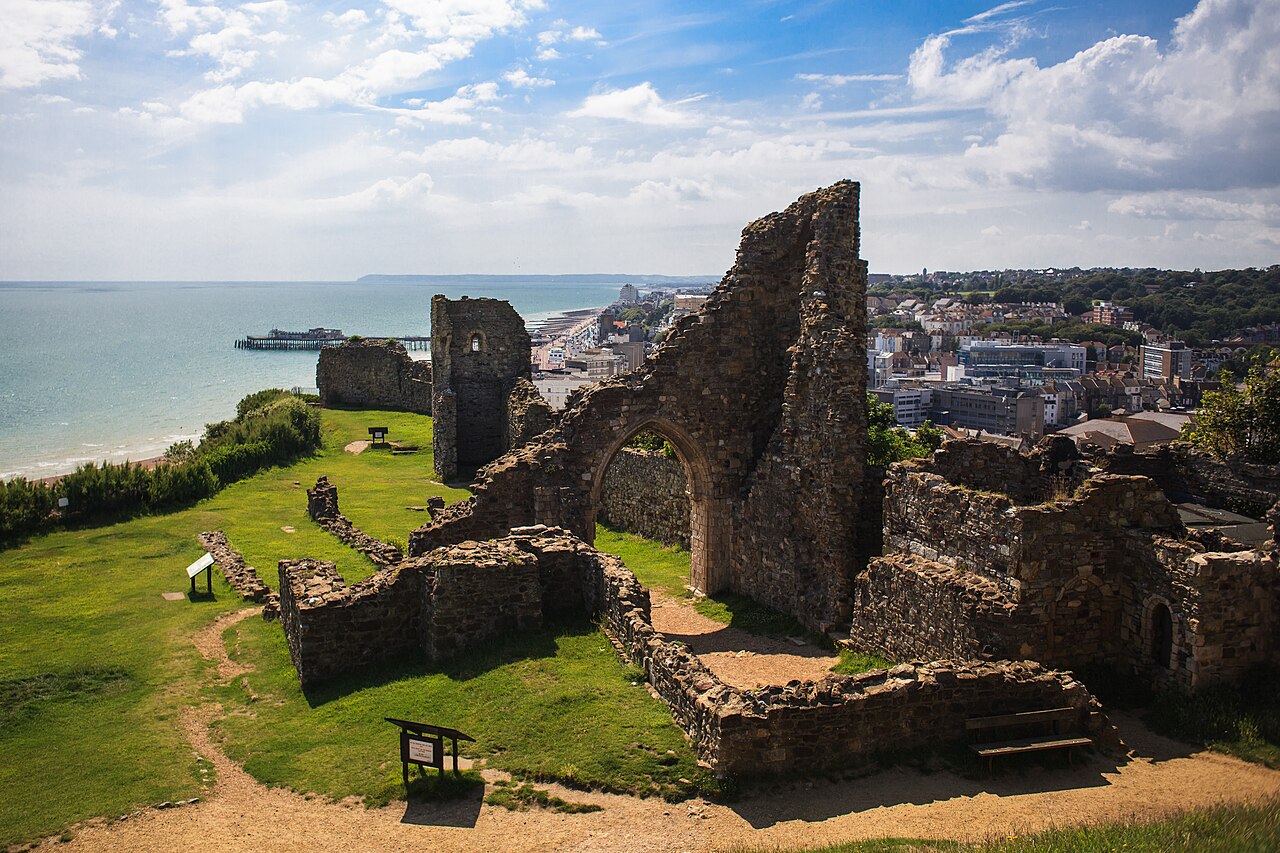
Photo by Kreepin Deth • CC BY-SA 3.0
Natural disasters and decline
The late 13th century brought significant challenges to Hastings Castle. In 1287, a series of violent storms battered the coastline, causing a portion of the sandstone cliff on which the castle was built to collapse into the sea. This event destroyed parts of the castle and devastated the town's harbor, which led to the loss of Hastings' importance as a military port. The castle's position on soft sandstone cliffs made it particularly vulnerable to erosion, and over subsequent centuries, much of the structure was lost to the encroaching sea.
During the 14th century, the town of Hastings declined economically, becoming primarily a fishing village. The castle fell into disrepair, and further erosion continued to reduce the surviving fabric of the fortress. Attacks by French forces in 1339 and 1377 inflicted additional damage on the town and its defenses, hastening the decline of Hastings Castle as a military asset.
Post-medieval period and rediscovery
Following the dissolution of the monasteries by Henry VIII in the 16th century, the collegiate church within the castle was closed, and the castle itself was largely abandoned. In 1591, the Pelham family purchased the ruins and surrounding land, converting the area for agricultural use. For centuries, the castle remained overgrown and largely forgotten.
The 19th century saw renewed interest in Hastings Castle, particularly during the Victorian era when antiquarian excavations were undertaken by Thomas Pelham, the 6th Earl of Chichester, in 1824. These excavations uncovered stone blocks from the chapel and other parts of the castle, leading to partial restorations, including the reassembly of the chapel's floor and chancel arch. The castle became a tourist attraction, celebrated for its picturesque ruins and dramatic coastal setting.
20th-century history and preservation efforts
During World War II, Hastings Castle's strategic cliff-top location was repurposed for military defense, with anti-aircraft guns installed nearby and the cliffs used for commando training. The site suffered additional damage from bombing raids during the war. After the war, in 1951, the Pelham family sold the castle site, and local authorities undertook efforts to consolidate the ruins and make the site accessible to the public.
Today, Hastings Castle is a Grade I listed building, recognized for its exceptional historical and architectural significance. Visitors can explore the remains of the stone motte-and-bailey castle, the surviving sections of the curtain walls, and the archaeological remnants of the Norman collegiate church. The castle's Norman rock-cut tunnels and storage chambers offer fascinating insights into medieval military architecture and daily life.
Architectural features and layout
The castle's layout exemplifies the Norman motte-and-bailey design, featuring a large earthen motte topped by stone defensive structures and an enclosed bailey surrounded by curtain walls. The use of local sandstone for construction integrated the castle into the natural cliff landscape but also made it susceptible to erosion. The surviving stonework includes parts of the curtain wall, gatehouse remains, and foundations of internal buildings.
The collegiate church of St Mary, built within the castle walls, was a significant religious and administrative center. Its partial remains, including the reconstructed floor and chancel arch, highlight the castle's dual role as a fortress and a place of worship. The castle also features rock-cut tunnels and storage chambers carved into the sandstone, which were essential for storing provisions and protecting supplies during sieges.
Visiting information and cultural significance
Hastings Castle is open to visitors from March to October, offering a unique opportunity to explore a Norman fortress with a rich history and spectacular coastal views. The site includes informative displays and guided tours that explain the castle's role in English history, its architectural evolution, and the impact of natural forces on its preservation.
The castle's dramatic cliff-top setting and evocative ruins have inspired artists and historians alike, making it an important cultural landmark in East Sussex. Its story reflects the broader narrative of Norman conquest, medieval warfare, and the changing fortunes of coastal communities in England.
Frequently asked questions (FAQ)
- How do I get to Hastings Castle?
- Hastings Castle is located on Castle Hill Road in Hastings, East Sussex. It is accessible by car, bus, or on foot from the town center, with clear signposting to the site.
- What are the opening hours for Hastings Castle?
- The castle is open to visitors from March to October, typically during daylight hours. It is advisable to check the official website or local tourist information for exact times before visiting.
- Is there an admission fee to visit Hastings Castle?
- Yes, there is a small admission fee to enter Hastings Castle, which helps support its maintenance and preservation. Discounts may be available for children, seniors, and groups.
- What remains can I see at Hastings Castle?
- Visitors can explore the ruins of the stone motte-and-bailey castle, including parts of the curtain walls, the motte itself, and the remains of the collegiate church of St Mary. The Norman rock-cut tunnels and storage chambers are also accessible.
- Why is Hastings Castle historically important?
- Hastings Castle was a key Norman fortress established shortly after the 1066 invasion. It played a strategic role in securing the southeast coast and is closely linked to the Battle of Hastings and the Norman conquest of England.
- Can I visit the Norman rock-cut tunnels at Hastings Castle?
- Yes, the rock-cut tunnels and storage chambers carved into the sandstone cliff are part of the visitor experience, offering insight into medieval castle logistics and defense.
- What caused the decline of Hastings Castle?
- The castle's decline was largely due to coastal erosion from storms, particularly in 1287, which caused part of the sandstone cliff and castle to collapse into the sea. Combined with military conflicts and economic decline, this led to its ruin.
Photo gallery

Information
Loading map...
Visitor reviews
No reviews yet. Be the first to share your experience!