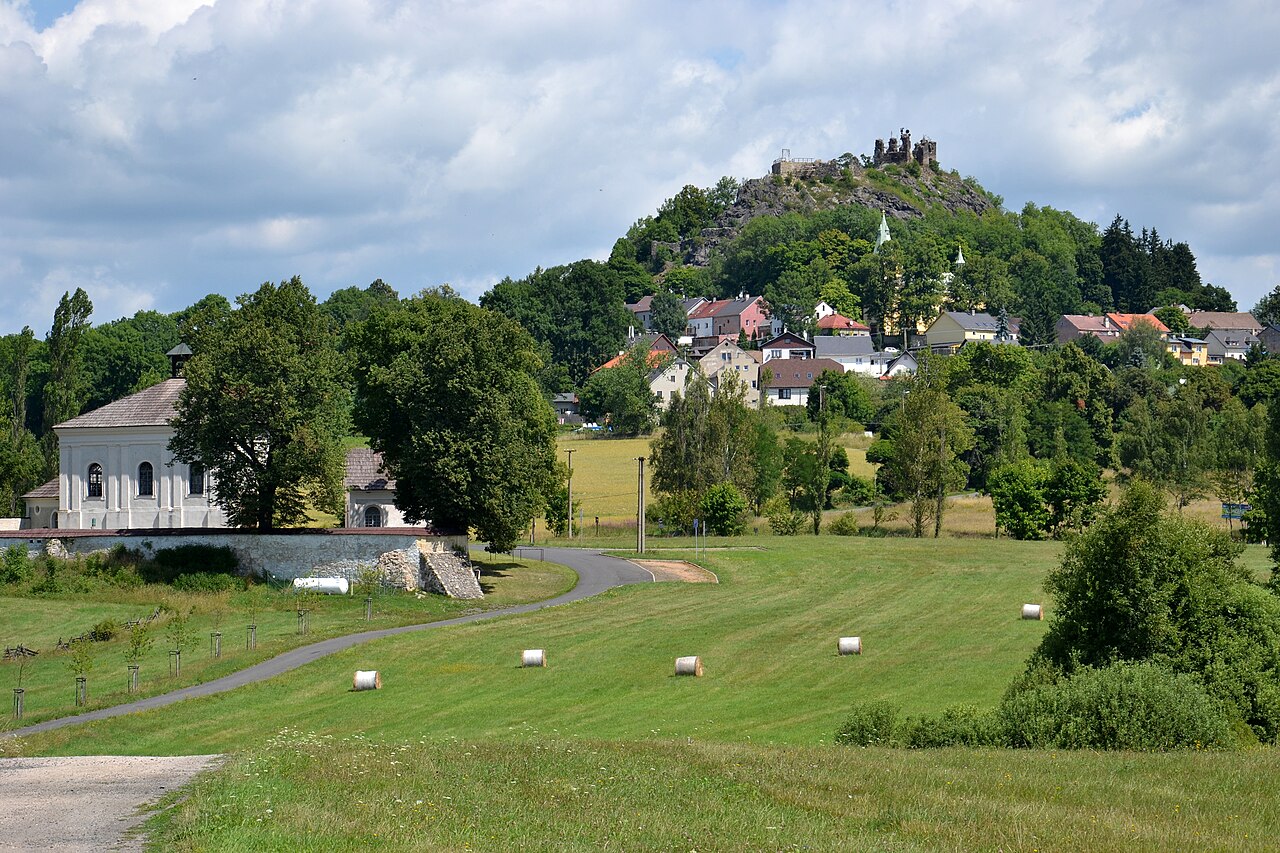
Hartenstein Castle
Hartenstein Castle, also known as Hartenštejn, is a remarkable example of a late Gothic hill castle located near the town of Bochov in the Czech Republic. Built in the 15th century, this castle stands on a solitary hill approximately 730 meters above sea level, commanding a strategic vantage point over the surrounding landscape. Its ruins today bear witness to a turbulent history shaped by noble families, military innovation, and regional power struggles during the late medieval period.
The castle was constructed before 1473, with its first documented mention dating from that year. It was established as a replacement fortress following the destruction of the nearby Hungerberg Castle in 1469. This new stronghold was commissioned around 1471 by Heinrich II of Plauen, a nobleman who had been granted the County of Hartenstein by King Sigismund in 1426. Originally named Neuhartenstein, the castle's name evolved over time to Hartenstein and eventually to the Czech form, Hartenštejn.
Historical significance and noble lineage
Hartenstein Castle played a critical role as a military and administrative center for the Plauen family during the late medieval era. Its early occupants included Heinrich III of Plauen, a prominent noble who governed the castle until his death in 1519. His son, Heinrich IV, believed to have been born at Hartenstein in 1510, continued the family's legacy into the early 16th century.
The castle's ownership passed through various noble hands due to inheritance, marriage, and political alliances. After Heinrich III's death, the estate became subject to complex guardianship and claim disputes within the lineage. By the mid-16th century, the castle had come under the possession of Johann the Younger of Kolovrat through marriage to Barbara, Heinrich III's widow. Later, in 1567, ownership transferred to Heinrich Niklas of Lobkowicz, reflecting the shifting power dynamics among the Bohemian nobility.
Despite its initial importance, Hartenstein Castle began to decline in the late 16th century. By 1573, it was described as deserted, signaling the end of its active military and residential use. Although restoration attempts were made in the late 1500s and early 1600s, the castle was fully abandoned by 1609. Subsequently, it became part of the estate of Andělská Hora, with nearby fortresses like Herstošice administered within this domain until the mid-16th century.
Architectural features and fortifications
The castle's design reflects the late Gothic architectural style adapted for military defense. It occupies an approximately square plan atop the hill, with robust stone masonry forming its curtain walls. The elevated position provided a commanding view and natural defense against attackers.
Defensive structures included three semi-circular battery towers projecting from the curtain walls on three sides, enabling defenders to deliver flanking fire. A large polygonal bastion on the western side offered substantial protection, complemented by a smaller semi-circular bastion near the main entrance gate on the same side. These bastions were innovative for their time, designed to accommodate artillery and small arms fire while shielding defenders.
Within the castle grounds, a small palace occupied the southwestern corner, serving as the residential quarters for the ruling family. Other buildings once surrounded the courtyard, although these have not survived. Archaeological excavations in the 1930s revealed a deep well on the northeastern side of the courtyard, reaching 34 meters underground, which was vital for sustaining the castle during sieges.
Additional fortifications included two towers situated on the northern and southern sides of the castle, enhancing its defensive perimeter. Near the southern bastion, a vaulted building with a cellar was discovered, likely used for storage or as a secure refuge. Despite centuries of decay, significant portions of the walls, bastions, and towers remain visible today, with 20th-century conservation efforts stabilizing and partially restoring these structures.
Conservation and visitor experience
Recognized for its cultural and historical importance, Hartenstein Castle was designated a cultural monument in 1964. Since then, conservation work has focused on preserving the remaining defensive structures and preventing further deterioration. Visitors today can explore the ruins via a marked path approximately 1 kilometer long from Bochov, providing access to the castle's silhouette against the hilltop.
The site offers a compelling glimpse into late medieval fortification techniques and the lifestyle of Bohemian nobility. While much of the castle lies in ruins, the surviving bastions and towers illustrate the strategic military architecture of the 15th century. The castle's elevated position and well-planned defenses reflect the evolving nature of warfare during the late Gothic period, particularly the integration of artillery into castle design.
Legacy and historical context
Hartenstein Castle stands as a testament to the regional history of western Bohemia during a time of significant political and military change. Its construction following the destruction of Hungerberg Castle symbolizes the resilience and adaptability of noble families such as the Plauens. The castle's eventual decline and abandonment mirror broader shifts in military technology and aristocratic residence patterns in the early modern period.
Today, the ruins of Hartenstein Castle continue to attract historians, architects, and tourists interested in medieval fortifications and Czech heritage. Its preserved elements provide valuable insights into late Gothic castle architecture and the socio-political landscape of 15th and 16th century Bohemia.
Frequently asked questions (FAQ)
- What is the historical significance of Hartenstein Castle?
- Hartenstein Castle, dating back to the 14th century, is a remarkable example of Gothic architecture in the region. It played a crucial role in the defense strategies of the area and has witnessed various historical events that shaped Czechia's history.
- When was Hartenstein Castle built?
- Hartenstein Castle was constructed in the 14th century, with its first historical mention occurring in the year 1350. Over the centuries, it has undergone several renovations, preserving its historical essence while adapting to modern times.
- What are the opening hours for Hartenstein Castle?
- Hartenstein Castle is open to visitors from April to October, typically from 10 AM to 6 PM. During the off-season, it is advisable to check the official website for specific opening hours as they may vary.
- Can I take guided tours of Hartenstein Castle?
- Yes, guided tours are available and provide an insightful exploration of the castle's history, architecture, and surrounding landscape. Tours are conducted in multiple languages, making the experience accessible to a wider audience.
- How do I get to Hartenstein Castle?
- Hartenstein Castle is easily accessible by car and public transportation, with ample parking available nearby. For those traveling by train, the closest station is in Bochov, followed by a short taxi ride or a pleasant walk to the castle.
- Is Hartenstein Castle accessible for visitors with disabilities?
- The castle has made efforts to enhance accessibility for all visitors, including wheelchair access to certain areas. However, due to its historical nature, some parts may still pose challenges, so it’s best to check in advance for specific accessibility options.
- What is the best time to visit Hartenstein Castle?
- The best time to visit Hartenstein Castle is during the spring and summer months when the weather is pleasant and the surrounding gardens are in full bloom. Additionally, special events and festivals are often held in these seasons, enhancing the visitor experience.
- What are the ticket prices for Hartenstein Castle?
- Ticket prices for Hartenstein Castle are generally affordable, with discounts available for students and seniors. Children under a certain age may enter for free, making it a great destination for families.
- Are there any nearby attractions to visit after Hartenstein Castle?
- Yes, after visiting Hartenstein Castle, you can explore the charming town of Bochov, known for its picturesque landscapes and local culture. Additionally, several hiking trails and nature reserves are nearby, offering beautiful views and outdoor activities.
Information
Website
Visit websiteSources & official resources
Verify the information above using these authoritative references.
Loading map...
Visitor reviews
No reviews yet. Been here? Write the first review and help other travelers!
Write the first reviewVisited this castle? Share your experience
Your review helps other travelers and adds first-hand knowledge to our encyclopedia.