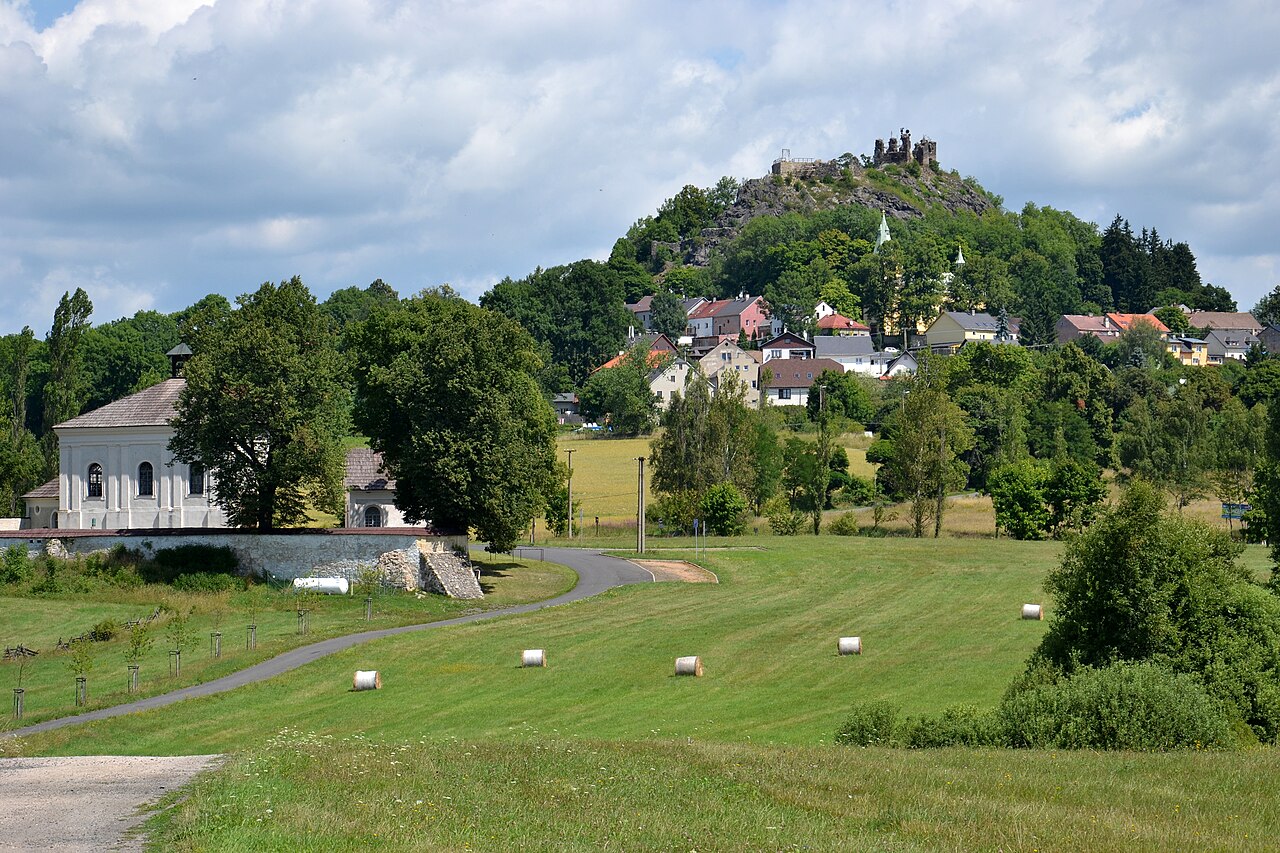
Touzim Castle
Toužim Castle, located in the town of Toužim in the Czech Republic, is a historic hill castle with origins dating back to the late medieval period. The castle complex reflects a layered history, evolving from a 15th-century fortified religious site to a multi-purpose chateau with significant Baroque modifications and later industrial adaptations.
The earliest known mention of Toužim dates to 1354, when the site was home to a Premonstratensian provostry connected to the Milevsko monastery. This religious estate played a notable role in the region's ecclesiastical landscape until the early 15th century. In 1394, the provostry was attacked and looted, and during the turbulent Hussite Wars in 1420, it served as a refuge for monks fleeing conflict.
Medieval origins and early fortifications
Around 1436 or 1437, Emperor Sigismund of Luxembourg granted the provostry as a fief to Jakoubek of Vřesovice, who transformed the religious site into a fortified castle. This original stronghold, known today as Jan's Castle or the upper chateau, was constructed on the foundations of the former monastic estate. The castle played a defensive role during the mid-15th century conflicts, notably resisting a siege during the reign of King George of Poděbrady when it was held by Jan of Vřesovice against the Zelená Hora union.
In 1469, following the destruction of the nearby settlement of Útvina, refugees settled below the castle, founding the fortified town of Toužim. This marked the beginning of the town's development closely tied to the castle's presence.
Ownership changes and architectural evolution
Throughout the late 15th and 16th centuries, the castle and town changed ownership multiple times. In 1490, the estate passed to Jindřich IV of Plavno, whose family expanded the town's rights and abolished feudal obligations, fostering local autonomy. Financial difficulties led to the property's transfer in 1563 to Jindřich Mikuláš Hasištejnský of Lobkowicz.
The 17th century brought significant architectural changes. After acquisition by Julius Heinrich of Saxony-Lauenburg in 1623, the castle underwent extensive Baroque modifications, reflecting the period's stylistic preferences. From 1689 to 1787, the Margraves of Baden owned the estate and added two smaller buildings, further expanding the complex.
Later ownership included the royal chamber, the Schwarzenberg family, and from 1837, the Beaufort-Spontin family, who maintained the estate primarily for agricultural use rather than noble residence.
Structural features and remaining architecture
The Toužim castle complex consists of two main parts: the upper castle (Jan's Castle) and the lower chateau. The upper castle, built in the mid-15th century, survives mainly in its basement levels as a three-room structure with a fragment of a polygonal tower. This section retains elements of its medieval defensive function.
Surrounding the original castle are remnants of the defensive enceinte and a parkán wall with two bastions, which served as outer fortifications. These defensive walls illustrate the castle's military significance during periods of siege and unrest.
The lower chateau, dating largely from late 15th and early 16th century reconstructions, is a three-winged, single-story building. Its eastern wing features a facade decorated with pilaster strips and a richly adorned main portal. The courtyard side includes a series of ground-floor arcades, providing sheltered walkways and aesthetic appeal.
Within the courtyard of the lower chateau, a brewery was established, indicating the site's adaptation to local industry and economic activities. Although altered, the brewery remains a notable feature of the complex.
Historically, the chateau contained Renaissance painted coffered ceilings, which were decorative wooden ceiling panels with painted designs. Unfortunately, these artworks were lost due to vandalism and theft in recent decades, representing a significant cultural loss.
Modern history and preservation efforts
During the 19th and early 20th centuries, the castle complex underwent various changes including the lowering of building heights and removal of Baroque gables. Part of the lower chateau was converted into apartments, while the courtyard housed the brewery.
After World War II, the upper castle remained largely unused, and the lower chateau served as a cultural center. Toward the late 20th century, the town acquired the property and transferred it to private ownership with plans for a conference and cultural center, but no restoration was completed.
In 2002, the castle passed to a Russian company, during which time the complex suffered significant neglect. Theft of roofing materials and Renaissance-era ceiling decorations, as well as a damaging fire, further deteriorated the buildings. Following bankruptcy and legal disputes, the town regained control in 2009.
Restoration efforts began in the late 2010s focusing on the brewery and upper castle. However, newer sections remain partially roofed and continue to deteriorate. The entire complex is currently recognized as an endangered immovable monument, highlighting the need for ongoing preservation.
Cultural and historical significance
Toužim Castle stands as a testament to the region's complex history, reflecting transitions from religious to military, residential, and industrial uses over several centuries. Its surviving architectural elements provide valuable insights into late medieval fortifications, Baroque architectural trends, and the economic history of the area.
The castle's association with notable figures such as Jakoubek of Vřesovice, King George of Poděbrady, and the various noble families who owned the estate contributes to its historical importance. Despite challenges posed by neglect and damage, Toužim Castle remains a significant cultural landmark within the Czech Republic.
Frequently asked questions (FAQ)
- How do I visit Toužim Castle?
- Toužim Castle is located in the town of Toužim in the Karlovy Vary Region of the Czech Republic. Visitors should check local tourism websites or contact the town's cultural office for current access and tour availability, as the castle is partially preserved and undergoing restoration.
- What is the historical significance of Toužim Castle?
- Toužim Castle originated as a medieval religious site and was transformed into a fortified castle during the Hussite Wars. It played a defensive role during 15th-century conflicts and later evolved into a chateau with Baroque modifications, reflecting the region's complex history.
- Can I see the brewery within the castle complex?
- Yes, the brewery is located within the courtyard of the lower chateau and remains a notable part of the complex. Though altered over time, it reflects the castle's adaptation to local industry and economic functions.
- When was Toužim Castle built?
- The castle was constructed in 1469 on the foundations of a former Premonstratensian provostry, transforming the religious site into a fortified stronghold.
- Is Toužim Castle accessible for people with disabilities?
- Due to the castle's historical structure and ongoing restoration, accessibility may be limited. Visitors with mobility concerns should inquire in advance about available accommodations and access routes.
Information
Website
Visit websiteSources & official resources
Verify the information above using these authoritative references.
Loading map...
Visitor reviews
No reviews yet. Been here? Write the first review and help other travelers!
Write the first reviewVisited this castle? Share your experience
Your review helps other travelers and adds first-hand knowledge to our encyclopedia.