
Hartenberg Castle
Hartenberg castle stands as a remarkable example of a high medieval hill castle in the Czech Republic, with origins tracing back to the early 13th century. Built by the lords of Hartenberg, this fortress was strategically positioned above the village of Hřebeny in the municipality of Josefov to guard a vital trade route connecting Saxony, Thuringia, and Bohemia. Its location on a rocky promontory overlooking the Svatava River provided natural defenses and commanding views of the surrounding landscape.
The earliest documented mention of Hartenberg dates to 1214, with more certain records from 1345. Initially controlled by the founding Hartenberg family until 1362, the castle changed hands multiple times, including ownership by Těma of Koldice and Emperor Charles IV. Throughout the 15th and 16th centuries, the castle was held by the Šlik family, who contributed to its restoration and regional economic development through lead mining. Later, the Písnicové family maintained possession for over 150 years, weathering the challenges of the Thirty Years’ War and a devastating fire in 1668.
In the late 18th century, the Auersperg family inherited the estate and transformed the medieval fortress into a more refined chateau, incorporating Baroque and Empire style elements. This period marked the castle’s evolution from a military stronghold to a cultural and intellectual center, attracting notable figures such as Johann Wolfgang von Goethe, who celebrated his seventy-second birthday here in 1821.
Architectural evolution and features
Early construction and romaneseque origins
The initial construction phase of Hartenberg castle in the early 13th century featured typical Romanesque architectural elements. The earliest structures included a two-story stone building with two rooms, setting a sturdy foundation for later expansions. These Romanesque remnants are still visible in the castle’s oldest walls and vaulted cellars, uncovered during archaeological excavations from 2007 to 2010.
Gothic transformation and fortifications
The 14th century brought significant Gothic reconstruction, reshaping the castle into a formidable palace complex. A massive rectangular tower, incorporating a natural rock monolith, became the centerpiece. This tower featured an elevated entrance for enhanced defense and a portal reflecting the stylistic transition from late Gothic to early Renaissance around the late 14th to early 15th century. The palace was unified into a single large building with vaulted cellars accessible through a semicircular portal.
Defensive enhancements in the 15th century included the addition of outer walls and bastions, reinforcing the castle’s perimeter. The interior houses the chapel of the Three Kings, situated on the second floor of the palace. Originally vaulted with ribbed cross vaults, it was later remodeled with six-field cross vaulting supported by two central pillars, showcasing late Gothic and early Renaissance influences. The chapel's portal bears the date 1608, marking one of its later modifications.
Notable interior features and artworks
The chapel contains a richly decorated main altar with columns, statues of saints, and a large painting depicting the Three Kings. Among its treasures is a polychrome wooden statue known as the Black Madonna, approximately 110 centimeters tall and stylistically dated to circa 1420–1430. This rare medieval statue survived the 1668 fire and remains one of the few Black Madonnas in the Czech Republic, underscoring the castle’s cultural significance.
Baroque and empire style renovations
Following the fire of 1668, extensive Baroque renovations spanned over two decades, culminating in 1688. These included structural repairs and aesthetic enhancements that softened the medieval fortress’s austere character. In the 19th century, the Auersperg family introduced Empire style features, demolishing parts of the original gatehouse, outer walls, and bastions. The defensive moat was filled in, and a one-story administrative building was constructed, reflecting the castle’s transition to a residential and cultural estate. The former knight’s hall was converted into living quarters with heraldic ceiling paintings, further emphasizing its refined domestic use.
Historical significance and ownership timeline
The castle’s history is marked by a succession of notable owners and turbulent events. After its founding by the lords of Hartenberg, the castle was transferred to Těma of Koldice in 1362 and subsequently became part of Emperor Charles IV’s royal holdings in 1364. The 15th century saw the castle besieged and plundered due to its association with Jan Malerik’s descendants, who used it as a base for robbery, leading to military action by the town of Cheb in 1459.
The Šlik family’s tenure brought restoration and economic development through lead mining, enhancing the castle’s regional importance. The Písnicové family’s long ownership period included hardship during the Thirty Years’ War, with sieges and plundering that inflicted significant damage. The 1668 fire was a major setback, but the subsequent Baroque renovations revitalized the site.
The Auersperg family’s acquisition in the late 18th century marked the castle’s cultural zenith, hosting intellectuals and artists. The visit of Johann Wolfgang von Goethe is a highlight, symbolizing the castle’s role beyond military functions.
After World War II, the castle was seized by the Czechoslovak state and repurposed for military and forestry storage. Unfortunately, from 1984 to 1991, the castle suffered multiple deliberate fires, reducing it to ruins. Since 1997, private owner Bedřich Loos has spearheaded restoration efforts, supported by an international volunteer program known as the Hartenberg Workshop, which has become Europe’s largest castle conservation volunteer initiative.
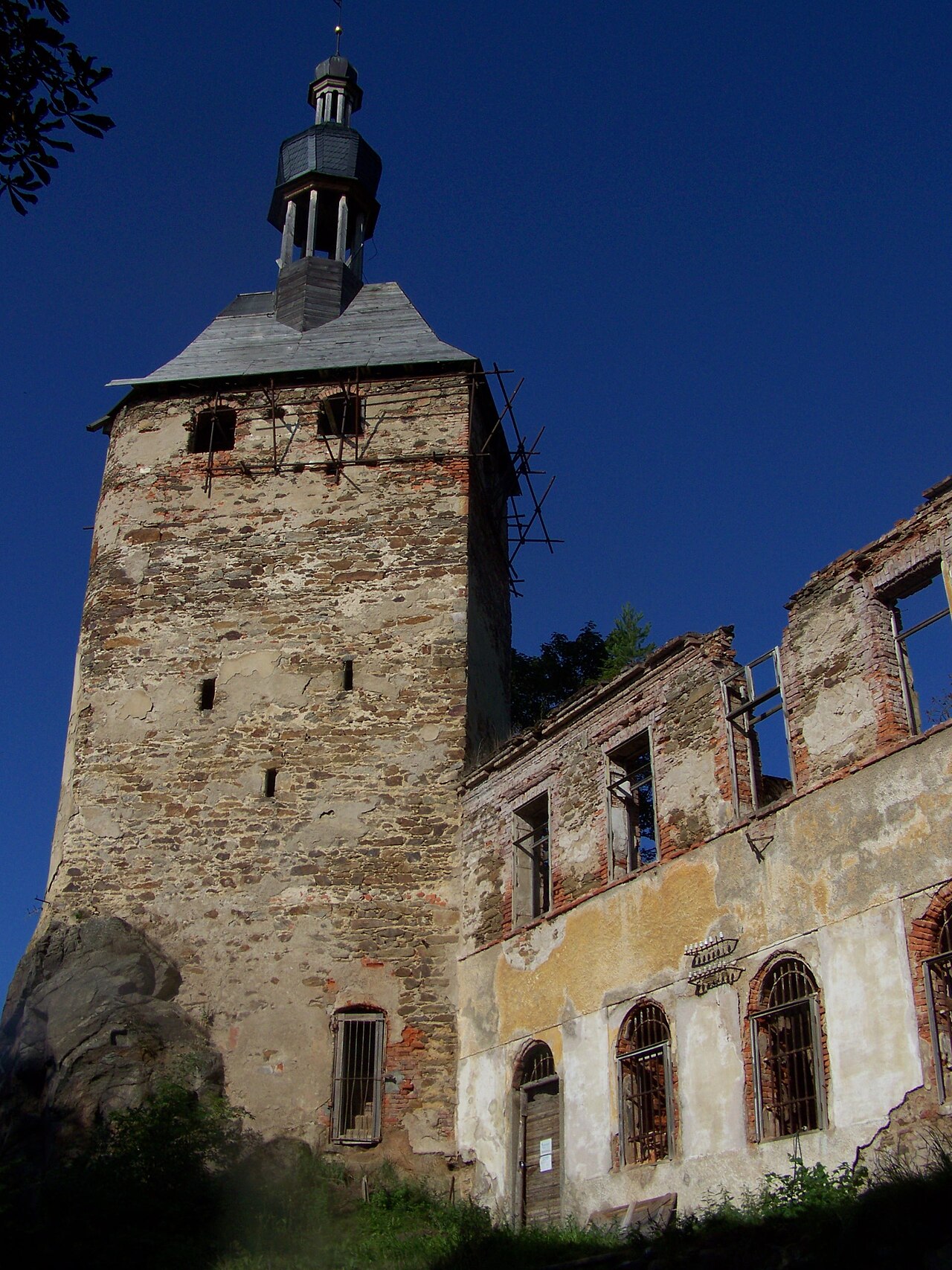
Photo by Zipacna1 • CC BY 3.0
Current condition and restoration efforts
Today, Hartenberg castle is classified as partially restored, with significant portions of the main palace, chapel, and Gothic cellars reconstructed. The restoration focuses on preserving the castle’s historical fabric while making it accessible to visitors and volunteers. The Hartenberg Workshop has attracted over a thousand volunteers worldwide, contributing to the stabilization and rebuilding of key architectural elements.
Excavations have revealed the castle’s layered history, from Romanesque foundations to Gothic expansions and Baroque modifications. The ongoing work includes structural repairs, archaeological research, and conservation of artworks such as the Black Madonna statue. Recognition of these efforts came in 2016 with the Patrimonium pro futuro award, underscoring the castle’s cultural and historical value.
Visitor information and cultural heritage
While restoration continues, Hartenberg castle serves as a cultural landmark and educational site. The castle’s dramatic ruins and restored sections offer insights into medieval fortification, architectural evolution, and regional history. The volunteer program provides a unique opportunity for heritage enthusiasts to engage directly with conservation work.
Visitors can explore the castle’s remains, including the Gothic palace, chapel, and Romanesque cellars, gaining an understanding of the site’s strategic importance and artistic heritage. The castle’s setting in the scenic Czech countryside adds to its appeal as a destination for history lovers and cultural tourists.
Future plans aim to enhance visitor facilities and interpretive programs, ensuring that Hartenberg castle remains a vibrant part of Czechia’s historical landscape.
Frequently asked questions (FAQ)
- When was Hartenberg castle originally built?
- Hartenberg castle was originally built in the early 13th century, with the first documented mention dating to 1214.
- What architectural styles are visible at Hartenberg castle?
- The castle features a blend of Romanesque, Gothic, Baroque, and Empire style architectural elements due to various construction phases and renovations.
- Is Hartenberg castle open to visitors and volunteers?
- Yes, the castle is accessible to visitors and hosts the Hartenberg Workshop, Europe's largest volunteer program for castle restoration.
- What significant artworks are housed in the castle chapel?
- The chapel contains a richly decorated altar and a rare polychrome wooden Black Madonna statue dating from the early 15th century.
- How did the castle survive the 20th-century damages?
- After suffering multiple arson attacks in the 1980s, the castle was left in ruins but has been under restoration since 1997 by a private owner with international volunteer support.
Photo gallery

Information
Sources & official resources
Verify the information above using these authoritative references.
Loading map...
Visitor reviews
No reviews yet. Been here? Write the first review and help other travelers!
Write the first reviewVisited this castle? Share your experience
Your review helps other travelers and adds first-hand knowledge to our encyclopedia.