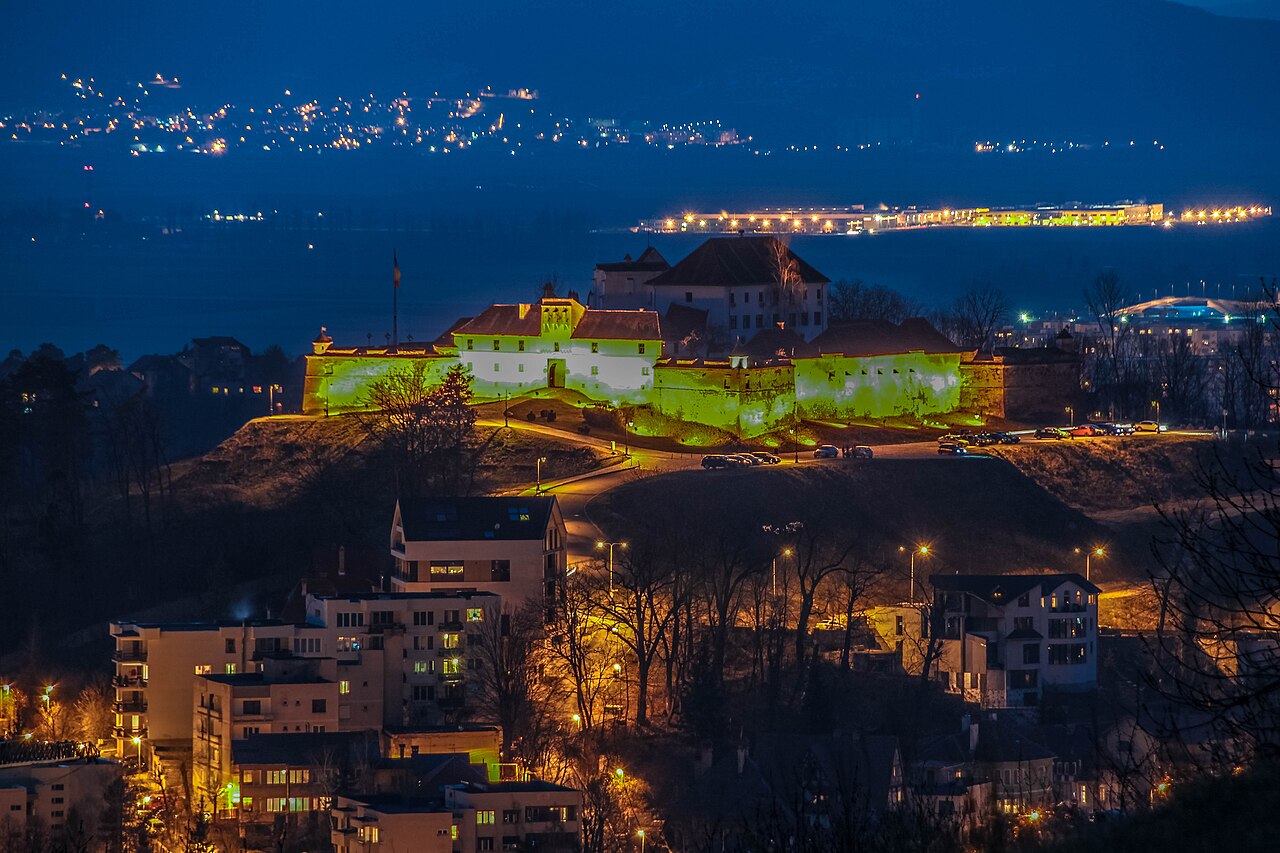
Hărman
The Hărman fortified church, located in the village of Hărman in Romania, stands as a remarkable example of a Renaissance bastioned fortress integrated with a religious structure. Its origins date back to the early 13th century, with the first recorded mention in 1240 when the settlement was granted to the Cistercian order. The Cistercians are credited with constructing the original Romanesque three-nave basilica dedicated to Saint Nicholas, featuring two barrel-vaulted chapels which exemplify early medieval ecclesiastical architecture.
Medieval architectural evolution and fortification
Throughout the centuries, the church underwent significant architectural transformations reflecting the changing needs and styles of the region. In the 14th century, a tower was added to the church, marking the beginning of its fortification. The 15th-century Gothic renovation introduced elevated vaulting, new windows, and the heightening of the tower to approximately 32 meters. The northern chapel was converted into a sacristy during this period, enhancing the church's functional spaces.
The devastating fire of 1595 led to the replacement of the nave's ceiling with a vaulted roof, a typical feature of fortified churches designed to improve structural resilience. Following the Reformation, the church was taken over by Protestants, reflecting the religious shifts in Transylvania during the early modern period.
Strategic fortifications and bastioned defenses
Hărman’s fortifications are a testament to the turbulent history of Transylvania, especially during the period of frequent invasions and conflicts. After the region suffered depopulation due to raids, Hungarian kings resettled the area with Saxon settlers from Germany. These settlers fortified the church extensively, transforming it into a formidable bastioned fortress.
The fortress was surrounded by three concentric defensive walls and a water-filled moat. The innermost wall was approximately 4 meters thick and nearly 12 meters high, enclosing a perimeter of about 230 meters. Its thickness allowed for a concealed gallery for guards at the top, equipped with numerous arrow slits for defense. Seven towers punctuated the walls, with the most prominent being the gate tower, which controlled access through a drawbridge and a vaulted gate passage.
The second wall, lower at 4.5 meters, was positioned along the edge of the moat, while the third outer wall, now lost, once enclosed the moat’s external boundary. The fortress’s water supply was secured by a well inside the walls, vital for withstanding sieges.
Refuge cells and residential adaptations
Inside the walls, approximately 200 small refuge cells were built into the thickness of the inner wall. These cells, arranged on multiple levels and accessible by wooden galleries and stairs, served as shelters for the local population during attacks. In times of peace, these spaces functioned as storage rooms, demonstrating the dual military and civilian use of the fortress.
The church itself was augmented with two-story annexes attached to its walls, which served as living quarters, further illustrating the integration of residential and defensive architecture.
Historical significance and military engagements
Hărman’s fortified church played a crucial role in regional defense and witnessed multiple sieges. Notably, in 1612, the fortress withstood a two-week siege by Gabriel Báthory, the prince of Transylvania, who commanded 7,000 soldiers but failed to capture it. This event underscores the fortress’s strategic importance and robust construction.
In 1794, the church tower was topped with a Baroque helmet, reflecting stylistic updates beyond its military function. By the 19th century, the fortress lost its military relevance. In 1815, the gatehouse was remodeled, the moat was filled, and the drawbridge replaced by a covered passage. The complex was repurposed mainly as a grain storage facility, which contributed to its preservation.
Cultural heritage and preservation
Today, the fortified church of Hărman is among the best-preserved examples of its kind in Transylvania. It was inscribed in 1999 on the UNESCO World Heritage List alongside six other fortified churches built by the Transylvanian Saxons during the Middle Ages. This designation highlights its outstanding cultural and architectural significance.
The church retains valuable historical features such as pre-Reformation frescoes, a Gothic choir, and a Baroque altar. A unique element is the organ donated by Swedish troops who were stationed in the area during 1710-1711 while supporting the Hungarian uprising led by Francis II Rákóczi.
Visitors to the site can explore the well-preserved inner defensive wall, the towers, and the residential and storage rooms surrounding the courtyard. The defensive gallery encircling the walls and a chapel located within one of the towers are accessible, providing insight into the fortress’s military and religious functions.
Frequently asked questions (FAQ)
- When was the Hărman fortified church originally built?
- The original Romanesque church was constructed by the Cistercian order in the early 13th century, with the first mention of Hărman dating to 1240.
- What architectural styles are visible in the Hărman fortified church?
- The church exhibits Romanesque origins, Gothic modifications in the 14th and 15th centuries, and Renaissance fortifications from the late 16th century.
- Can visitors explore the defensive walls and towers?
- Yes, visitors can walk along the well-preserved inner defensive wall, visit the towers, and explore the residential and storage rooms around the courtyard.
- What is the significance of the organ inside the church?
- The organ was donated by Swedish troops stationed in the area during 1710-1711, supporting the Hungarian uprising, and it remains a unique historical artifact within the church.
- Is the Hărman fortified church accessible year-round?
- The church is open daily from 09:00 to 17:00, allowing year-round access for visitors interested in its historical and architectural heritage.
Information
Opening hours
09:00-17:00, daily
Ticket prices
€3 adult, €1.5 child
Current owner
Municipality
Loading map...
Visitor reviews
No reviews yet. Been here? Write the first review and help other travelers!
Write the first reviewVisited this castle? Share your experience
Your review helps other travelers and adds first-hand knowledge to our encyclopedia.