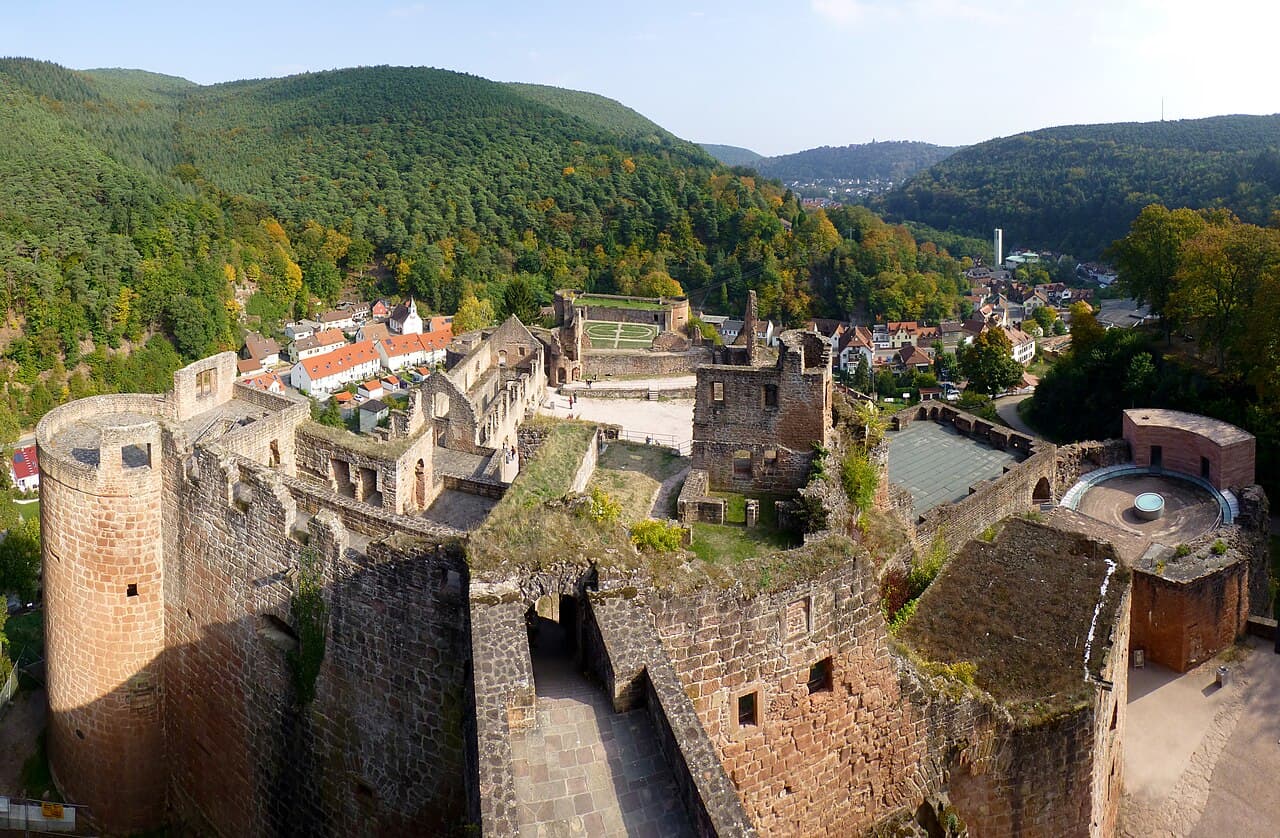
Hardenburg Castle
Hardenburg Castle stands on the eastern edge of the Palatinate Forest, near the town of Bad Dürkheim in Rhineland-Palatinate, Germany. Despite its current state as a ruin, it remains one of the most imposing and historically significant castles in the Palatinate region. The castle’s origins date back to the early 13th century, when it was initially constructed by the Counts of Leiningen as a modest hilltop fortress. Over the centuries, Hardenburg evolved from a defensive stronghold into an expansive Renaissance residence, reflecting the changing needs and tastes of its noble owners.
Early construction and medieval origins
The castle was originally built in the high medieval period, strategically positioned on a hill to oversee the surrounding landscape and control important trade routes in the region. Its initial design was typical of hill castles of the time, focused on defense with thick walls, towers, and a compact layout. The Counts of Leiningen established Hardenburg as their seat, and it served as a military and administrative center during the Middle Ages.
Renaissance transformation and architectural features
In the 16th century, Hardenburg underwent significant expansion and transformation into a fortified Renaissance palace. This period saw the addition of spacious residential wings, elegant halls, and ornamental gardens that contrasted with the castle’s original fortress-like character. The castle’s architecture from this era includes bulwarks, turrets, and catacombs that highlight its dual role as a defensive structure and noble residence.
The Renaissance modifications introduced more comfort and style, reflecting the increased importance of residential and ceremonial functions alongside military ones. The castle’s layout expanded to include large halls for gatherings, private chambers for the family, and service areas. The gardens and open courtyards added aesthetic value and leisure space, a departure from the purely utilitarian medieval fortress.
Historical events and decline
Hardenburg Castle survived the Thirty Years' War relatively intact, which was a rare feat given the widespread destruction of castles in the region during that conflict. However, its fortunes changed during the Palatinate War of Succession in 1690 when French forces occupied the castle and caused significant damage. After this, the Leiningen family undertook rebuilding efforts to restore the castle’s defensive and residential functions.
The final blow came in 1794 with the arrival of French revolutionary troops. The castle’s interior furnishings were destroyed, and the prominent Westbollwerk—a massive bastion that dominated the complex—was blown up. Following this, the site was largely abandoned and used as a source of building materials, accelerating its decline into ruin.
Preservation and current status
Despite its ruined condition, Hardenburg remains a remarkable historical monument. Since the late 19th century, efforts have been made to secure and partially restore the remaining structures. Visitors can explore the extensive ruins, including the surviving walls, towers, and foundations that convey the castle’s former scale and complexity.
The castle grounds include a visitor center with an exhibition that provides detailed insights into Hardenburg’s history. Modern multimedia guides and computer reconstructions allow visitors to visualize the castle as it appeared during its Renaissance heyday, showcasing the layout of rooms, halls, and gardens. This blend of archaeological remains and interpretive technology makes Hardenburg a compelling destination for those interested in medieval and Renaissance architecture as well as regional history.
Architectural highlights
- Hilltop location: The elevated position provided strategic defense and extensive views over the Palatinate Forest and surrounding valleys.
- Fortified walls and bulwarks: Thick stone walls and bastions designed to withstand sieges and artillery attacks.
- Turrets and towers: Defensive towers punctuate the walls, offering vantage points for surveillance and defense.
- Residential wings: Spacious living quarters added during the Renaissance, reflecting the castle’s dual military and noble residential role.
- Catacombs and cellars: Subterranean structures used for storage and refuge during attacks.
- Gardens and courtyards: Ornamental outdoor spaces introduced in the Renaissance period for leisure and aesthetic appeal.
The counts of leiningen and their legacy
The Counts of Leiningen were the castle’s original builders and long-term owners. Hardenburg served as their main residence until 1725, when they relocated to Schloss Dürkheim. The Leiningen family played a significant role in the political and cultural history of the Palatinate region. Their patronage influenced the castle’s architectural evolution and the surrounding landscape.
Visiting hardenedburg castle today
Today, Hardenburg is accessible to the public as an archaeological site and historical monument. Visitors can walk through the extensive ruins, explore the visitor center, and engage with multimedia exhibits that bring the castle’s history to life. The site offers panoramic views of the Palatinate Forest and the town of Bad Dürkheim, making it a popular destination for history enthusiasts and tourists alike.
Guided tours and educational programs are often available, providing deeper context about the castle’s construction, its role in regional conflicts, and its architectural features. The combination of well-preserved ruins and modern interpretive tools creates a rich visitor experience.
Frequently asked questions (FAQ)
- How do I get to Hardenburg Castle from Bad Dürkheim?
- Hardenburg Castle is located just a short drive or a pleasant hike east of Bad Dürkheim. Visitors can follow marked trails through the Palatinate Forest or drive via local roads leading to the castle's parking area.
- What is the historical significance of Hardenburg Castle?
- Hardenburg Castle was the residence of the Counts of Leiningen and played an important role as a fortified stronghold and noble residence from the 13th century through the Renaissance period.
- Can I explore the interior of Hardenburg Castle?
- As a ruin, much of Hardenburg Castle's interior is exposed and accessible for exploration. The visitor center offers multimedia guides and reconstructions to help visualize the original interiors and layout.
- When is the best time to visit Hardenburg Castle?
- The castle is best visited during spring to early autumn when weather conditions are favorable for hiking and outdoor exploration of the ruins and gardens.
- Is Hardenburg Castle suitable for families and children?
- Yes, the castle ruins and visitor center provide an educational and engaging experience for families. However, visitors should be cautious on uneven terrain and supervise children closely.
Photo gallery

Information
Current owner
Municipality
Loading map...
Visitor reviews
No reviews yet. Been here? Write the first review and help other travelers!
Write the first reviewVisited this castle? Share your experience
Your review helps other travelers and adds first-hand knowledge to our encyclopedia.


