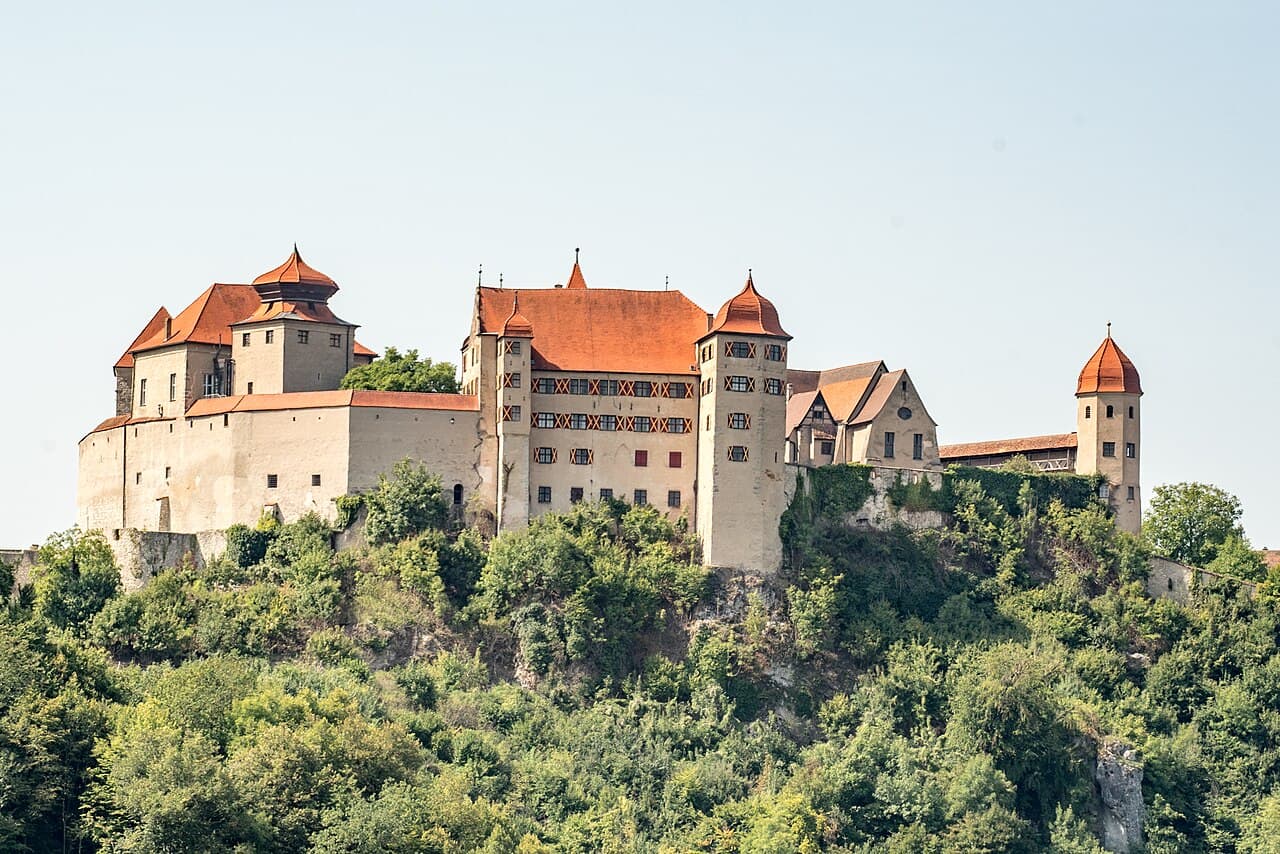
Harburg Castle
Harburg Castle stands as a monumental example of a medieval hill castle in Germany, prominently situated on a steep spur at 480 meters above sea level overlooking the Wörnitz valley. This fortress, with origins dating back to the 11th century, is one of the most complete and well-preserved castles from the High Medieval period in southern Germany. Its strategic location and extensive fortifications illustrate its historical importance as a military stronghold and noble residence.
The castle's earliest documented mention is from 1150, during the reign of King Conrad III and his son Henry Berengar, who stayed there amid military campaigns. Built originally by the Staufer dynasty (also known as the Hohenstaufen emperors), Harburg Castle served as an imperial fortress or Reichsburg. It was administered by ministeriales, unfree knights loyal to the empire, such as Otto de Goshaim. The castle's role as a royal seat was underscored when King Conrad IV, grandson of Conrad III, resided there in 1239.
Historical evolution and ownership
Ownership of Harburg Castle transitioned in 1299 when King Albert I of Habsburg pledged it to the Counts of Oettingen. The Oettingen family, and later the Oettingen-Wallerstein branch, maintained possession of the castle for centuries, confirmed by royal decrees from King Rupert in 1407 and Emperor Sigismund in 1418. The castle became a principal residence for the Oettingen counts, including notable rulers like Wolfgang I and Karl Wolfgang (ruling 1493–1549).
Karl Wolfgang was instrumental in introducing the Protestant Reformation to the region in 1524, making the castle church the first in the Ries region to conduct Protestant worship. The castle also witnessed turmoil during the Schmalkaldic War in 1546, when it was occupied and plundered, resulting in Karl Wolfgang's deposition.
Unlike many castles damaged during the Thirty Years' War (1618–1648), Harburg Castle remarkably escaped destruction. In the 18th century, under Prince Albrecht Ernst II, it underwent partial renovations in the Baroque style, enhancing the castle church and princely residence while preserving its fortified character.
The castle faced military action again during the Napoleonic Wars in 1800, when it was besieged and surrendered after artillery bombardment. In the 20th century, Harburg Castle was repurposed for military and political uses, including hosting a Hitler Youth training camp and Gestapo operations during World War II.
Architectural features and fortifications
The castle complex covers approximately 220 meters by 120 meters and is divided into a main castle (Hauptburg) and an outer bailey (Vorburg), connected by a series of fortified gates. The outer boundary is defined by a robust ring wall with six towers, including two medieval bergfriede (tall defensive towers). The Diebsturm, dating from the 12th century, is a 16-meter-tall tower with walls up to 3 meters thick, featuring a high entrance five meters above ground and historically used for storage and as a prison with torture chambers.
The Faulturm, constructed in the 13th century, was adapted in 1717 with a distinctive spiral-shaped "snail" roof and a staircase. The castle's defensive system includes a covered battlement walkway from the 15th century, a zwinger killing zone with multiple towers, arrow slits, and murder holes for dropping projectiles on attackers. Unique to Harburg are the "wooden eyes" (Holzaugen), movable apertures in the walls designed for firearm defense.
Access is controlled through three main gates between the outer bailey and the main castle. The lowest gate originally had a drawbridge, replaced by a stone bridge in 1807. The inner gate, dating to the Staufer era, is built from buckelquader ashlar with a bent design to expose attackers to flanking fire. The upper gate, added later, was equipped with a portcullis in 1752.
Water supply and infrastructure
Harburg Castle's water supply was ingeniously secured by a deep well reaching 129 meters into the Wörnitz aquifer, though only 48 meters remain accessible today due to partial collapse. A secondary water system transported water from the nearby Hühnerberg hill to the outer bailey, ensuring sustainability during sieges.
Residential and functional buildings
The castle houses several significant buildings reflecting its evolving use. The Fürstenbau, built in the 16th century atop remains of a 13th-century palas, served as a grain store and lodging for hunting parties. The Saalbau contains a large festal hall of 232 square meters, decorated with Ionic pilasters and stucco reliefs of castles. Its 18th-century ceiling paintings depict Greek mythology scenes transferred from Schloss Tiergarten.
The former bakery, the Pfisterbau, now functions as the ticket office and shop, while the Kastenhaus was initially a granary before being converted into stables and courtrooms. The Vogtei, a half-timbered building from 1562, currently operates as a hotel and restaurant.
The castle church of St. Michael is the oldest church in Harburg. Originally a Romanesque chapel, it was rebuilt in the 18th century in the Baroque style. The church contains three large epitaphs honoring the first three generations of the Protestant Oettingen-Oettingen line, as well as late Gothic wood carvings of the Virgin Mary and Archangel Michael.
Outer bailey buildings
The outer bailey features timber-framed and stone buildings dating from the 15th to 17th centuries, including the Red Stables (15th century), the Amtspflegerhaus (1744), the Zehentstadel granary (1679), and livestock stalls (1694). A brewery established in 1748 once stood here but was destroyed by fire in 1873.
Conservation and modern use
Since 2000, Harburg Castle has been owned by the Fürst zu Oettingen-Wallerstein Kulturstiftung, a non-profit dedicated to its preservation. Extensive restoration projects since 2010 have focused on key structures such as the Saalbau, Faulturm, and Turmknechtshaus. Repairs included roof and ceiling restoration, stucco work, and the reinstatement of historic Versailles-patterned parquet floors.
The Turmknechtshaus, a late 18th-century residential building altered in the 1920s, was restored between 2023 and 2024 to approximate its original appearance, with reconstructed windows, repaired timber framing, and new exhibition spaces.
Harburg Castle remains a cultural landmark and tourist attraction, with parts of the complex accessible to visitors during summer months. It includes a small hotel and restaurant, allowing guests to experience the historical ambiance firsthand. The castle's remarkable state of preservation and extensive fortifications make it a unique example of Staufer imperial architecture and a testament to the region's medieval heritage.
Frequently asked questions (FAQ)
- What is the historical significance of Harburg Castle?
- Harburg Castle, dating back to the 11th century, is one of the best-preserved castles in Germany and showcases medieval architecture. It served as a key defensive stronghold during various conflicts and has a rich history that reflects the region's past, including its role in the Holy Roman Empire.
- When was Harburg Castle built?
- Construction of Harburg Castle began around 1100, with various modifications and expansions occurring over the centuries. The castle's strategic location and robust design have allowed it to survive numerous historical events, making it a fascinating site for visitors.
- What are the opening hours for Harburg Castle?
- Harburg Castle is typically open to visitors from 10 AM to 6 PM during the summer months and 10 AM to 4 PM in the winter. However, it's advisable to check the official website for any seasonal variations or special holiday hours before planning your visit.
- Can I access Harburg Castle with limited mobility?
- Harburg Castle has some accessibility options; however, due to its historic architecture, certain areas may be challenging for visitors with limited mobility. It's best to contact the castle administration in advance to inquire about specific accommodations and assistance available for your visit.
- What are the ticket prices for Harburg Castle?
- Tickets for Harburg Castle vary depending on age and group size, with discounts available for students and seniors. Adults can expect to pay around €6, while children under 12 often enter for free, making it an affordable destination for families.
- When is the best time to visit Harburg Castle?
- The best time to visit Harburg Castle is during the late spring and early autumn months when the weather is pleasant, and the surrounding landscapes are vibrant. Additionally, this period often features various events and festivals that enhance the visitor experience.
- What nearby attractions can I explore after visiting Harburg Castle?
- After exploring Harburg Castle, visitors can enjoy the picturesque town of Harburg, which offers charming shops and local eateries. Additionally, the nearby Wörnitz Valley and the historic town of Nördlingen are great options for those looking to extend their sightseeing experience.
Photo gallery

Information
Website
Visit websiteSources & official resources
Verify the information above using these authoritative references.
Loading map...
Visitor reviews
No reviews yet. Been here? Write the first review and help other travelers!
Write the first reviewVisited this castle? Share your experience
Your review helps other travelers and adds first-hand knowledge to our encyclopedia.


