Hagueneck Castle
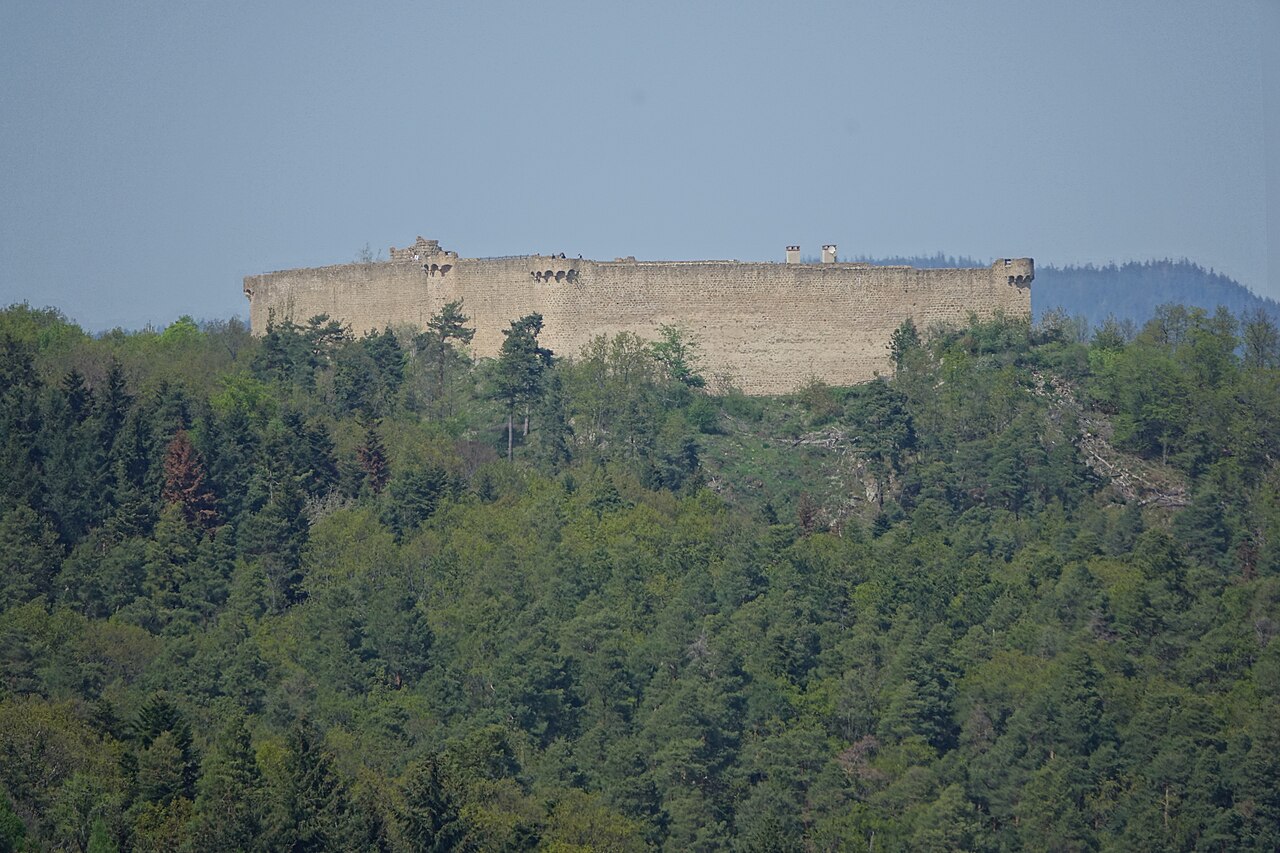
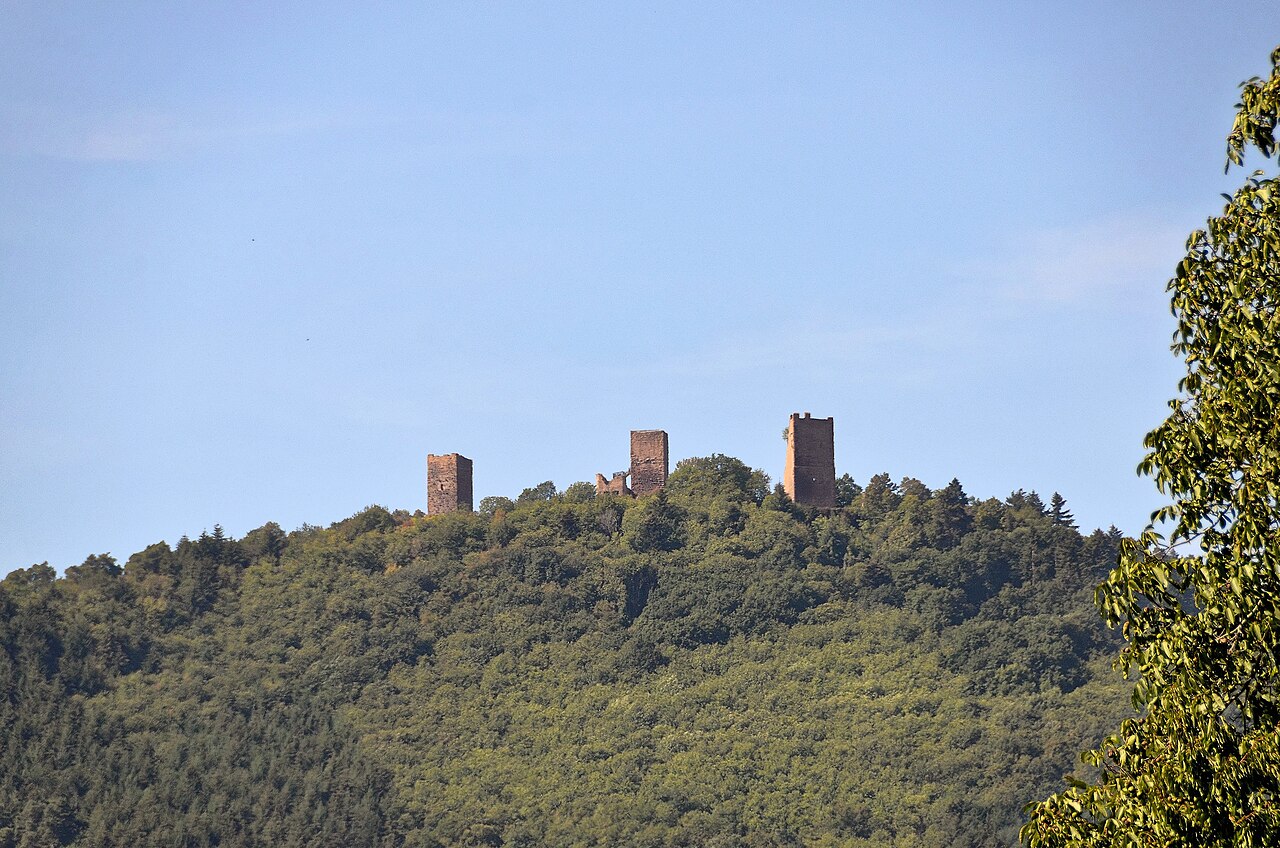
Hagueneck Castle, also known locally as Château du Hagueneck, is a striking medieval ruin perched above the village of Wettolsheim in the Haut-Rhin department of France, within the historic region of Southern Alsace or the Vosges. This hill castle occupies a strategic granite outcrop approximately 440 meters above sea level, overlooking a densely wooded valley and forming part of a cluster of medieval fortifications that illustrate the region's feudal past.
Constructed probably around 1230, Hagueneck Castle was initially established by local lords under the authority of the Bishop of Strasbourg. The castle's early function was likely more residential than military, as it was situated at the end of a wooded valley, away from main communication routes. The first documented owner, Burckhard de Hagueneck, a vassal of the bishop, is mentioned in 1263, confirming the castle's role within the bishopric's feudal system.
The castle's historical timeline and ownership
Ownership of the castle changed hands several times over the centuries, reflecting the complex political landscape of the region. Around 1300, the castle was sold to the Laubgassen family, who had lost their ancestral seat and sought refuge at Hagueneck. In 1304, it was burned during a conflict involving the noble Hattstatt and Hus families but was promptly rebuilt and fortified, underscoring its continued strategic and residential importance.
Throughout the 15th century, the castle passed through various noble families, including the Rappoltstein family, who held it as a fief under the House of Habsburg. By the mid-16th century, around 1550, the castle was abandoned as a permanent residence, and by 1640 it was described as a ruin. The Thirty Years' War further devastated the castle when it was destroyed by Swedish troops, leading to its long-term abandonment.
In 1674, the castle came under the ownership of the Knights Hospitaller (Johanniterkommende) based in Colmar. It remained in their possession until the French Revolution, when it was confiscated and sold as national property. The ruins later served as a residence for a local forest official during the 19th century before being acquired by the municipality of Wettolsheim in 1912, marking the beginning of preservation efforts.
Architectural features and layout
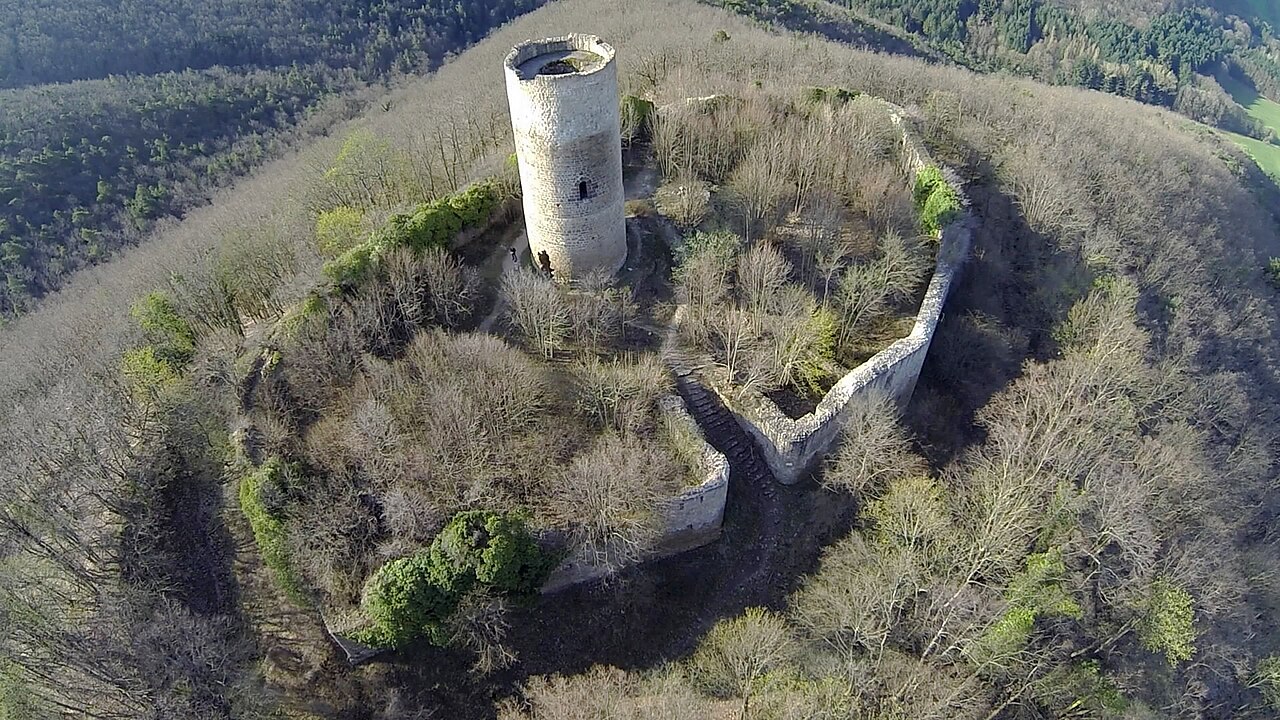
The castle's remains reveal a rectangular inner courtyard (Kernburg) and an eastern outer bailey (Vorburg), both enclosed by a formidable outer ring wall. The site is naturally defended by steep rock faces and enhanced by deep neck ditches on the southwestern and southeastern approaches, which served as formidable obstacles to attackers.
The castle walls are constructed from locally quarried granite, with finely worked blocks and distinctive cushion-shaped boss stones marking corners, the central tower, and the main gate. Originally, window frames were made from yellow sandstone sourced from Rouffach, though these have not survived.
A notable defensive feature is the semicircular flanking tower on the southeast side, likely guarding the main entrance located at the southern corner of the defensive wall. The addition of a zwinger in the early 15th century—a narrow outer ward—further enhanced security by forcing visitors or attackers to pass through a confined space before reaching the inner bailey.
The bergfried and main residential building
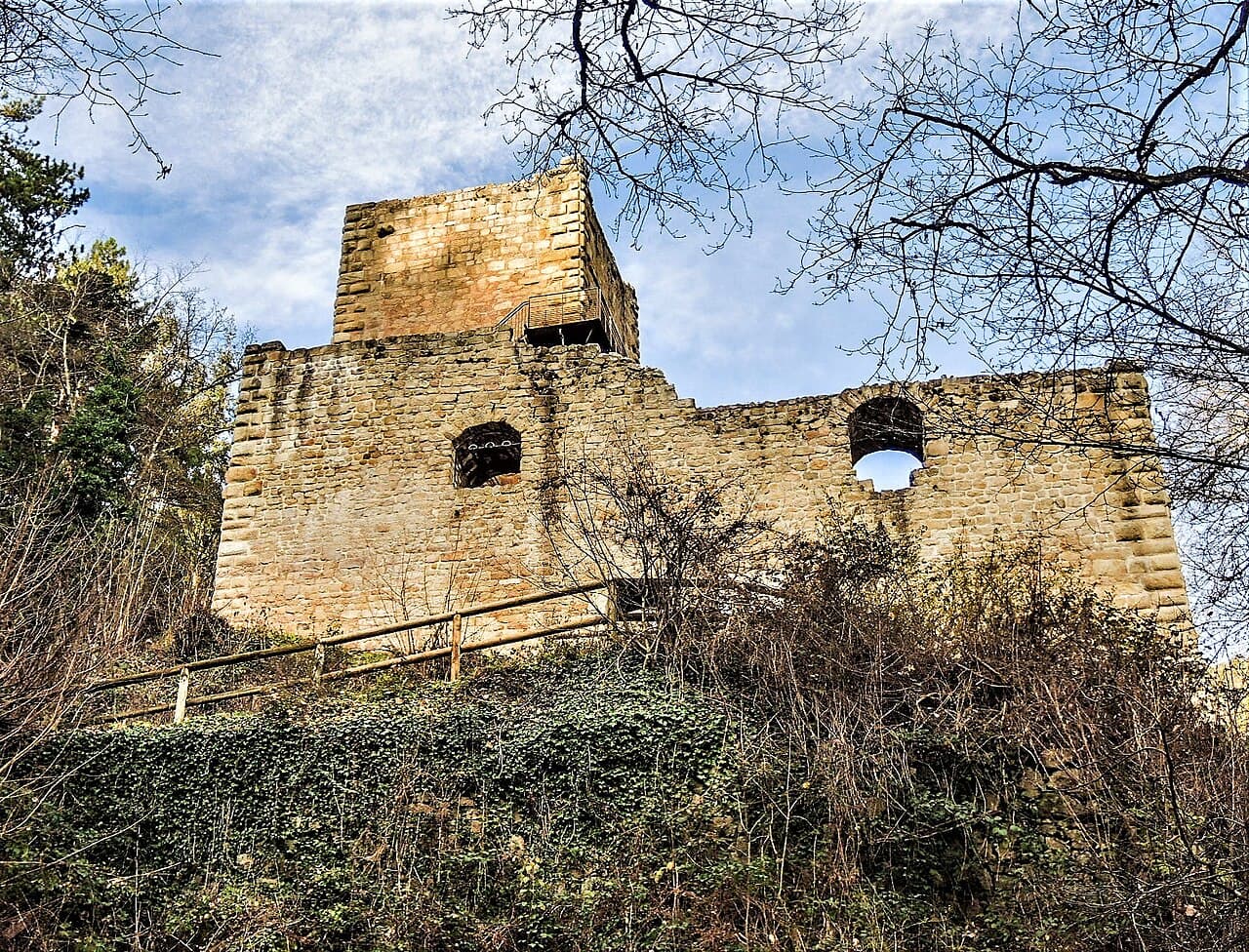
At the heart of the castle stands the bergfried, a tall square tower originally about 22 meters high, now partially collapsed to roughly 18 meters. Its interior is mostly solid, except for a narrow spiral staircase leading to the battlement platform protected by a low parapet. The bergfried's entrance is a distinctive round-arched doorway situated approximately 16 meters above ground, formerly accessed by a wooden gallery connecting to the ring wall. Unlike French donjons, this tower was not designed for habitation.
Opposite the bergfried lies the palas, the castle's main residential building, occupying nearly half the inner bailey. It is a two-story structure facing the protected northeast side. The ground floor features narrow window openings that served as arrow slits or light sources for the outer bailey, while the upper floor had rounded-arched double windows, now preserved as pointed niches with wide seating. A surviving granite capital suggests a fireplace once warmed the interior.
Preservation and cultural significance
Despite its modest scale compared to neighboring fortresses, Hagueneck Castle holds significant cultural and historical value. Its ruins provide a window into the feudal era of Alsace and the architectural evolution of hill castles in the region. The castle is part of the Route of the 5 Castles, a popular tourist trail connecting several medieval fortifications, including Pflixbourg, Hohlandsbourg, and the three Éguisheim castles.
The castle is freely accessible today, reachable by a short five-minute walk from the nearest road, offering visitors a secluded and atmospheric experience. It also anchors the Herzog path, a 2.8-kilometer forest trail that links the historic site to its natural surroundings, enhancing the visitor experience by combining cultural heritage with scenic nature.
Restoration efforts have been ongoing since the late 19th century, with significant campaigns in 1884, 1932, 1972, and from 1981 onward under a local heritage association. Since 1923, the castle has been officially recognized as a historic monument, underscoring its importance to French cultural heritage.
Visiting information and accessibility
Visitors to Hagueneck Castle can explore the ruins at their own pace, enjoying the rugged landscape and panoramic views of the surrounding Vosges hills and the nearby town of Colmar. The site is ideal for history enthusiasts and hikers interested in medieval architecture and Alsace's rich past. The castle's location away from urban centers provides a peaceful retreat into nature and history.
Frequently asked questions (FAQ)
- How do I get to Hagueneck Castle?
- Hagueneck Castle is accessible by a short five-minute walk from the nearest road near Wettolsheim. It is best reached by car or local transport to Wettolsheim, followed by a walk through wooded paths.
- What is the historical significance of Hagueneck Castle?
- Hagueneck Castle is a medieval hill castle built around 1230, reflecting the feudal system under the Bishop of Strasbourg. It has connections to notable families like the Laubgassen and the House of Habsburg and was destroyed during the Thirty Years' War.
- Can I visit the interior of Hagueneck Castle?
- The castle is a ruin and freely accessible to visitors. While interiors like the bergfried and palas are not fully intact, visitors can explore the remains and appreciate the architectural features and defensive structures.
- When is the best time to visit Hagueneck Castle?
- The best time to visit Hagueneck Castle is during the spring to early autumn months when the weather is mild, and the surrounding forest trails are most enjoyable for hiking and sightseeing.
- Is there an entrance fee to visit Hagueneck Castle?
- There is no entrance fee to visit Hagueneck Castle. The site is open to the public and can be explored freely at any time.
Photo gallery

Information
Sources & official resources
Verify the information above using these authoritative references.
Loading map...
Visitor reviews
No reviews yet. Been here? Write the first review and help other travelers!
Write the first reviewVisited this castle? Share your experience
Your review helps other travelers and adds first-hand knowledge to our encyclopedia.