Guirbaden Castle
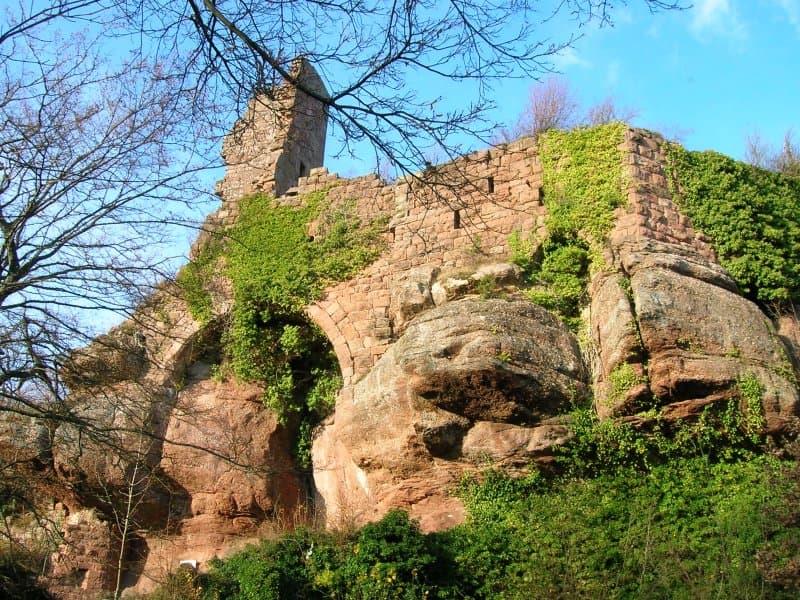
Guirbaden Castle, also known as Château de Guirbaden, is a monumental medieval fortress ruin located on a mountainous ridge southwest of the village of Mollkirch in the Bas-Rhin department of France. Nestled within the Guirbaden forest in the historical region of Alsace, this castle complex is renowned as the largest castle ruin in Alsace by area and extent. Its strategic position offers commanding views over the Plain of Alsace and the Bruche Valley, underscoring its historical military significance.
The castle complex is unique in that it comprises three distinct castles aligned from east to west, each representing different construction phases and architectural styles spanning several centuries. The earliest section, centered around a ruined keep perched on a rocky outcrop at the eastern end, was likely founded in the 10th century by Hugues III of Éguisheim. This initial fortress was primarily intended to protect the property of the nearby Altorf Abbey, a Benedictine monastery closely linked to the regional nobility.
The castle is first historically documented in 1137 during the consecration of its chapel located at the western end of the complex. In 1162, the castle suffered destruction when it was burned by Emperor Frederick I Barbarossa as reprisal for the destruction of the castle of Horbourg by Hugues IX, despite an imperial ban. Following this, the castle was rebuilt and significantly expanded, including the addition of a palas (a grand residential hall), forming the middle castle of the complex.
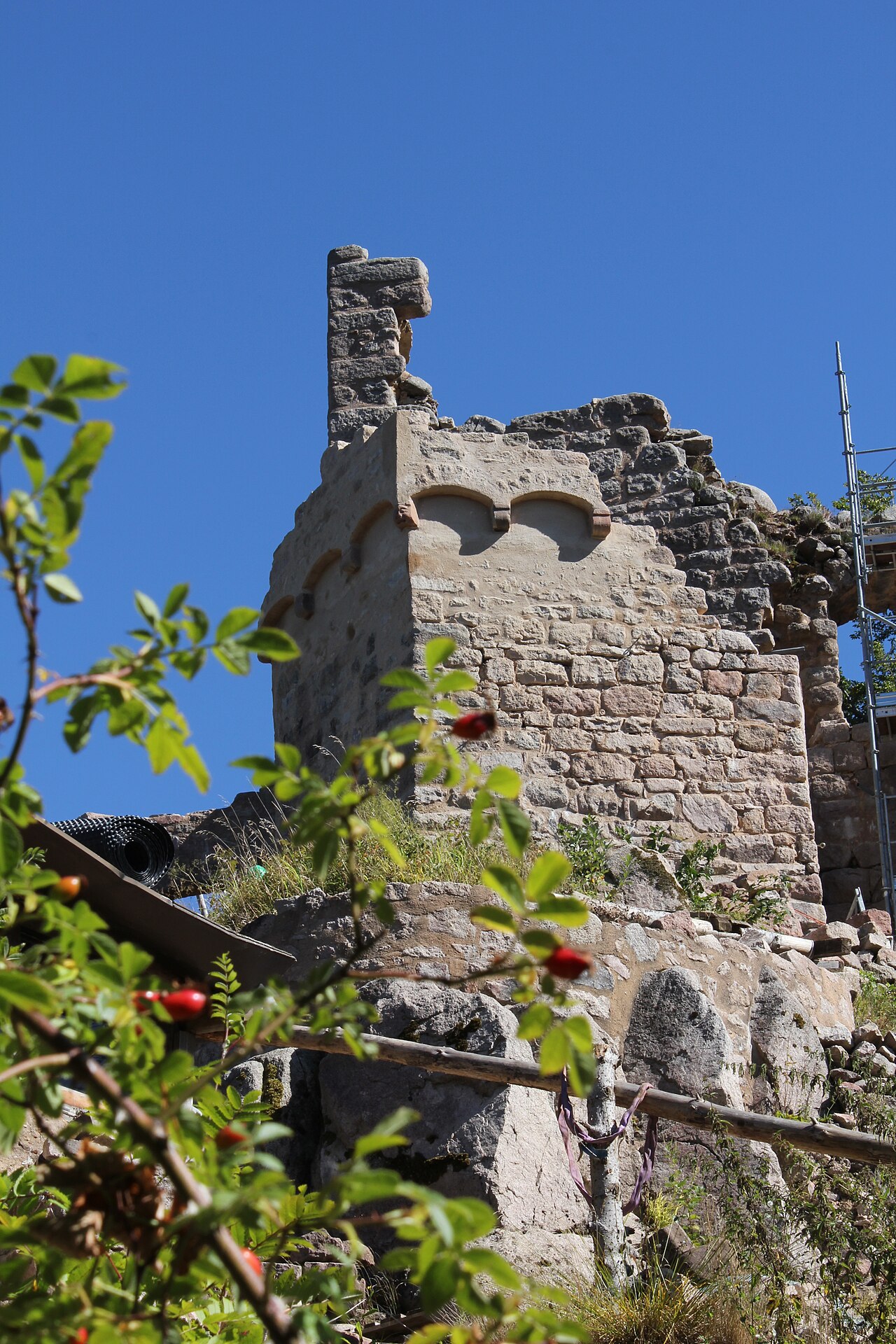
The westernmost and youngest part of the complex, known as Nouveau-Guirbaden, was constructed between 1218 and 1225 under the direction of Emperor Frederick II. This section was built around the pre-existing 12th-century chapel and separated from the older castle by a dry moat carved into the rock. It featured its own keep, famously known as the Hunger Tower, which remains standing today.
Historical evolution and ownership
The castle's ownership history reflects the complex feudal and ecclesiastical politics of medieval Alsace. After the last descendant of the Éguisheim family died, the castle passed to the Bishop of Strasbourg. Subsequent bishops granted the castle as a fief to various noble families, including the Lords of Hohenstein and Rathsamhausen. Notably, in 1226, Emperor Frederick II and his son Henry (VII) transferred their share of the castle to Bishop Berthold I of Strasbourg, who later consolidated full control by purchasing the remaining portions.
Guirbaden Castle endured multiple conflicts, including surviving the Peasants’ War of the early 16th century but suffering severe damage during the Thirty Years’ War. In 1633, after two failed assaults, Swedish forces captured and burned the castle. Though repairs were attempted in 1647 by Frederick of Rathsamhausen, the castle was once again engulfed by fire in 1652. Ultimately, French troops demolished the remaining ruins in 1657, leaving the castle in a state of ruin.
Architectural features and layout
Overall complex and defensive structures
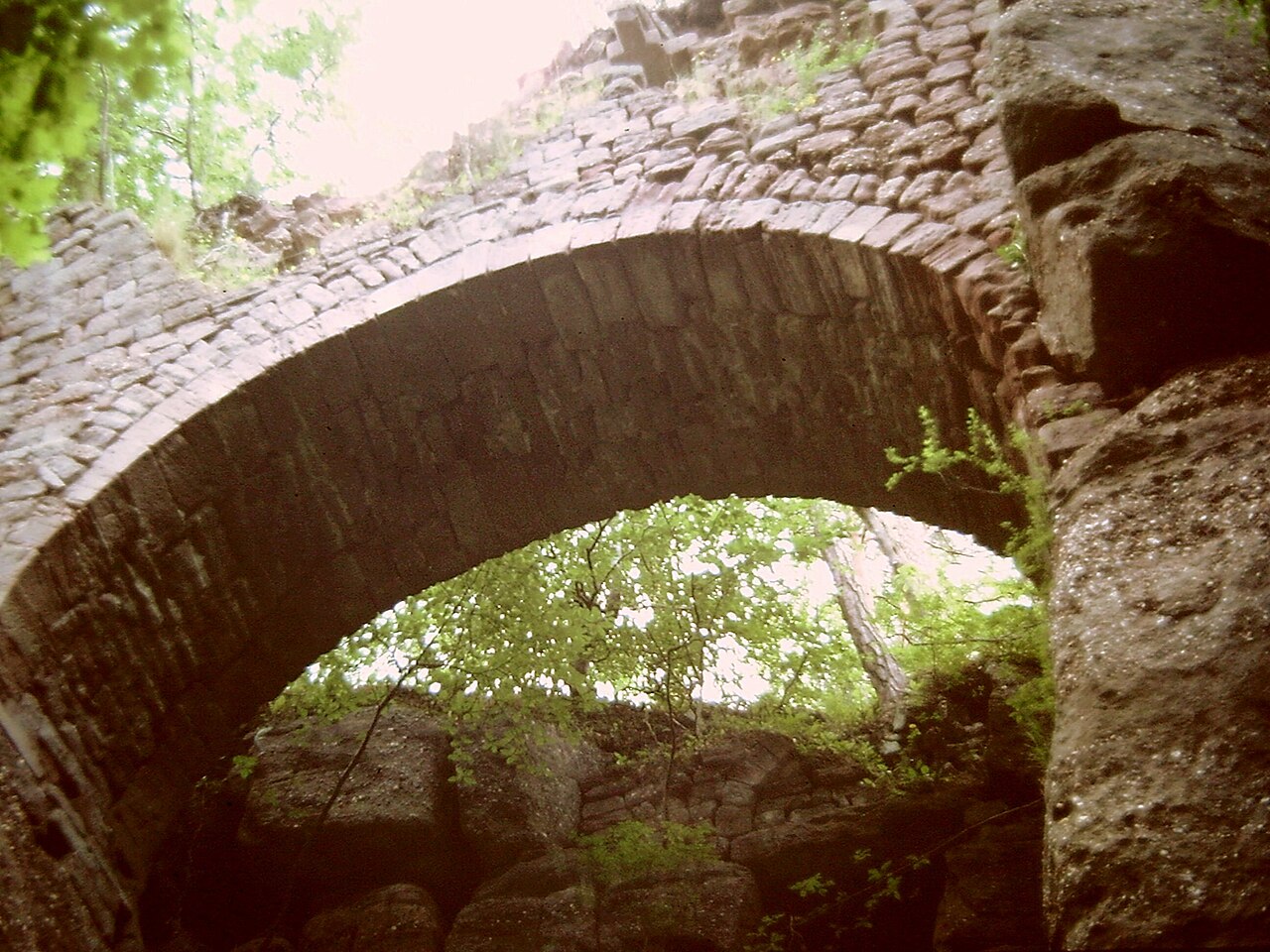
Spanning approximately 280 meters in length and 60 meters in width, Guirbaden Castle’s extensive layout is divided into an upper castle (citadel) and a larger lower castle. The citadel is roughly polygonal and encircled by a formidable ring wall made of rusticated ashlar masonry, known in German as buckelquader. The most striking feature of the citadel is its bergfried (a tall defensive tower), constructed atop a base of Buntsandstein sandstone and supported by large relieving arches, demonstrating advanced medieval engineering techniques.
The lower castle, about twice the size of the citadel, is internally divided by a transverse wall and includes the palas, a grand residential hall measuring approximately 33 by 11 meters. This hall once featured a deep neck ditch crossed by a bridge leading to the western entrance gate. The palas’s southern gable wall was originally decorated with four window openings framed by columns and topped with a decorative rosette, similar to architectural elements found at Wildenberg Castle. Today, only one of these ornate window arches remains intact.
Chapel and religious significance
The castle chapel, dedicated to Saint Valentin, is a notable Romanesque structure built alongside the castle’s core expansions in the 12th century. It served as a hermitage until the 19th century and was rebuilt after a fire in 1850. The chapel remains an important pilgrimage site, hosting an annual blessing of animals ceremony on Whit Monday, reflecting its enduring cultural and religious significance.
Defensive enhancements and outer wards
Throughout the 14th and 15th centuries, the castle’s eastern sector was fortified with additional zwingers (outer wards) and multiple towers to enhance its defensive capabilities. The castle’s main entrance was located on the west and featured a series of five gates, supplemented by an eastern gate equipped with a drawbridge. Defensive adaptations for firearms, including cannon openings, were integrated into the gates, illustrating the castle’s evolution in response to changing military technology.
Burgmann settlement and ancillary structures
Outside the main castle walls lies the former burgmann settlement, housing for castle officials and retainers, enclosed by walls dating from Frederick II’s rebuilding phase. At the western end of this area stands the Hungerturm or Hunger Tower, a square bergfried that served both defensive and symbolic functions. The surrounding walls vary in height from one to four meters, with many interior walls now obscured by vegetation.
Restoration and current status
After centuries of neglect, the castle was officially listed as a protected monument in 1898. In the late 1960s, a private entrepreneur acquired the ruins and initiated restoration efforts, although some parts were unfortunately demolished during this process. These works ceased after a few years, leaving the castle in its present partially restored state.
Since 2015, the castle has been managed by an association of volunteers dedicated to its preservation and consolidation. The site is currently open to visitors, although certain areas are fenced off for safety reasons due to ongoing structural concerns. Visitors can reach the castle via a scenic 45-minute hike through forest paths, making the journey part of the experience.
Guirbaden Castle stands today as a testament to the region’s medieval heritage, showcasing a complex architectural evolution shaped by noble ambitions, ecclesiastical influence, and military necessity. Its extensive ruins offer valuable insights into medieval castle construction, defensive strategies, and feudal history in the Alsace region.
Frequently asked questions (FAQ)
- How do I get to Guirbaden Castle from Mollkirch?
- Guirbaden Castle is accessible by a scenic 45-minute hike through forest trails starting from Mollkirch village. The path is well-marked but involves moderate elevation gain, so comfortable walking shoes are recommended.
- What is the historical significance of Guirbaden Castle?
- Guirbaden Castle is the largest medieval castle ruin in Alsace, originally built in the 10th century to protect ecclesiastical property and later expanded by emperors Frederick I and II. It reflects centuries of regional military and noble history.
- Can I visit the interior of Guirbaden Castle?
- Visitors can freely explore most of the castle ruins, though some sections are fenced off due to safety concerns. The core castle area has restricted access to preserve structural integrity.
- When is the best time to visit Guirbaden Castle?
- The best time to visit is during late spring to early autumn when the forest trails are clear and the weather is favorable for hiking. The annual blessing of animals at the chapel takes place on Whit Monday.
- Are there guided tours available at Guirbaden Castle?
- Currently, there are no regular guided tours, but local associations occasionally organize events and volunteer-led visits. Checking with the Mollkirch tourist office can provide information on scheduled activities.
Photo gallery

Information
Website
Visit websiteSources & official resources
Verify the information above using these authoritative references.
Loading map...
Visitor reviews
No reviews yet. Been here? Write the first review and help other travelers!
Write the first reviewVisited this castle? Share your experience
Your review helps other travelers and adds first-hand knowledge to our encyclopedia.