Guildford Castle
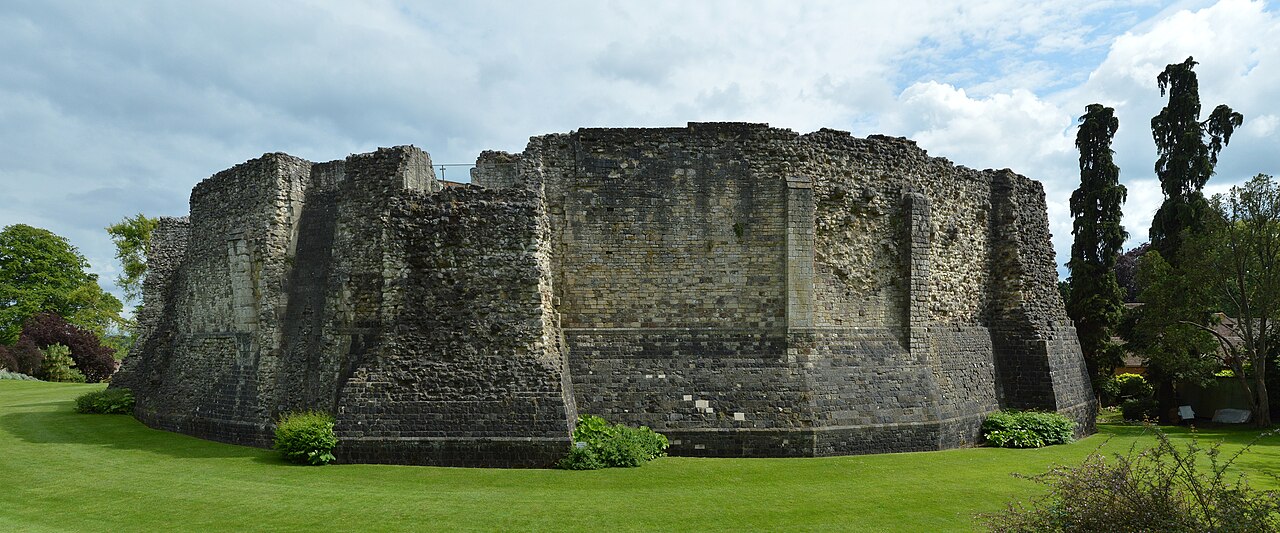
Guildford Castle stands as a remarkable example of Norman military architecture combined with medieval royal residential features, located in the historic town of Guildford, Surrey, England. Established shortly after the Norman Conquest of 1066, this hill castle is centered around a prominent artificial motte topped by a substantial quadrangular stone keep. Its evolution from a timber fortification to a stone stronghold reflects the strategic and domestic needs of successive centuries.
The castle’s origins lie in the immediate post-Conquest period, likely initiated by William the Conqueror or his close followers, although it is not mentioned in the Domesday Book of 1086. The initial construction featured a motte and bailey design typical of Norman castles, with a wooden keep on the motte and a defensive ditch surrounding the mound. The bailey was enclosed by timber palisades and subdivided internally, covering an area roughly delineated by modern Castle Street, South Hill, Racks Close, and Quarry Street.
Medieval construction and architectural development
By the late 11th or early 12th century, the timber structures were replaced with more durable stonework. Builders used locally sourced Bargate stone to construct a shell keep around the motte, which was later superseded by a robust quadrangular stone keep in the 1130s. This keep was built on deep foundations extending to the chalk bedrock, underscoring the importance and permanence of the structure.
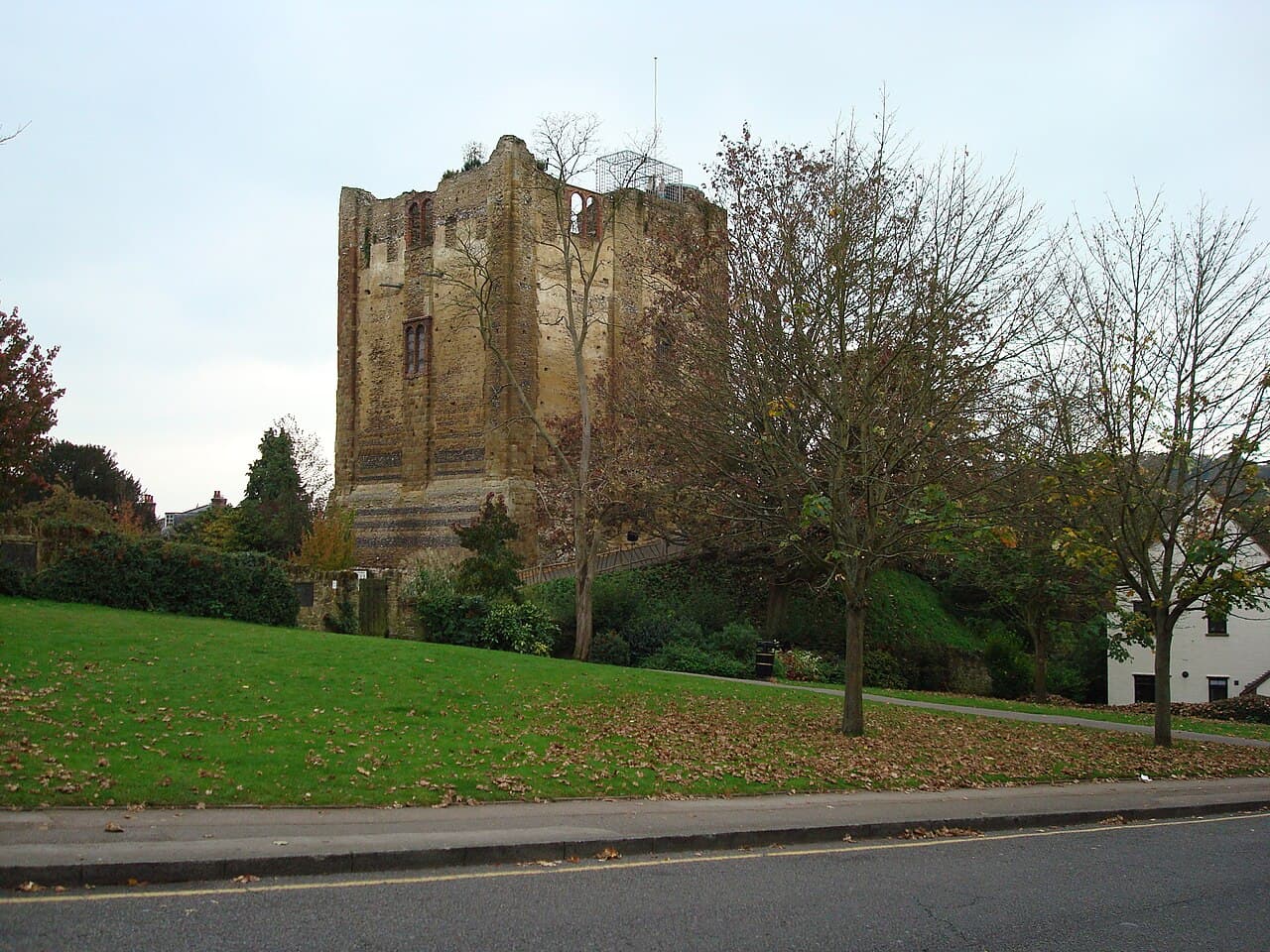
The stone keep initially had two floors, with the main entrance located on the first floor—an intentional defensive feature to hinder attackers. A third floor was added later, raising the height to over 70 feet (21 meters). The keep’s walls are thick, about 10 feet (3 meters) at the base, tapering upwards, and the interior was finished with plastered and whitewashed walls to create a bright and clean environment. The roof was covered with lead, a luxury material for the time, and the keep contained essential chambers including a main hall, a private chapel, a wardrobe with an attached latrine, and a two-seat latrine on the upper floor, reflecting medieval attention to comfort and hygiene.
The bailey and royal apartments
The bailey of Guildford Castle housed several important buildings, including a great hall and royal apartments constructed during the 12th and 13th centuries. King Henry III was a significant patron, enhancing the castle with large windows fitted with colored glass, marble columns, intricately painted chambers, and a garden surrounded by marble pillars. These additions transformed the castle into a refined royal residence as well as a defensive fortress.
In 1245, Henry III expanded the bailey to provide living quarters for his son Edward, completing the work by 1246. The formal entrance gate on Quarry Street was finished in 1256, marking a key access point to the bailey and connecting the castle to the town. The castle’s role during this period was both residential and administrative, hosting royal family members and serving as a stronghold during times of conflict.
Historical significance and military role
Guildford Castle played a strategic role during several medieval conflicts. It was involved in the civil war under King Stephen (1135–1154) and the rebellion of Henry II’s sons (1173–1174), serving as a royal stronghold. During the First Barons’ War (1215–1217), the castle was occupied by Prince Louis of France in 1216, although no battles were fought on the site. Similarly, it was involved in the 1260s rebellion led by Simon de Montfort without direct conflict.
Prince Edward used Guildford Castle as a staging ground before embarking on military campaigns abroad, underscoring its ongoing strategic importance in the 13th century. However, from the 14th century onward, the castle’s military significance declined as royal attention shifted to a nearby moated hunting lodge.
Transition to administrative and domestic use
By 1379, many royal apartments had fallen into disrepair, with only the King’s great chamber remaining intact. The castle keep was repurposed as a county jail for Surrey and Sussex until 1487, when prisoners were moved to Lewes. In the 16th century, the Daborne family, custodians of the castle gardens, introduced domestic features such as brick windows and fireplaces, reflecting changing residential needs.
Ownership changed hands several times, including a royal grant to Francis Carter in 1611 and acquisition by the Duke of Norfolk around 1820. During the 1630s, after the removal of the keep’s roof, the tower was adapted for use as a cockpit for cockfighting. Portions of the surrounding land were farmed or rented out, marking a shift from military and residential functions to agricultural and recreational uses.
Modern restoration and public access
In 1885, the Guildford Corporation purchased the castle site and undertook restoration efforts on the keep and curtain walls. The grounds were opened as public gardens in 1888 to celebrate Queen Victoria’s Golden Jubilee. These gardens feature colorful flowerbeds and a life-size statue of Lewis Carroll, commemorating the author’s local connections.
A major conservation project between 2003 and 2004 restored the keep’s first floor and roof, revealing original defensive features such as crenellations along the roofline. Today, the keep houses a visitor center with exhibits on the castle’s history and a model depicting its appearance around 1300. Visitors can climb a staircase to the roof for panoramic views of the castle grounds and the town of Guildford.
The old gatehouse survives as part of the nearby Guildford Museum, which holds collections related to the local history, archaeology, and needlework, maintaining a tangible link to the castle’s medieval heritage and its ongoing role within the community.
Architectural features and layout
The castle’s layout is defined by its motte, an artificial mound encircled by a defensive ditch, supporting the imposing stone keep. The keep itself measures approximately 47 feet (14 meters) by 45.5 feet (13.9 meters) externally, with walls about 10 feet (3 meters) thick at the base, tapering upwards. The ground floor was built without windows for defense, while the upper floors contained living quarters, a chapel, and latrines, reflecting a blend of military and domestic architecture.
Surrounding the motte, the bailey was enclosed by timber palisades and later stone walls, containing important structures such as the great hall, royal apartments, and chapels. The 13th-century enhancements by Henry III introduced decorative elements like large colored-glass windows and marble columns, elevating the castle’s status as a royal residence.
The gate on Quarry Street, completed in 1256, served as the formal entrance to the bailey, linking the castle to the town’s street network. Although earlier gates have not survived, this gate remains a significant element of the castle’s medieval defensive and logistical system.
Preservation and visitor experience
Today, Guildford Castle is well preserved and accessible to the public. The keep’s restoration allows visitors to explore medieval defensive architecture firsthand, while the public gardens offer a peaceful setting enriched with historical sculptures and plantings. The visitor center provides educational resources and interactive displays, making the castle a valuable cultural and heritage site in Surrey.
The castle’s integration with the Guildford Museum enhances the visitor experience by offering broader historical context and archaeological insights. This combination of preserved architecture, curated exhibits, and landscaped gardens ensures that Guildford Castle remains a significant attraction for both history enthusiasts and casual visitors.
Frequently asked questions (FAQ)
- What is the historical significance of Guildford Castle?
- Guildford Castle, built in the 11th century, played a crucial role in the defense of England during the medieval period. It served as a royal residence and a symbol of power during the Norman Conquest, reflecting the architectural style and military strategies of its time.
- When was Guildford Castle built?
- Guildford Castle was constructed shortly after the Norman Conquest in 1066, with significant developments occurring throughout the 12th and 13th centuries. The castle underwent several renovations, reflecting changes in military architecture and royal preferences over the centuries.
- Can I visit Guildford Castle?
- Yes, Guildford Castle is open to visitors throughout the year. Guests can explore the castle grounds, enjoy the gardens, and learn about its rich history through informative displays.
- What are the opening hours for Guildford Castle?
- Guildford Castle typically opens at 10 AM and closes at 5 PM, with extended hours during the summer months. It is advisable to check the official website for any changes or special events that may affect these hours.
- Is there an entry fee to visit Guildford Castle?
- Yes, there is a nominal entry fee to access the castle and its grounds. Discounts are often available for children, seniors, and families, making it an affordable outing for all.
- How accessible is Guildford Castle for visitors with mobility challenges?
- Guildford Castle strives to be accessible for all visitors, with wheelchair access to the grounds and gardens. However, the castle's historic structure may pose challenges, and it's best to contact the visitor center for specific accessibility information.
- What is the best time to visit Guildford Castle?
- The best time to visit Guildford Castle is during the spring and summer months when the gardens are in full bloom and outdoor activities are available. Visiting during weekdays can also help avoid crowds, ensuring a more enjoyable experience.
- Are there any nearby attractions to explore after visiting Guildford Castle?
- Yes, nearby attractions include the Guildford Museum, the River Wey, and the picturesque High Street, offering shops and dining options. A short walk can also lead you to the beautiful Surrey Hills, perfect for nature lovers.
Photo gallery

Photo by SuzanneKn at English Wikipedia•Public domain
Information
Website
Visit websiteSources & official resources
Verify the information above using these authoritative references.
Loading map...
Visitor reviews
No reviews yet. Been here? Write the first review and help other travelers!
Write the first reviewVisited this castle? Share your experience
Your review helps other travelers and adds first-hand knowledge to our encyclopedia.