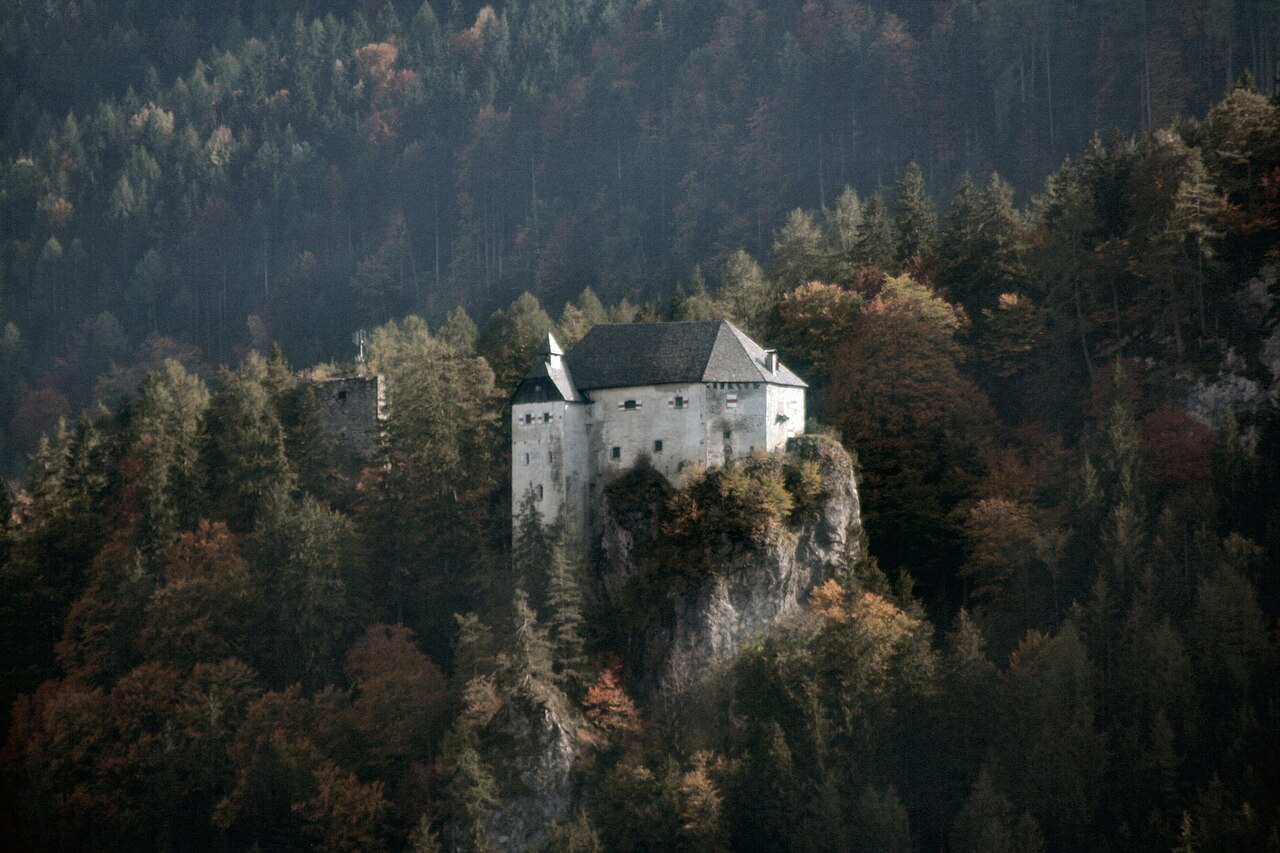
Groppenstein Castle
Groppenstein Castle, located in Semslach, Austria, is a remarkable example of a High Medieval hill castle that has witnessed centuries of history and architectural evolution. First mentioned in historic documents in 1254, the castle occupies a commanding rock promontory overlooking the confluence of the River Mallnitz and the River Möll. Its strategic location provided natural defenses and control over the surrounding valley, making it a significant stronghold during the medieval period.
The castle's origins likely date back earlier than its first written mention, with linguistic evidence suggesting the name derives from the Old High German personal name "Groppo," indicating a possible early stone tower predating the 13th century. Initially constructed as a stone tower or keep, Groppenstein evolved into a fortified complex over the centuries, reflecting the changing needs of defense and residence.
Early history and ownership
The earliest known record of Groppenstein appears in 1254 when Archbishop Philip of Salzburg granted land near the castle to his archer Heinrich Swärhaupt. This document was witnessed by Pabo de Cropensteine, a ministerial officer serving the Counts of Ortenburg, confirming the castle's established presence. During the late 13th or early 14th century, the castle came under the control of the Counts of Gorizia, a noble family influential in the region.
In 1324, Friedrich von Groppenstein is recorded as an official at the joint Gorizia-Tyrol court, indicating the castle's administrative importance. By the mid-14th century, Groppenstein had transformed from a simple tower castle into a fortified stronghold with protective walls. The castle was leased as a feudal fief in 1342 to Jörg von Groppenstein, son of castellan Konrad der Gröppler, demonstrating its role as a noble residence and defensive site.
Architectural development and fortifications
Between 1470 and 1480, Groppenstein underwent significant enlargement and fortification under the direction of Jakob Gröppel von Groppenstein, a Gorizian ministerial. This period marked the castle's evolution into a more complex residence with enhanced defenses, including the addition of a residential palace and strengthened curtain walls. The castle's architectural style reflects a transition from Romanesque origins to Gothic influences, evident in its dwellings and defensive structures.
The massive bergfried, or main defensive tower, is a prominent Romanesque feature, rising approximately 23 meters tall with five stories. Its robust rectangular form has retained much of its medieval character. Connected to the Gothic-style palace by a wooden bridge at the second floor, the bergfried served as a key defensive and residential element.
The three-story palace building primarily dates from the 15th century but was extensively renovated in the 19th century by Viennese architect Adolf Stipperger, who acquired the castle in 1872. Stipperger introduced modern features such as chimneys, a crenellated gable, and larger windows, blending medieval and contemporary styles while preserving the castle's historic character. The palace facade displays the mid-16th-century coat of arms of the Schernperg counts, reflecting the noble families associated with Groppenstein.
Surrounding the core buildings is a crenellated defensive wall with a three-story gate tower known as the Torturm. Originally, the castle was accessed via a drawbridge over a deep moat on the western side, forming a formidable barrier. This drawbridge has since been replaced by a permanent concrete bridge, maintaining access while altering the original defensive feature.
Interior features and artistic elements
Inside the castle, the Knights Hall is notable for its beautiful 16th-century stained glass windows, which add artistic and historical value. Additional glass paintings were added in the 20th century by Professor Franz Chvostek, who owned the castle from 1936 to 1944. The castle chapel, consecrated to St. Katharina, features a Gothic aisle and a semi-circular Romanesque apse, illustrating the blend of architectural styles present within the fortress.
Later history and preservation
Ownership of Groppenstein passed through several noble families over the centuries, including the Groppenstein, Schernperg, Khevenhüller, Hollenegg, Lind, and Sternbach families. Each contributed to the castle's maintenance and adaptation, ensuring its continued use and preservation. The Sternbach barons held the castle from 1693 until 1870, after which it was acquired by Adolf Stipperger, who undertook significant restoration work.
Restoration efforts resumed in 1968 and have continued intermittently, preserving Groppenstein's medieval character. The castle remains privately owned and is accessible only by special arrangement, reflecting its status as a well-preserved historical monument rather than a public tourist site.
Strategic location and defensive advantages
Groppenstein Castle's position on a steep rock formation with precipitous drops on three sides provided natural defenses that were enhanced by man-made fortifications. The castle commands views over the village of Raufen and the nearby river confluence, allowing control of key transportation and communication routes during the medieval period.
The combination of natural topography and architectural features such as the bergfried, curtain walls, gate tower, and moat made Groppenstein a formidable fortress. Its name also lends itself to the nearby Groppenstein Gorge, underscoring the castle's prominence in the local landscape and history.
Architectural significance and legacy
Groppenstein Castle exemplifies the architectural transition from Romanesque to Gothic styles in medieval fortifications. Its preserved structures, including the bergfried, palace, chapel, and defensive walls, offer valuable insights into castle construction and noble residence design during the High Middle Ages and late medieval period.
The castle's continuous habitation and periodic restorations have contributed to its remarkable state of preservation, making it a significant cultural heritage site in Austria. While not widely open to the public, Groppenstein remains an important subject of study for historians and architects interested in medieval fortifications and noble residences.
Frequently asked questions (FAQ)
- When was Groppenstein Castle first mentioned in historical documents?
- Groppenstein Castle was first mentioned in historical documents in 1254, establishing its presence in the High Middle Ages.
- What architectural styles are represented in Groppenstein Castle?
- Groppenstein Castle features a blend of Romanesque and Gothic architectural styles, with later 19th-century renovations adding modern elements.
- Is Groppenstein Castle open to the public for visits?
- Groppenstein Castle is privately owned and generally accessible only by special arrangement, not open for regular public tours.
- What are the key defensive features of Groppenstein Castle?
- Key defensive features include the massive Romanesque bergfried, crenellated curtain walls, a gate tower, and its strategic position on a steep rock promontory.
- Who was the architect responsible for the 19th-century restoration of Groppenstein Castle?
- The Viennese architect Adolf Stipperger undertook extensive restoration of Groppenstein Castle in 1872, blending medieval and modern architectural elements.
Information
Sources & official resources
Verify the information above using these authoritative references.
Loading map...
Visitor reviews
No reviews yet. Been here? Write the first review and help other travelers!
Write the first reviewVisited this castle? Share your experience
Your review helps other travelers and adds first-hand knowledge to our encyclopedia.