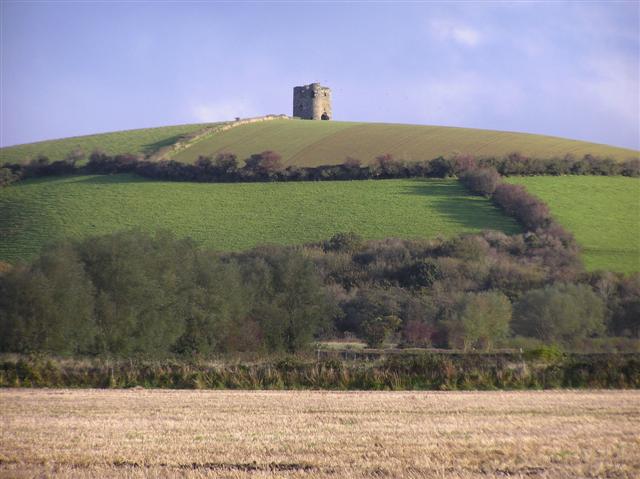
Grianan of Aileach
Grianán of Aileach (Irish: Grianán Ailigh) is a remarkable stone ring fort situated atop Mount Greenan in County Donegal, Ireland. This ancient fortress stands as a testament to Ireland's early medieval history and was a significant cultural and political center from approximately 800 BC to 1200 AD. Its strategic location, about 10 kilometers west of the city of Derry, offers commanding views over the Inishowen Peninsula and the surrounding landscape, highlighting its historical importance as a defensive and royal site.
The fort was the royal seat of the kings of Aileach, who ruled over the kingdoms of Ulaidh and Airgíalla, both sub-kingdoms under Aileach’s influence. The site originally functioned as a hill fort before evolving into the stone ring fort seen today. It is closely associated with the powerful Uí Néill dynasty, who occupied the fort from the 5th century onward, establishing it as a symbol of their dominance in the region. Later, ownership passed to the influential O'Donnell clan, who maintained control until the fort's decline.
Architectural features and construction
The Grianán of Aileach is a prime example of a ringfort, characterized by its circular stone walls with a diameter of approximately 23 meters. The walls are constructed from large, dry-stone masonry, a technique that has helped preserve the structure through centuries. The fort’s walls are notably thick and robust, designed to withstand attacks and provide a formidable defense. The fort comprises several bastions and defensive towers integrated into the ring walls, enhancing its military capabilities.
The site is positioned on a hilltop, which provided natural defensive advantages and extensive visibility over the surrounding terrain. This elevated position was critical for early warning against invaders and for asserting control over the territory. The fort’s entrance is carefully designed to be easily defensible, with narrow gateways and strong stone lintels.
Historical significance and timeline
Early history and the uí néill dynasty
The origins of the Grianán of Aileach date back to the early medieval period, though the site itself was used as a hill fort even earlier. It became the principal seat of the Uí Néill, one of the most powerful dynasties in early medieval Ireland, around the 5th century. The Uí Néill established the fort as a royal residence and military stronghold, consolidating their power over the northern kingdoms.
Later ownership and decline
Following the Uí Néill, the fort came under the control of the O'Donnell clan, who were prominent Gaelic rulers in the northwest of Ireland. However, by the late 12th century, around 1177, the Kingdom of Aileach had lost significant territory to the invading Normans. This loss of land diminished the fort's strategic importance.
In the same period, the fort suffered destruction during military campaigns led by Muirchertach Ua Briain, the king of Munster. The attack marked a turning point, leading to the fort's abandonment and ruin for several centuries.
Restoration and modern status
In the 19th century, around 1870, the Grianán of Aileach underwent an authentic restoration to preserve its historical and cultural legacy. The restoration efforts focused on reconstructing the main bastions and walls using traditional materials and techniques to maintain historical accuracy. Today, the fort is recognized as an Irish national monument and is protected as part of Ireland’s cultural heritage.
Visitors to the site can explore the well-preserved stone walls, bastions, and the surrounding landscape that once defined this royal stronghold. The site offers insights into early Irish fortification architecture and the political history of the region.
Cultural and archaeological importance
The Grianán of Aileach is not only an architectural landmark but also a cultural symbol representing the power and influence of early Irish kingship. Its long history reflects the complex political landscape of medieval Ireland, including dynastic rivalries and external invasions.
Archaeologically, the fort provides valuable information about construction methods and defensive strategies used in early medieval Ireland. The site continues to be a focus for historical research and attracts scholars and tourists interested in Ireland’s ancient past.
Visitor information and experience
Today, the Grianán of Aileach is accessible to the public and offers an evocative experience of Ireland’s early medieval heritage. The site’s elevated position allows for panoramic views of the surrounding countryside, including the Inishowen Peninsula and beyond. Visitors can walk along the restored walls and imagine the fort’s role as a royal seat and military bastion.
Interpretive signage and guided tours provide context about the fort’s history, architecture, and significance. The site is open year-round, though weather conditions can affect accessibility due to its hilltop location.
Frequently asked questions (FAQ)
- What is the historical significance of Grianán of Aileach?
- Grianán of Aileach was the royal seat of the kings of Aileach and a major political center in early medieval Ireland, associated with the powerful Uí Néill dynasty.
- When was Grianán of Aileach built?
- The stone fort was constructed in the 5th century on the site of an earlier hill fort, serving as a royal residence and defensive structure.
- Can visitors explore the fort today?
- Yes, the fort has been authentically restored and is open to the public, allowing visitors to walk along its stone walls and bastions.
- Why was Grianán of Aileach restored?
- The fort was restored in the 19th century to preserve its historical and cultural heritage as an important Irish national monument.
- What architectural features does the fort have?
- Grianán of Aileach features thick dry-stone walls forming a circular ring fort with bastions and defensive towers, typical of early medieval Irish fortifications.
Information
Current owner
State
Loading map...
Visitor reviews
No reviews yet. Been here? Write the first review and help other travelers!
Write the first reviewVisited this castle? Share your experience
Your review helps other travelers and adds first-hand knowledge to our encyclopedia.