Grey Point Fort
Grey Point Fort is a historic coastal defence battery located at Helen's Bay on the south side of Belfast Lough in Northern Ireland. Constructed in the early 20th century, it formed a key part of the defensive network protecting Belfast and its important maritime approaches. Its strategic position allowed it to control naval access to Belfast, a vital industrial and shipbuilding hub, particularly during the two World Wars.
Construction and early armament
The battery's construction began in 1904 and the main artillery pieces were installed by 1907. Grey Point Fort was equipped with two 6-inch Mark VII breech-loading guns, which were state-of-the-art coastal artillery at the time. These guns were mounted in protected emplacements designed to withstand naval bombardment and provide a commanding field of fire across Belfast Lough.
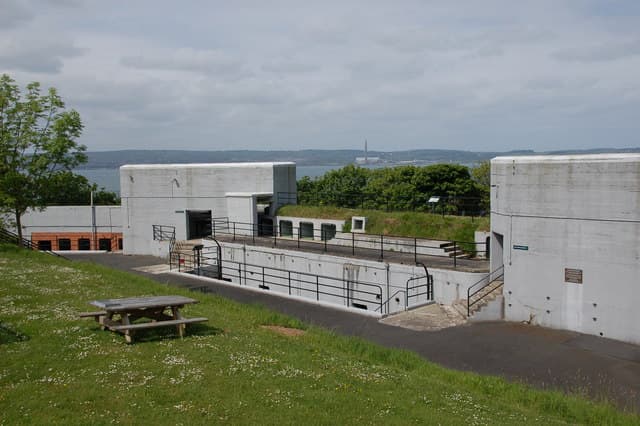
The fort's design reflects the principles of a bastioned fortress, with reinforced concrete gun positions and defensive earthworks. The Owen Report of 1905 specifically noted the construction of this battery alongside a counterpart at Kilroot on the opposite side of the Lough, emphasizing its role in a coordinated defensive system.
Role during the first world war
During the First World War, Grey Point Fort's role expanded beyond artillery. Additional buildings were constructed to accommodate men from Kitchener's Army, reflecting the increased military presence and the fort's importance in coastal defence. The fort helped protect Belfast's shipyards and maritime infrastructure from potential enemy naval threats.
Interwar period and modernization
Following the war, Grey Point Fort remained operational and underwent upgrades. In 1936, two coastal defence searchlights were installed to enhance night-time targeting capabilities. These improvements were part of broader efforts to modernize coastal defences in response to evolving military technology and threats.
Second world war enhancements and operations
During the Second World War, Grey Point Fort was manned by the 525th (Antrim) Coast Regiment, Royal Artillery, a Territorial Army unit. The fort's gun emplacements were further reinforced with concrete overhead covers to protect the artillery and crews from aerial attack and shellfire. This period marked the fort's peak operational readiness, as it stood guard against the threat of German naval and air attacks on Belfast and surrounding areas.
Post-war period and decommissioning
After the war, Grey Point Fort continued to serve a defensive role. In 1954, a mobile radar installation was added, reflecting the shift towards modern electronic surveillance in coastal defence strategies. However, with the abolition of coast artillery in 1956, the fort was officially disarmed and ceased to function as an active military installation.
Restoration and current status
Between 1992 and 1996, efforts were made to restore the fort's historic artillery capability. Two original guns were sourced from coastal fortifications in County Cork—one from Fort Mitchel on Spike Island and the other from Fort Davis. These guns were installed at Grey Point Fort, enhancing its value as a heritage site and a tangible link to Britain's coastal defence history.
Since 2008, the fort has been opened to the public by the Grey Point Amateur Radio Society. It now serves as a cultural and historical landmark, offering visitors insight into early 20th-century military architecture and coastal defence systems. The site provides educational opportunities and a glimpse into the technological and strategic developments that shaped Britain's maritime security during two world wars.
Architectural features and design
Grey Point Fort exemplifies the characteristics of a bastioned fortress built in the early 20th century. Its design incorporates reinforced concrete gun emplacements with protective overhead covers added during WWII. The layout includes ammunition storage facilities, crew quarters, and observation posts, all integrated within earthworks that blend with the natural landscape to reduce visibility and maximize defence.
The fort's two main gun positions are spaced to provide overlapping fields of fire across Belfast Lough, enabling effective control of naval traffic. The addition of searchlights and later radar installations demonstrates the evolution of coastal defence technology implemented at the site.
Historical significance and heritage value
Grey Point Fort holds significant historical value as part of the United Kingdom's early 20th-century coastal defence network. It illustrates the transition from traditional artillery fortifications to more modern, technology-integrated military installations. The fort's continuous use through both world wars and the Cold War era highlights its strategic importance.
Today, Grey Point Fort stands as a well-preserved example of a bastioned coastal battery and serves as a reminder of Belfast's maritime and military heritage. Its restoration and public accessibility contribute to the understanding of coastal defence history and the broader narrative of Britain's military preparedness during periods of global conflict.
Frequently asked questions (FAQ)
- What is Grey Point Fort?
- Grey Point Fort is a historic coastal fort located in the United Kingdom of Great Britain and Northern Ireland. It was originally built in the 19th century to protect the Belfast Lough from naval threats and served as a key defensive structure during both World Wars.
- When was Grey Point Fort constructed?
- Grey Point Fort was constructed in the 1850s as part of a series of fortifications designed to defend against potential attacks. It was officially completed in 1862 and played an essential role in the military history of the region.
- What are the opening hours for Grey Point Fort?
- Grey Point Fort typically opens to visitors from April to September, with varying hours depending on the day of the week. It's best to check the official website for the most current opening times before planning your visit.
- Can I visit Grey Point Fort year-round?
- While Grey Point Fort is primarily open to visitors during the warmer months, special events and tours may be available during the off-season. Always check the official site for updates on accessibility and special events throughout the year.
- Is Grey Point Fort accessible for visitors with mobility challenges?
- Grey Point Fort has made efforts to improve accessibility, but some areas may still pose challenges due to its historical structure. It is advisable to contact the fort in advance to inquire about specific accessibility features and accommodations.
- What are the ticket prices for Grey Point Fort?
- Ticket prices for Grey Point Fort are generally affordable, with discounts available for children, students, and seniors. Check the official website for the latest pricing information and any special promotions that may be running.
- When is the best time to visit Grey Point Fort?
- The best time to visit Grey Point Fort is during the spring and summer months when the weather is more favorable and the fort is fully operational. Visiting during special events or guided tours can also enhance your experience.
- Are there any nearby attractions to visit along with Grey Point Fort?
- Yes, there are several nearby attractions such as the beautiful coastal walks and the historic town of Bangor. Visitors can also explore other nearby forts and natural parks, making it an ideal spot for a full day of sightseeing.
- How do I get to Grey Point Fort?
- Grey Point Fort is accessible by car and public transport, with parking available nearby. If you're traveling by bus, check local routes that service the area to ensure a convenient journey to the fort.
Photo gallery

Information
Loading map...
Visitor reviews
No reviews yet. Been here? Write the first review and help other travelers!
Write the first reviewVisited this castle? Share your experience
Your review helps other travelers and adds first-hand knowledge to our encyclopedia.