Carrickfergus Castle
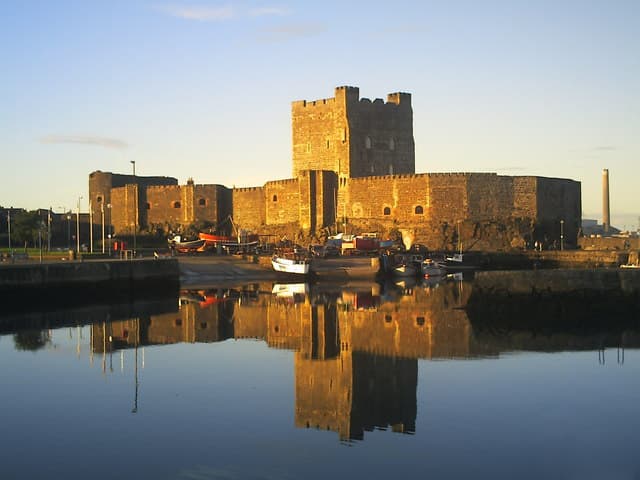
Carrickfergus Castle stands as one of the most significant and best-preserved medieval fortifications in Northern Ireland. Perched on a rocky promontory overlooking Belfast Lough in the town of Carrickfergus, County Antrim, this Norman castle has played a pivotal role in the military and political history of the region for over seven centuries. Its strategic location, surrounded originally on three sides by water, allowed it to control access to the lough and defend the northern approaches to the town below.
The castle was founded between 1177 and 1195 by the Anglo-Norman knight John de Courcy, who conquered eastern Ulster and established himself as a petty ruler. De Courcy constructed the initial fortification comprising a three-storey square keep within a small enclosure, now known as the Inner Ward. This early castle was designed with a high polygonal curtain wall and an eastern gate, providing a formidable defensive position at the tip of the rocky outcrop. The keep itself was a massive four-storey structure serving as the lord's residence and military stronghold.
Norman construction and early expansions
Following de Courcy's ousting in 1204 by another Norman noble, Hugh de Lacy, the castle underwent significant expansion. After King John of England captured the castle in 1210, construction efforts intensified. The keep was raised to its present height during the second building phase starting in 1216, and a second set of defensive walls, known as the Middle Ward, was added to extend the castle's footprint. These walls, although mostly reduced to foundations today, enhanced the castle's defensive capabilities.
Between 1226 and 1242, under Hugh de Lacy's rule, the castle was further extended to enclose the entire rocky promontory, creating what is now called the Outer Ward. This expansion doubled the castle's area and included a robust gatehouse flanked by two large circular towers, designed to guard the main entrance. Defensive features such as a ribbed vault over the entrance passage, murder holes, and portcullises were incorporated to thwart attackers. The east tower, notable for its Romanesque-style double window, likely served as the castle chapel.
Military significance and sieges through the centuries
Carrickfergus Castle witnessed numerous sieges and changes of control throughout its history. During the Edward Bruce invasion of Ireland, the castle fell to the Scots in 1316 after a prolonged siege. In the late 16th and early 17th centuries, the castle was adapted to accommodate artillery, with modifications including lowered towers and the addition of gunports and embrasures for cannon defense.
Despite these improvements, the castle changed hands multiple times. In 1689, it was besieged and captured by General Schomberg during the Williamite War in Ireland. King William III himself landed at Carrickfergus in 1690, marking the castle's continued strategic importance. Later, in 1760, the castle was briefly taken by French forces under François Thurot, who looted the castle and town before being defeated.
By the late 18th century, the castle had transitioned to a prison and was heavily fortified against the threat of French invasion during the Napoleonic Wars, equipped with up to 22 cannons on its eastern battery. Although only six remain today, these guns are a tangible reminder of the castle's military role during this era.
Role in modern conflicts and preservation
During the First World War, Carrickfergus Castle served as a garrison and ordnance store, and in the Second World War, it was repurposed as an air raid shelter. The castle was continuously garrisoned for approximately 750 years until 1928, when it was transferred from military use to the Government of Northern Ireland for preservation as a historic monument.
Restoration efforts in the 20th century removed many post-medieval and Victorian additions to reveal the castle's original Norman architectural character. The banqueting hall has been fully restored, and the castle now features exhibits and life-size models that illustrate medieval life, enhancing its appeal as a cultural and educational site.
Architectural features and layout
The castle's layout reflects its evolution over centuries of military use. The Inner Ward contains the imposing keep and several domestic buildings. Surrounding this is the Middle Ward, whose remnants hint at the castle's expansion in the early 13th century. The Outer Ward encloses the entire promontory, with formidable curtain walls and the gatehouse flanked by the distinctive D-shaped towers, modified in the early 1600s for artillery defense.
Defensive innovations include arrow slits, machicolations, and multiple portcullises designed to protect against siege warfare. The castle's position on a rocky outcrop originally nearly surrounded by sea provided natural defenses, enhanced by man-made fortifications.
Historical and cultural significance
Carrickfergus Castle is more than a military fortress; it is a symbol of Norman power in Ireland and a witness to centuries of conflict and change. Its continuous occupation by various rulers—from Anglo-Normans to English monarchs—reflects the turbulent history of Ulster and Northern Ireland.
The castle's association with notable figures such as John de Courcy, Hugh de Lacy, King John, General Schomberg, and King William III enriches its historical narrative. The nearby life-size bronze statue of William III commemorates his landing at Carrickfergus in 1690, highlighting the castle's role in wider British and Irish history.
Visiting Carrickfergus Castle today
Today, Carrickfergus Castle is maintained by the Northern Ireland Environment Agency as a state care historic monument. Visitors can explore the well-preserved medieval keep, the restored banqueting hall, and the castle's extensive defensive walls. Interpretive displays and models provide insight into the lives of the castle's inhabitants and the military technologies of the Middle Ages.
The castle offers a unique opportunity to experience a Norman stronghold that has survived over 800 years of history. It remains a popular tourist attraction, open daily with a modest admission fee, inviting visitors to step back in time and explore one of Northern Ireland's most iconic medieval landmarks.
Frequently asked questions (FAQ)
- What is the historical significance of Carrickfergus Castle?
- Carrickfergus Castle is one of the best-preserved medieval structures in Northern Ireland, with a history dating back to the 12th century. It played a crucial role in defending the area from invasions and was a strategic stronghold during various conflicts, including the Anglo-Norman conquests and the Irish Civil War.
- When is the best time to visit Carrickfergus Castle?
- The best time to visit Carrickfergus Castle is during the spring and summer months, from April to September, when the weather is generally milder and more conducive to outdoor exploration. This season also coincides with various events and activities held at the castle, enhancing your visitor experience.
- Can I access Carrickfergus Castle with limited mobility?
- Yes, Carrickfergus Castle is committed to accessibility. There are designated pathways and facilities for visitors with limited mobility, making it easier for everyone to enjoy the castle's historical features. However, some areas may have steep steps; it's advisable to check in advance if you have specific accessibility needs.
- What are the opening hours for Carrickfergus Castle?
- Carrickfergus Castle typically opens from 9:30 AM to 5:00 PM daily, with extended hours during the summer months. It is advisable to check the official website for any seasonal changes or special closures before your visit.
- How much do tickets cost to enter Carrickfergus Castle?
- Ticket prices for Carrickfergus Castle vary, with discounts available for children, students, and seniors. As of the latest information, adult tickets are approximately £5, while children under 16 can enter for free when accompanied by an adult.
- What nearby attractions can I visit while at Carrickfergus Castle?
- While visiting Carrickfergus Castle, you can also explore the charming Carrickfergus town, which features the historic St. Nicholas' Church and the picturesque marina. Additionally, nearby attractions include the beautiful Gobbins Path and the scenic Ballygally Castle, offering a rich array of experiences for history and nature enthusiasts alike.
- Is it possible to host events at Carrickfergus Castle?
- Yes, Carrickfergus Castle provides unique venues for a variety of events, including weddings, corporate functions, and educational programs. The castle's stunning backdrop and historical ambiance make it a memorable location for any special occasion. It's recommended to contact the castle's management for availability and specific arrangements.
Photo gallery

Information
Website
Visit websiteSources & official resources
Verify the information above using these authoritative references.
Loading map...
Visitor reviews
No reviews yet. Been here? Write the first review and help other travelers!
Write the first reviewVisited this castle? Share your experience
Your review helps other travelers and adds first-hand knowledge to our encyclopedia.