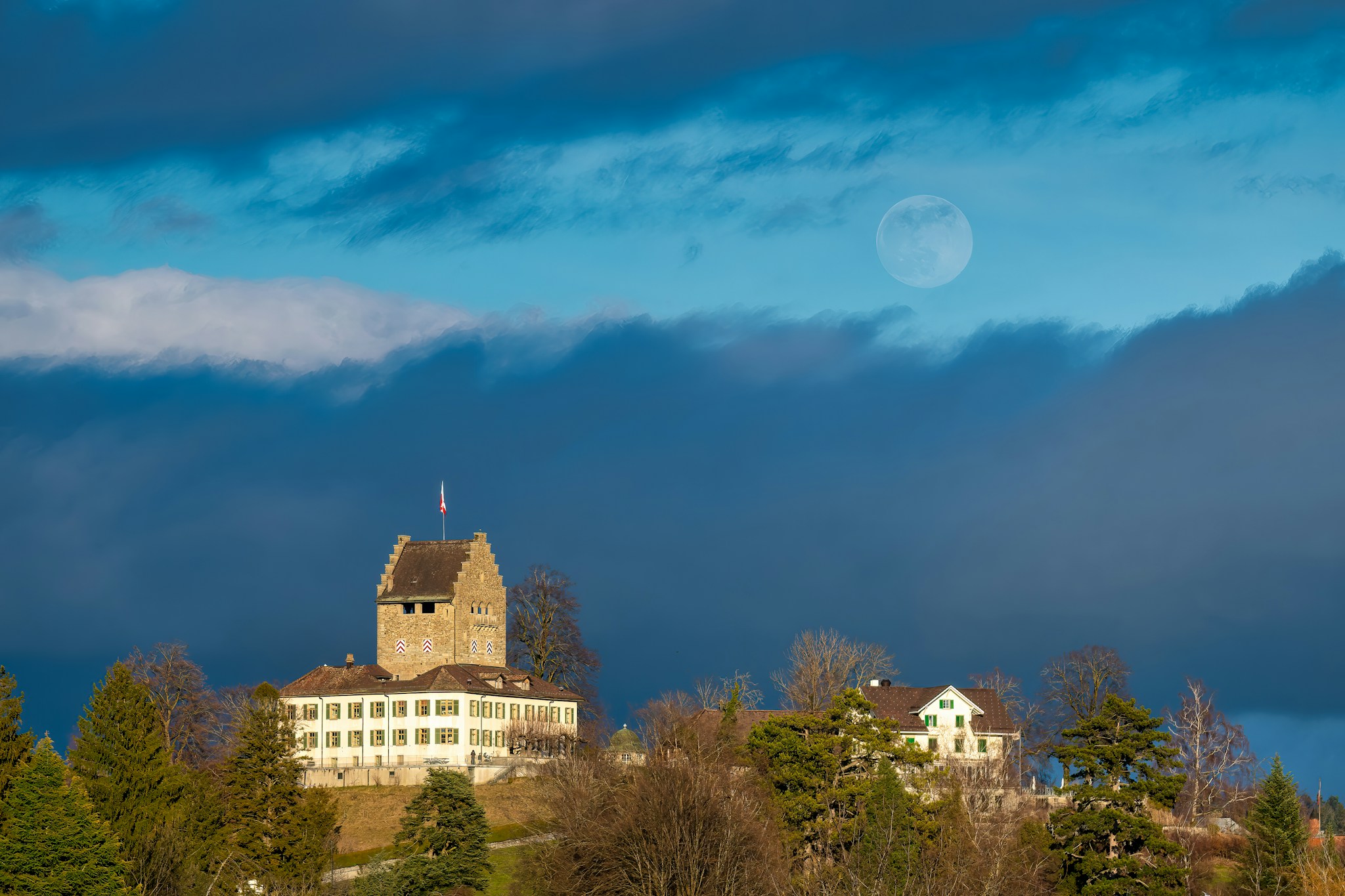
Greifensee Castle

Greifensee Castle: medieval fortress and cultural venue in Switzerland
Greifensee, Zurich, Switzerland
High Medieval (11th–13th c.)
Restored

Greifensee Castle stands as a significant example of high medieval fortification architecture in the Swiss canton of Zurich. Situated on the shores of Lake Greifensee, the castle's origins trace back to the early 12th century when the Counts of Rapperswil likely established an initial defensive tower on the site. This early structure laid the groundwork for what would become a more extensive castle complex by the mid-13th century.

Medieval origins and early construction

The core of Greifensee Castle was constructed around 1250, during the high medieval period. The castle was strategically positioned on a rocky outcrop that originally jutted directly onto the lake shore, providing a natural defensive advantage. The main residential building, or palas, was complemented by a surrounding ring wall and a moat that fortified the castle against attacks from land. These features reflect typical medieval defensive design, emphasizing protection through natural and man-made barriers.

Destruction and reconstruction

In May 1444, during the Old Zürich War, the castle suffered significant damage. It was partially destroyed in the conflict, which involved regional power struggles between the city of Zürich and its neighbors. The damage left the castle in ruins for several decades, impacting its military and residential functions.

By 1520, the city council of Zürich undertook a decision to rebuild the castle ruins. Unlike its original imposing medieval fortress form, the reconstruction aimed to create a more modest and functional castle. This reflects the changing needs and architectural trends of the early 16th century, moving away from purely military fortifications towards structures that could serve administrative and residential purposes.

Architectural features and layout

The castle's layout centers around the palas, which was the main hall and living quarters for the lord or governor. The ring wall encircling the castle provided a secure perimeter, while the moat added an extra layer of defense. The rocky foundation not only elevated the castle above the lake but also made it difficult for attackers to approach directly.

Over the centuries, modifications have altered the castle's appearance, but key medieval elements remain visible. The castle's position on the lake shore historically allowed control over local waterways and trade routes, enhancing its strategic importance.

Modern use and preservation

Today, Greifensee Castle has been thoroughly renovated and adapted for public use. It serves as a cultural and community venue hosting conferences, seminars, lectures, presentations, receptions, courses, small concerts, exhibitions, and private events such as banquets and weddings. Visitors can also rent individual rooms, making the castle a versatile space that blends historical ambiance with modern functionality.

The careful restoration efforts have preserved the castle's historical character while ensuring it meets contemporary standards for accessibility and comfort. As a result, Greifensee Castle remains an important heritage site in Switzerland, reflecting the region's medieval history and ongoing cultural life.

Historical significance and cultural heritage

Greifensee Castle is a valuable monument for understanding the medieval history of the Zurich region and the evolution of castle architecture in Switzerland. Its connection to the Counts of Rapperswil and involvement in the Old Zürich War highlight its role in regional power dynamics during the Middle Ages.

The castle's transformation from a military fortress to a cultural venue illustrates broader historical shifts in the use and perception of such structures. It stands as a testament to the adaptation of medieval buildings to modern needs while preserving their historical essence.

Frequently asked questions (FAQ)

When was Greifensee Castle originally built?
Greifensee Castle was originally constructed around 1250 during the high medieval period, with earlier defensive structures possibly dating to the early 12th century.
What happened to Greifensee Castle during the Old Zürich War?
In May 1444, Greifensee Castle was partially destroyed during the Old Zürich War, a conflict involving the city of Zürich and surrounding regions.
Can visitors rent rooms or host events at Greifensee Castle today?
Yes, the castle has been renovated and is available for public use, including renting rooms and hosting conferences, seminars, concerts, exhibitions, and private events.
What defensive features did the original castle have?
The original castle featured a palas on a rocky outcrop, protected by a moat and a surrounding ring wall, strategically located on the lake shore for natural defense.
Who built the first defenses on the site of Greifensee Castle?
The Counts of Rapperswil are believed to have built an early defensive tower on the site in the early 12th century, preceding the main castle construction.

Information

Hill Castle

Current owner

Municipality

Loading map...

Visitor reviews

No reviews yet. Been here? Write the first review and help other travelers!

Write the first review

Visited this castle? Share your experience

Your review helps other travelers and adds first-hand knowledge to our encyclopedia.

Write a review

(5/5)

0/2000 characters

Your review will be visible after admin approval

Nearby castles

3 km

Castle of Maur

Maur, Switzerland

The Castle of Maur stands as a remarkable example of a medieval hill castle in the municipality of Maur, Switzerland. Constructed in the mid-13th century, it originally served as a fortified stone residential tower and an administrative center under the auspices of the Fraumünster Abbey in Zürich. This castle’s strategic location on a terrace overlooking the village of Maur near Greifensee exemplifies typical medieval defensive siting, providing commanding views and natural protection. Architecturally, the castle began as a square stone tower approximately 8.9 meters per side, with robust foundations about 1.4 meters thick. The construction employed a masonry technique combining rough fieldstones with finely dressed corner stones, a method that enhanced both stability and durability. This technique was common in high medieval Swiss fortifications and contributed to the castle’s impressive preservation. Historical significance and ownership Built around 1250, the castle was entrusted to the Meier family of Maur, who acted as local administrators and exercised low-level judicial authority on behalf of the Fraumünster Abbey. This arrangement highlights the castle’s dual function as a residence and an administrative hub within the ecclesiastical territorial framework of medieval Switzerland. Ownership and control of the castle evolved over the centuries, reflecting broader political and social changes. From the 15th century, notable owners included Junker Johannes Engelhard and Junker Georg Grebel. In the 18th century, the castle passed to David Herrliberger, a prominent copper engraver who transformed it into both a home and a publishing center. Herrliberger’s tenure also involved limited judicial rights, which occasionally sparked local tensions. The judicial authority over the region alternated between the Kyburg family and the Landvogtei of Greifensee during the 17th and 18th centuries, yet the castle remained a freehold of the Meier family until Herrliberger’s acquisition. In 1775, the castle and its judicial rights were sold to Hans-Jakob Zollinger, though ultimate judicial control soon reverted to the city of Zürich. Architectural evolution and expansions Significant architectural changes occurred around the 18th and 19th centuries, marking a transition from a fortified tower to a more refined manor house. Herrliberger’s additions in the 1750s included an annex that expanded living and working spaces, reflecting the castle’s evolving residential and artistic functions. By the late 18th century, further expansions around 1800 transformed the castle’s character, adapting it to the needs of a manor house rather than a defensive stronghold. Around 1850, a stairwell was added to improve internal circulation, demonstrating continued adaptation to residential comfort and accessibility. Interior features and museum conversion The interior spaces have been thoughtfully adapted to preserve and showcase the castle’s unique history. The cellar houses workshops dedicated to copper engraving and book printing, honoring Herrliberger’s legacy as a publisher and artist. These workshops are integral parts of the museum’s exhibition facilities, offering visitors insight into traditional crafts. Additional exhibition spaces include the Salomon Cabinet and an art chamber, which host rotating displays highlighting the cultural heritage of Maur and the surrounding region. Since the municipality acquired the castle in 1962, major renovations in 1974–75 have facilitated its use as a museum, preserving its architectural integrity while adapting it for public education and cultural enrichment. Construction techniques and preservation The castle’s construction demonstrates the effective use of medieval masonry techniques, combining rough fieldstones with finely cut corner blocks to ensure structural stability. The thick foundations and robust walls have contributed to the building’s well-preserved condition, allowing it to survive centuries of change and remain a tangible link to the region’s medieval past. Today, the Castle of Maur stands not only as a monument to medieval architecture and Swiss history but also as a vibrant cultural institution. Its preservation as a museum dedicated to local history, art, and traditional crafts makes it a significant destination for visitors interested in the rich heritage of the Zürich region.

High Medieval (11th–13th c.)
Details
3 km

Regensberg Castle

Regensberg, Switzerland

Regensberg Castle stands as a remarkable example of a high medieval hill castle constructed in the mid-13th century by the influential House of Regensberg. Situated on a prominent hill in the municipality of Regensberg, Switzerland, this castle was conceived not merely as a fortress but as a fortified castle town, reflecting the strategic and urban planning ideals of its era. Architectural layout and fortifications The castle complex is divided into two main sections: the Upper Castle (Oberburg) and the Lower Castle (Unterburg). The Upper Castle is centered around a rectangular plaza which served as the main square, surrounded by two rows of houses that formed a protective and communal enclosure. One of the castle's most impressive features is a 57-meter deep water well hewn directly into the limestone bedrock, ensuring a secure water supply during sieges. The Lower Castle, likely constructed in the 14th century, lies nestled on the hillside outside the main town walls. Unlike the Upper Castle, it was not included in the significant fortification upgrades carried out in 1689, which modernized the defenses of the upper town according to contemporary military standards. Historical significance and ownership The foundation of the fortified town of Neu-Regensberg is attributed to either Lütold V von Regensberg or his son Ulrich von Regensberg around 1250. Following Ulrich's death circa 1280, his successor, Lütold VIII, was compelled to sell the castle and town to the powerful Habsburg dynasty in 1302. The Habsburgs frequently mortgaged the property, and in 1407, the city of Zürich acquired the Herrschaft Regensberg. From 1417, the castle served as the seat of the bailiff overseeing the bailiwick of Regensberg. During the Old Zürich War in 1443, the castle was besieged and captured by opposing forces but was spared destruction and soon reoccupied by Zürich troops. A devastating fire in 1540 destroyed the town but left the castle intact, leading to the reconstruction of the upper castle the following year. In 1689, the castle and upper town underwent modernization of their fortifications, reflecting advances in military architecture. The political upheavals of the late 18th century, including the French revolutionary invasion in 1798, ended the rule of the city republic of Zürich over Regensberg. Subsequently, the castle became the seat of cantonal authorities and housed the county jail until 1863. Architectural features and preservation The castle's design exemplifies the fortified castle town concept, with the Upper Castle's plaza and housing forming a defensible urban core. The round tower remains a prominent feature, accessible to visitors and offering panoramic views of the surrounding region. Informational panels inside the tower provide insights into the castle's extensive history and the development of the small country town. Today, Regensberg Castle is owned by the Regensberg Castle Foundation and is well preserved, allowing visitors to appreciate its medieval architecture and strategic location. The castle's walls, towers, and well-preserved structures provide a tangible connection to the high medieval period and the complex history of feudal and urban development in this part of Switzerland. The castle in regional context Regensberg Castle is part of a broader network of medieval fortifications in Switzerland that illustrate the shifting political and military landscape of the region during the Middle Ages. Its transition from a noble family seat to Habsburg possession and later to Zürich's control reflects the dynamic power struggles of the era. The castle's survival through wars, fires, and political changes underscores its resilience and importance as a cultural heritage site. Visitors to Regensberg Castle can explore not only the architectural marvels of the castle itself but also gain an understanding of medieval urban planning and defense mechanisms. The castle's hilltop position offers commanding views that were critical for surveillance and defense, while the town layout demonstrates the integration of residential and military functions within a fortified environment. Visiting regensberg castle today Currently, the castle is accessible to the public, with the round tower open for tours that showcase the castle's history and panoramic vistas. The site hosts various cultural events and educational programs aimed at preserving and promoting the castle's legacy. The Regensberg Castle Foundation manages the site, ensuring its maintenance and facilitating visitor engagement. As a well-preserved example of a high medieval hill castle and fortified town, Regensberg Castle offers a unique glimpse into the medieval past of Switzerland, making it a valuable destination for history enthusiasts, architecture scholars, and tourists alike.

High Medieval (11th–13th c.)
Details
3.5 km
Uster Castle — Switzerland castle

Uster Castle

Uster, Switzerland

Uster Castle stands prominently on a long moraine hill in the municipality of Uster, Switzerland, rising about 30 meters above the surrounding landscape at an altitude of 496 meters. This hill castle was originally constructed around the 13th century, likely circa 1200, by the influential House of Rapperswil. Its strategic location overlooking the Glatt Valley and the Greifensee lake shore provided both defense and oversight of important regional routes. The castle's origins may trace even earlier, connected to a fief granted by the Abbey of Saint Gall to the lords of Winterthur around 1027, with subsequent control contested by noble families including the Kyburgs before passing to the Bonstetten family in the late 13th century. Throughout the High Medieval period, Uster Castle served as a fortified residence and administrative center for the ruling families who held jurisdiction over surrounding villages such as Nossikon, Kirchuster, and Wermatswil. The castle's defensive features, including a massive sandstone tower with walls approximately 3.4 meters thick, formed the core of its fortifications. The tower's lower section, preserved to this day, reflects medieval military architecture designed to withstand sieges and protect its inhabitants. Medieval origins and strategic importance The castle's initial construction phase centered on a robust tower, which likely included a small ring wall encircling the plateau to enhance defense. Although the full extent of the medieval fortifications remains partially unexplored archaeologically, historical records and depictions suggest a compact but formidable castle complex. The House of Rapperswil established the castle as a symbol of their regional power, leveraging its vantage point to control trade and military movements. In the early 15th century, the Bonstetten family solidified their position by aligning with the nearby city of Zürich. In 1407, a formal Burgrecht agreement granted Zürich the right to station troops at Uster Castle during wartime, reflecting the castle's ongoing military significance. This alliance proved crucial during the Appenzell Wars (1401–1429), when the castle was briefly occupied by forces from the canton of Schwyz. The castle also played a role in the Old Zürich War, with the neighboring town of Greifensee besieged and destroyed, while Uster Castle remained a strategic stronghold. Fires, rebuilding, and architectural evolution A devastating fire in 1492 destroyed much of Uster Castle, including its main residential tower. Reconstruction efforts included replacing the upper portion of the tower with a half-timbered structure, a common architectural style featuring wooden framing filled with plaster or brick. A wooden house was also built beside the tower but was lost to fire in 1526. By 1529, the tower was rebuilt with distinctive stepped gables, characteristic of the late medieval period, enhancing both its defensive and aesthetic qualities. Further modifications in the 17th and 18th centuries included the addition of a narrow staircase on the tower's south side and a battlemented curtain wall separated by a defensive trench, improving the castle's fortifications. Residential wings were added in the mid-18th century by Captain Wilhelm Schärer, expanding the castle's living quarters. In the 19th century, the stepped gables were removed and replaced by a belvedere atop the battlements, while a two-story building adjoining the tower housed district administrative offices. The tower also served as a prison during this period, reflecting the castle's evolving civic functions. Modern restoration and current use By the early 20th century, Uster Castle had fallen into disrepair until Jakob Heusser-Staub purchased and funded extensive restoration between 1916 and 1917. Architect Johannes Meier led the restoration, removing 19th-century additions such as the belvedere and battlements and reconstructing the upper floors with a historicist design inspired by the 1529 rebuilding phase. The restoration standardized window openings and revitalized the castle's medieval character while adapting it for contemporary use. Following restoration, the castle was gifted to the city of Uster and served as a cantonal agricultural and home economics school for several decades. Since 1995, it has housed a private boarding school, continuing its educational legacy. The castle grounds also include a restaurant, previously known as Burg and later rebuilt as a steakhouse in 2009, integrating hospitality with heritage tourism. Architectural features and preservation The castle's core is dominated by the preserved medieval tower, measuring approximately 11 meters across. Its thick sandstone walls form a formidable defensive structure that has withstood centuries of conflict and environmental challenges. Portions of a circular wall, possibly dating from the 17th century or earlier, survive north of the tower, along with historic buildings such as a barn of uncertain origin. Inside, the castle retains significant medieval spaces including the Knights' Hall and the weapon chamber, which offer insights into the castle's military and social functions. Stained glass windows commemorate the Heusser-Staub family, recognizing their role in preserving the castle's heritage. Natural heritage and access limitations Uster Castle's tower is home to a colony of western jackdaws, an endangered bird species in Switzerland that regularly breeds within the structure. This ecological significance has led to restricted public access to the tower to protect the birds' habitat. From July to October, visitors can access the tower as a vantage point overlooking the Glatt Valley and Greifensee lake, with guided tours of the weapon chamber and Knights' Hall available. Separate entrances serve the boarding school and the castle tower, balancing preservation with public engagement. The castle hill's southwestern slope also features a historic vineyard dating back to at least the early 16th century, with records from 1532 documenting viticulture on the site. This tradition has seen a revival in recent decades, maintaining the agricultural heritage alongside the castle's architectural legacy. Historical significance and cultural legacy Uster Castle embodies the layered history of medieval and early modern Switzerland, reflecting shifts in feudal power, urban alliances, and regional conflicts. Its association with prominent noble families such as the Rapperswils and Bonstettens, its strategic military role during the Appenzell and Old Zürich Wars, and its adaptation to civic and educational functions illustrate the dynamic evolution of Swiss castles. Today, Uster Castle stands as a well-preserved monument combining medieval architecture, natural conservation, and modern educational use. Its ongoing preservation efforts and controlled public access ensure that both its cultural and ecological values are respected, making it a unique heritage site within the canton of Zürich.

High Medieval (11th–13th c.)
Details