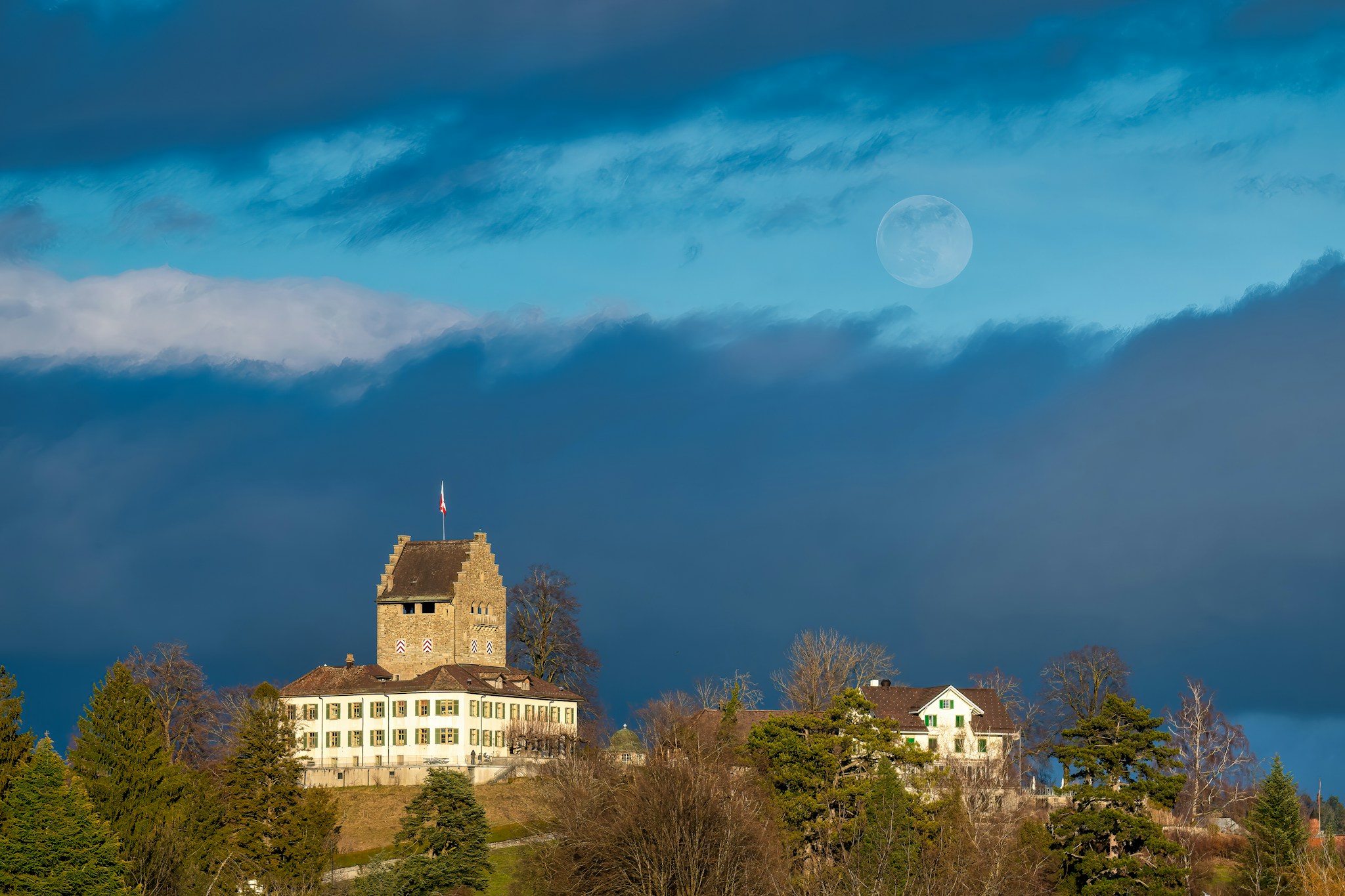
Castle of Maur
The Castle of Maur stands as a remarkable example of a medieval hill castle in the municipality of Maur, Switzerland. Constructed in the mid-13th century, it originally served as a fortified stone residential tower and an administrative center under the auspices of the Fraumünster Abbey in Zürich. This castle’s strategic location on a terrace overlooking the village of Maur near Greifensee exemplifies typical medieval defensive siting, providing commanding views and natural protection.
Architecturally, the castle began as a square stone tower approximately 8.9 meters per side, with robust foundations about 1.4 meters thick. The construction employed a masonry technique combining rough fieldstones with finely dressed corner stones, a method that enhanced both stability and durability. This technique was common in high medieval Swiss fortifications and contributed to the castle’s impressive preservation.
Historical significance and ownership
Built around 1250, the castle was entrusted to the Meier family of Maur, who acted as local administrators and exercised low-level judicial authority on behalf of the Fraumünster Abbey. This arrangement highlights the castle’s dual function as a residence and an administrative hub within the ecclesiastical territorial framework of medieval Switzerland.
Ownership and control of the castle evolved over the centuries, reflecting broader political and social changes. From the 15th century, notable owners included Junker Johannes Engelhard and Junker Georg Grebel. In the 18th century, the castle passed to David Herrliberger, a prominent copper engraver who transformed it into both a home and a publishing center. Herrliberger’s tenure also involved limited judicial rights, which occasionally sparked local tensions.
The judicial authority over the region alternated between the Kyburg family and the Landvogtei of Greifensee during the 17th and 18th centuries, yet the castle remained a freehold of the Meier family until Herrliberger’s acquisition. In 1775, the castle and its judicial rights were sold to Hans-Jakob Zollinger, though ultimate judicial control soon reverted to the city of Zürich.
Architectural evolution and expansions
Significant architectural changes occurred around the 18th and 19th centuries, marking a transition from a fortified tower to a more refined manor house. Herrliberger’s additions in the 1750s included an annex that expanded living and working spaces, reflecting the castle’s evolving residential and artistic functions.
By the late 18th century, further expansions around 1800 transformed the castle’s character, adapting it to the needs of a manor house rather than a defensive stronghold. Around 1850, a stairwell was added to improve internal circulation, demonstrating continued adaptation to residential comfort and accessibility.
Interior features and museum conversion
The interior spaces have been thoughtfully adapted to preserve and showcase the castle’s unique history. The cellar houses workshops dedicated to copper engraving and book printing, honoring Herrliberger’s legacy as a publisher and artist. These workshops are integral parts of the museum’s exhibition facilities, offering visitors insight into traditional crafts.
Additional exhibition spaces include the Salomon Cabinet and an art chamber, which host rotating displays highlighting the cultural heritage of Maur and the surrounding region. Since the municipality acquired the castle in 1962, major renovations in 1974–75 have facilitated its use as a museum, preserving its architectural integrity while adapting it for public education and cultural enrichment.
Construction techniques and preservation
The castle’s construction demonstrates the effective use of medieval masonry techniques, combining rough fieldstones with finely cut corner blocks to ensure structural stability. The thick foundations and robust walls have contributed to the building’s well-preserved condition, allowing it to survive centuries of change and remain a tangible link to the region’s medieval past.
Today, the Castle of Maur stands not only as a monument to medieval architecture and Swiss history but also as a vibrant cultural institution. Its preservation as a museum dedicated to local history, art, and traditional crafts makes it a significant destination for visitors interested in the rich heritage of the Zürich region.
Frequently asked questions (FAQ)
- What are the opening hours of the Castle of Maur?
- The Castle of Maur is open to visitors from Tuesday to Sunday, with hours from 10 AM to 5 PM. It is closed on Mondays and during certain holidays, so it's best to check the official website for any updates before planning your visit.
- Is it possible to take guided tours of the Castle of Maur?
- Yes, guided tours are available and highly recommended for a deeper understanding of the castle's rich history and architectural features. Tours typically run twice a day and can provide fascinating insights into the castle's past.
- When was the Castle of Maur built?
- The Castle of Maur was constructed in the late 12th century, making it a significant historical site in the region. Its architecture reflects the medieval styles prevalent during that time, showcasing the craftsmanship of the era.
- Can I access the Castle of Maur with a wheelchair?
- The castle has made efforts to improve accessibility for all visitors, including wheelchair access to certain areas. However, due to the historic nature of the site, some parts may still be challenging to navigate.
- What is the historical significance of the Castle of Maur?
- The Castle of Maur has played an important role in Swiss history, serving as a noble residence and a military stronghold. Its well-preserved structures and artifacts offer a glimpse into the feudal past of the region.
- What are the ticket prices for visiting the Castle of Maur?
- Admission to the Castle of Maur is reasonably priced, with adults paying around CHF 10 and reduced rates for seniors and students. Children under 12 can enter for free, making it an affordable outing for families.
- When is the best time to visit the Castle of Maur?
- The best time to visit the Castle of Maur is during the spring and early autumn months when the weather is pleasant and conducive to outdoor exploration. Additionally, visiting during special events can enhance your experience with unique activities.
- Are there any nearby attractions to visit along with the Castle of Maur?
- Yes, there are several nearby attractions, including beautiful hiking trails and scenic views of the Swiss countryside. The town of Maur itself offers charming cafes and shops that are perfect for a leisurely afternoon after your castle visit.
Information
Website
Visit websiteSources & official resources
Verify the information above using these authoritative references.
Loading map...
Visitor reviews
No reviews yet. Been here? Write the first review and help other travelers!
Write the first reviewVisited this castle? Share your experience
Your review helps other travelers and adds first-hand knowledge to our encyclopedia.