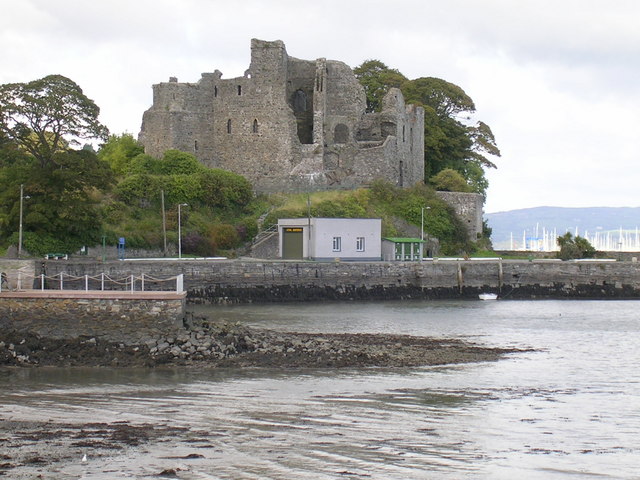
Green Castle
Green Castle, also known as Greencastle Castle, is a notable medieval fortress located next to the village of Greencastle, southwest of Kilkeel in County Down, Northern Ireland. This 13th-century castle holds significant historical and architectural importance as a strategic stronghold guarding the southern approaches to the Earldom of Ulster on the eastern shore of Carlingford Lough. It was built in the 1230s by the Anglo-Norman knight Hugh de Lacy, a key figure in the Norman colonization of Ireland.
Historical significance and early history
Green Castle was constructed to control the vital ferry link across Carlingford Lough to Carlingford Castle on the opposite shore, forming part of a defensive network securing Anglo-Norman territories. The castle's strategic location allowed it to oversee maritime traffic and protect the southern border of the Earldom.
In 1260, the castle was stormed by Irish forces, marking the beginning of a turbulent history marked by sieges and changes of control. From 1280 to 1326, Green Castle became a favored residence of Richard de Burgh, the "Red Earl" of Ulster, one of the most powerful men in Ireland during the late medieval period. His daughters were raised here, including Elizabeth de Burgh, who married Robert I the Bruce, King of Scotland, in 1302. This alliance did not prevent Robert's younger brother, Edward Bruce, from attacking and capturing Green Castle in 1316 during his campaign in Ireland.
Military conflicts and destruction
The castle endured multiple sieges and attacks. After an unsuccessful siege in 1333-34, Irish forces captured and destroyed Green Castle in 1343 and again in 1375. These repeated assaults illustrate the castle's contested status during the ongoing struggles between Anglo-Norman settlers and native Irish clans.
In 1505, the castle was granted to Gerald, Earl of Kildare, a prominent noble family in Ireland. However, following their downfall in 1534, the castle fell into decline. Despite this, it remained an English garrison in the 1590s, reflecting its continued military importance. Later, the castle was granted to the Bagnal family, who occupied it until 1635. The final destruction came in 1652 when Parliamentary forces bombarded and ruined the castle during the Cromwellian conquest of Ireland.
Architectural features and evolution
Originally, Green Castle was built as a rectangular two-storey tower raised upon a basement, containing a great hall. This keep was enclosed by a rectangular curtain wall with D-shaped corner towers and surrounded by a rock-cut ditch. Today, only the foundations of the curtain wall and corner towers remain. The main tower was accessed by a first-floor door on the south side, protected by a forebuilding, of which a portion still survives.
During the 15th century, the tower was remodeled to improve its defenses. A further story was added, and the ground floor was subdivided into three barrel-vaulted chambers. Additional modifications in the late 15th and mid-16th centuries gave the tower a more keep-like appearance. The walls were raised at the east and west ends, turrets were added at the angles, and features such as a spiral staircase, mural passages, and wall-walks were incorporated. These changes reflect the evolving military architecture of the late medieval period, adapting to new defensive needs.
Defensive structures
The castle's rock-cut ditch provided a formidable obstacle to attackers, enhancing the defensive capability of the curtain walls. The D-shaped towers at the corners allowed for flanking fire along the walls, a common feature in Anglo-Norman fortifications designed to resist siege warfare. The forebuilding protecting the entrance was an additional defensive measure, preventing direct assault on the main door.
Green Castle in the context of Irish and Scottish history
Green Castle played a role in the complex political and military conflicts of medieval Ireland and Scotland. The capture of the castle by Edward Bruce in 1316 was part of his campaign to establish himself as High King of Ireland, which disrupted Anglo-Norman control. The castle's association with the de Burgh family and its connection to Robert the Bruce through marriage highlight its importance in the intertwined histories of Ireland and Scotland.
After Edward Bruce's campaign ended in 1318, Robert the Bruce maintained interest in Ireland, visiting the island multiple times. Notably, in 1328, he proposed a peace treaty meeting at Green Castle between the English and Scots, underscoring the castle's diplomatic as well as military significance.
Current condition and visitor experience
Today, Green Castle is managed as a historical site and is accessible to the public free of charge during the summer months. The most substantial surviving structure is the rectangular keep, while only fragments of the surrounding curtain wall remain. The castle's rock-cut ditch is still visible, providing insight into its original defensive layout.
The castle's location offers excellent views of the Mourne Mountains and Carlingford Lough, making it a popular destination for visitors interested in medieval architecture and Irish history. The peaceful seaside village setting and the surrounding countryside add to the site's appeal.
Visitor information
- Access is free during the summer months.
- The site is open for self-guided visits, allowing exploration of the keep ruins and surrounding landscape.
- Visitors can enjoy panoramic views from the tower area, including vistas over Carlingford Lough and the Mourne Mountains.
Architectural legacy and significance
Green Castle stands as an important example of Anglo-Norman military architecture in Ireland. Its evolution from a simple rectangular tower to a more complex fortified keep reflects broader trends in castle design during the late medieval period. The castle's history of sieges, ownership changes, and strategic use illustrates the turbulent nature of medieval Irish politics and warfare.
The surviving architectural elements, including the barrel-vaulted chambers, spiral staircases, and mural passages, provide valuable insights into the defensive and domestic arrangements of a medieval stronghold. Green Castle's connection to significant historical figures and events further enhances its cultural heritage value.
Frequently asked questions (FAQ)
- How do I get to Green Castle?
- Green Castle is located in Greencastle, United Kingdom of Great Britain and Northern Ireland. Visitors can reach it by car, with ample parking available nearby, or by public transportation, with bus services connecting from major cities. The scenic drive along the coast adds to the experience of visiting this historic site.
- What is the historical significance of Green Castle?
- Green Castle dates back to the 13th century and played a crucial role in the defense of the region against various invasions. It is a remarkable example of medieval military architecture and offers insights into the turbulent history of the area. The castle's ruins tell stories of noble families and battles that shaped the local heritage.
- When was Green Castle built?
- Construction of Green Castle began in the early 1200s, with various additions and modifications made over the centuries. Its strategic location made it a key stronghold during its operational years. The castle has undergone significant restoration, allowing visitors to appreciate its historical grandeur.
- Can I take guided tours of Green Castle?
- Yes, guided tours of Green Castle are available and provide an in-depth look at its history and architecture. Knowledgeable guides share captivating stories about the castle's past and its significance. Tours typically run during peak visiting hours, so it's advisable to check the schedule in advance.
- Why is the architecture of Green Castle unique?
- The architecture of Green Castle reflects the military design common in the 13th century, featuring thick stone walls and strategic defensive structures. Its layout and design were intended for both defense and habitation, showcasing the ingenuity of medieval builders. The remaining ruins highlight its historical importance and architectural uniqueness.
- Is it possible to host events at Green Castle?
- Yes, Green Castle offers options for hosting events, including weddings and private gatherings, within its picturesque grounds. The stunning backdrop of the castle ruins and surrounding scenery makes it a memorable venue. Interested parties should contact the castle management for details on availability and arrangements.
- What are the opening hours of Green Castle?
- Green Castle is typically open to visitors from 10 AM to 5 PM, with extended hours during the summer months. It's advisable to check the official website for any seasonal changes or special events that may affect opening times. Visitors are encouraged to arrive early to fully explore the grounds.
- What are the ticket prices for visiting Green Castle?
- Ticket prices for Green Castle are generally affordable, with discounts available for children, students, and seniors. Family packages are also offered, making it a great destination for visitors of all ages. Tickets can be purchased at the entrance or online for convenience.
- What is the best time to visit Green Castle?
- The best time to visit Green Castle is during the spring and summer months when the weather is mild and the gardens are in full bloom. This period also coincides with various events and activities hosted at the castle. Autumn offers beautiful foliage, making it another picturesque time to explore the site.
- Are there nearby attractions to visit along with Green Castle?
- Yes, there are several nearby attractions that complement a visit to Green Castle, including beautiful coastal walks and historical sites. The charming town of Greencastle offers local shops and cafes for refreshments. Other nearby castles and museums provide additional insights into the region's rich history.
Information
Loading map...
Visitor reviews
No reviews yet. Been here? Write the first review and help other travelers!
Write the first reviewVisited this castle? Share your experience
Your review helps other travelers and adds first-hand knowledge to our encyclopedia.