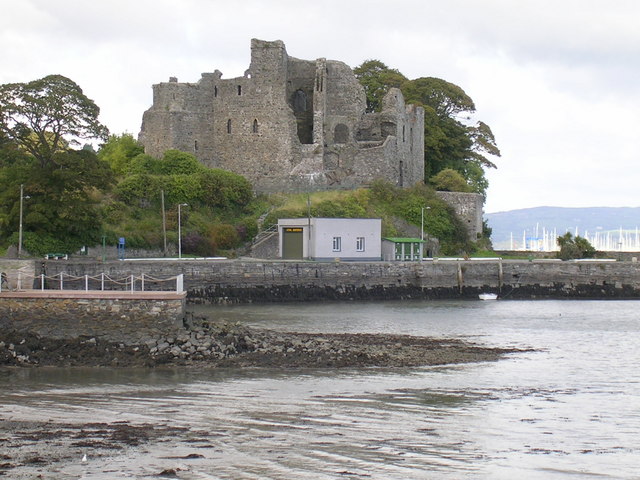
Carlingford Castle
Carlingford Castle, also widely known as King John's Castle, is a prominent medieval fortress located in the historic town of Carlingford in County Louth, Ireland. Sitting on a rocky outcrop overlooking Carlingford harbor, this castle commands a strategic position at the mouth of Carlingford Lough. Constructed in the late 12th century by the Norman lord Hugh de Lacy, it is recognized as the first fortified stone structure in Carlingford, marking the Norman consolidation of power in this region of Ireland.
The castle's location was critical for controlling access to Carlingford Lough, a vital waterway leading inland. Together with Green Castle, situated on the opposite side of the lough’s entrance near the Mourne Mountains, Carlingford Castle formed a defensive network securing the coastline and overseeing maritime traffic. This strategic importance is reflected in its enduring military and political role throughout the medieval and early modern periods.
Architectural design and features
Carlingford Castle is a classic example of a D-shaped enclosure castle, a design typical of Norman military architecture in Ireland during the High Medieval period. The castle's curtain walls are robustly constructed with deep embrasures and narrow defensive slits, allowing defenders to repel attackers while minimizing exposure. The western curtain wall features a rectangular gatehouse flanked by a square tower on the southwest side, portions of which, including the northern tower of the gatehouse, remain visible today.
In the latter half of the 13th century, a significant addition was made in the form of a large rectangular hall on the eastern side of the castle. This structure included two main floors above a basement, now largely filled with masonry. The great hall, positioned on the first floor, was designed to overlook the harbor, highlighting the castle’s dual role as both a military stronghold and a residence. The hall would have served as a center for administration, feasting, and gatherings, reflecting the social and political stature of its occupants.
Historical significance and changing ownership
The castle's popular name, King John's Castle, stems from the tradition that King John of England stayed here for three days during his 1210 campaign in Ireland. While the castle was originally built by Hugh de Lacy, it became associated with royal authority through this connection. Over the centuries, Carlingford Castle witnessed numerous changes in ownership and military action.
During the turbulent 17th century, the castle was captured by Sir Henry Tichbourne in 1642 amid the Irish Confederate Wars. It was later surrendered to Lord Inchiquin in 1649, only to be handed over to Sir Charles Coote in 1650. These shifts reflect the castle’s continued strategic importance during Ireland’s complex political conflicts.
In 1689, retreating Jacobite forces fired upon the castle, causing damage. Subsequently, it was repurposed as a hospital by General Schomberg in the lead-up to the Battle of the Boyne, underscoring its ongoing military utility even as warfare evolved.
Later developments and current condition
In the 19th century, the arrival of the Dundalk, Newry & Greenore Railway led to the construction of a deep cutting on the landward side of the castle. This engineering work enhanced the castle's prominence by exposing its defensive position more clearly to visitors and travelers. Despite these changes, the castle itself was not adapted for modern use and gradually fell into disuse.
Today, Carlingford Castle is partially preserved but not accessible inside due to the risk of falling masonry. Visitors can freely walk around the exterior and appreciate its imposing silhouette and commanding views over the harbor. The castle remains a key historical landmark within the town, which also features other medieval structures such as Taaffe's Castle and The Mint, a 16th-century tower house.
Carlingford castle in the context of Irish medieval fortifications
Carlingford Castle exemplifies the Norman approach to fortification in Ireland, combining military functionality with residential comfort. Its D-shaped curtain walls and defensive towers reflect an adaptation to local geography and the evolving nature of siege warfare during the High Medieval period. The castle's position guarding a key maritime route emphasizes the strategic priorities of Norman rulers in securing trade and military dominance.
The addition of the great hall in the 13th century illustrates the castle’s role beyond pure defense, serving as a center for governance and social life. This dual function was common among Norman castles in Ireland, which often acted as administrative hubs within their lordships.
Architectural details of the gatehouse and towers
The gatehouse of Carlingford Castle is a notable feature, originally comprising a rectangular structure with flanking towers designed to control access and provide strong defensive positions. The surviving northern tower demonstrates the use of thick stone walls and narrow arrow slits, allowing archers to cover the entrance effectively. The southwest square tower complemented these defenses, creating overlapping fields of fire.
The great hall and residential quarters
The great hall addition on the eastern side is a significant architectural element, reflecting the castle’s evolution from a purely military fortification to a noble residence. Positioned to overlook the harbor, the hall’s location would have offered both practical surveillance advantages and a prestigious outlook for its inhabitants. The multi-level design with a basement, main floors, and a grand hall space is typical of Norman castles adapting to the needs of lordly life.
Visiting Carlingford castle today
While the interior of Carlingford Castle is currently closed to visitors for safety reasons, the castle’s exterior and surrounding grounds provide a valuable historical experience. The castle’s prominent location by the harbor offers scenic views and photographic opportunities. Walking tours of Carlingford often include the castle as a highlight, along with other medieval buildings in the town.
The town of Carlingford itself has developed as a tourist destination, with its medieval streets, local shops, and eateries complementing the historical attractions. Nearby castles such as Taaffe's Castle and The Mint add to the rich architectural heritage visitors can explore.
Frequently asked questions (FAQ)
- What is the historical significance of Carlingford Castle?
- Carlingford Castle, built in the 12th century, is one of the best-preserved examples of medieval military architecture in Ireland. It played a crucial role in the defense of the region against various invasions and was a stronghold for the Anglo-Norman lords.
- When was Carlingford Castle built?
- Carlingford Castle was constructed in 1190 by the Anglo-Norman knight Hugh de Lacy. Its strategic location overlooking Carlingford Lough made it an important fortification during the medieval period.
- Can I visit Carlingford Castle?
- Yes, visitors are welcome to explore Carlingford Castle. The site offers a glimpse into medieval life and architecture, making it a popular destination for history enthusiasts.
- What are the opening hours for Carlingford Castle?
- Carlingford Castle is typically open to visitors from 10 AM to 5 PM daily, but it's advisable to check the official website for any seasonal changes or special events. This ensures you have the most accurate information for your planned visit.
- Is it possible to access Carlingford Castle for those with mobility challenges?
- While Carlingford Castle has some pathways and viewing areas, the historic nature of the site may present challenges for those with mobility impairments. It's recommended to contact the castle management in advance to inquire about accessibility options.
- When is the best time to visit Carlingford Castle?
- The best time to visit Carlingford Castle is during the late spring and early autumn months when the weather is generally mild and pleasant. This allows for an enjoyable experience while exploring the castle and its surroundings.
- What are the ticket prices for visiting Carlingford Castle?
- Admission to Carlingford Castle is typically free, but donations are appreciated to help with the maintenance of the site. Always check for any special events that might have different pricing.
- Are there nearby attractions to visit along with Carlingford Castle?
- Yes, visitors to Carlingford Castle can also explore the charming village of Carlingford, known for its picturesque streets and vibrant history. Additionally, the nearby Mourne Mountains offer excellent hiking opportunities and stunning landscapes.
Loading map...
Visitor reviews
No reviews yet. Been here? Write the first review and help other travelers!
Write the first reviewVisited this castle? Share your experience
Your review helps other travelers and adds first-hand knowledge to our encyclopedia.