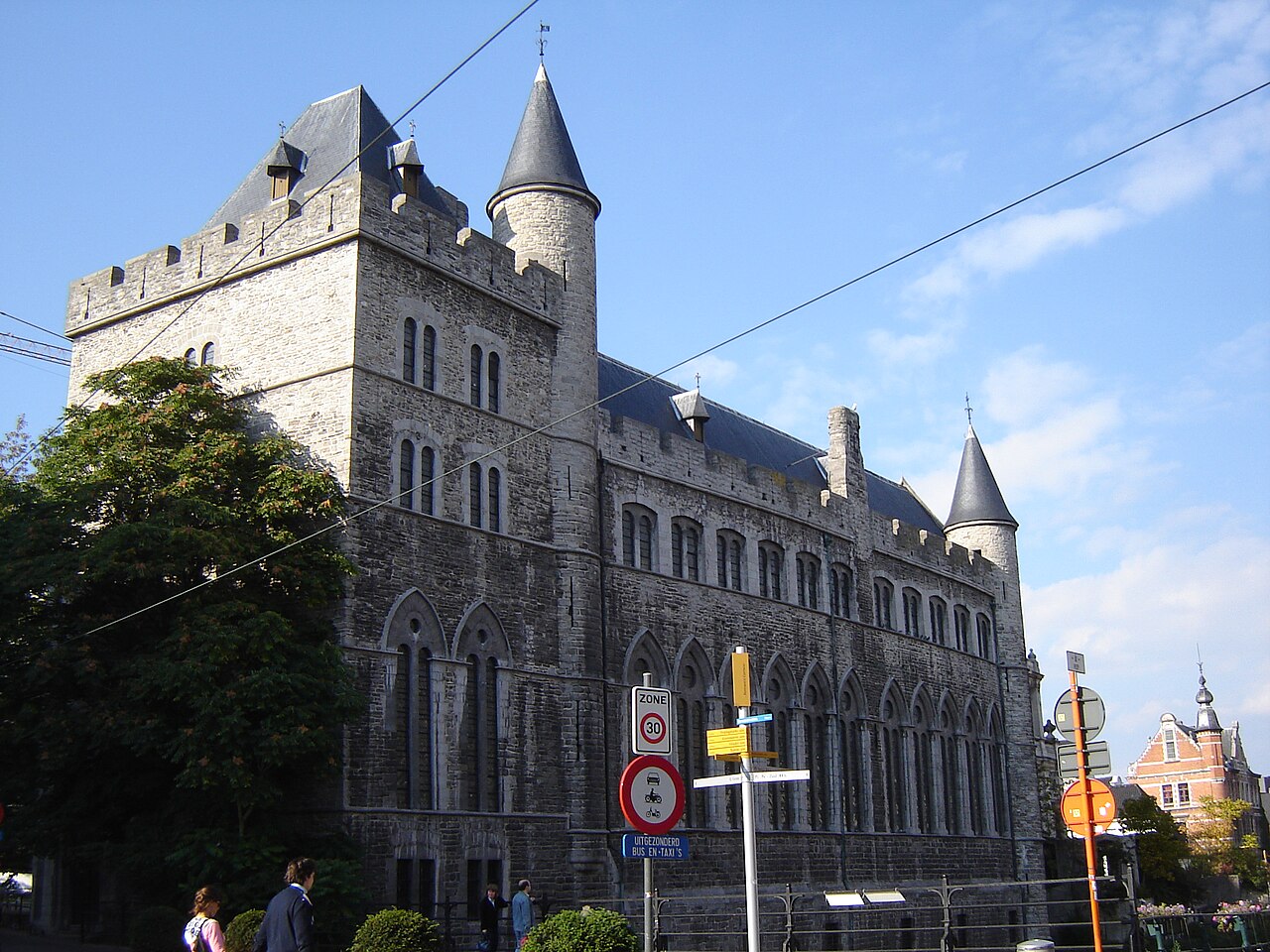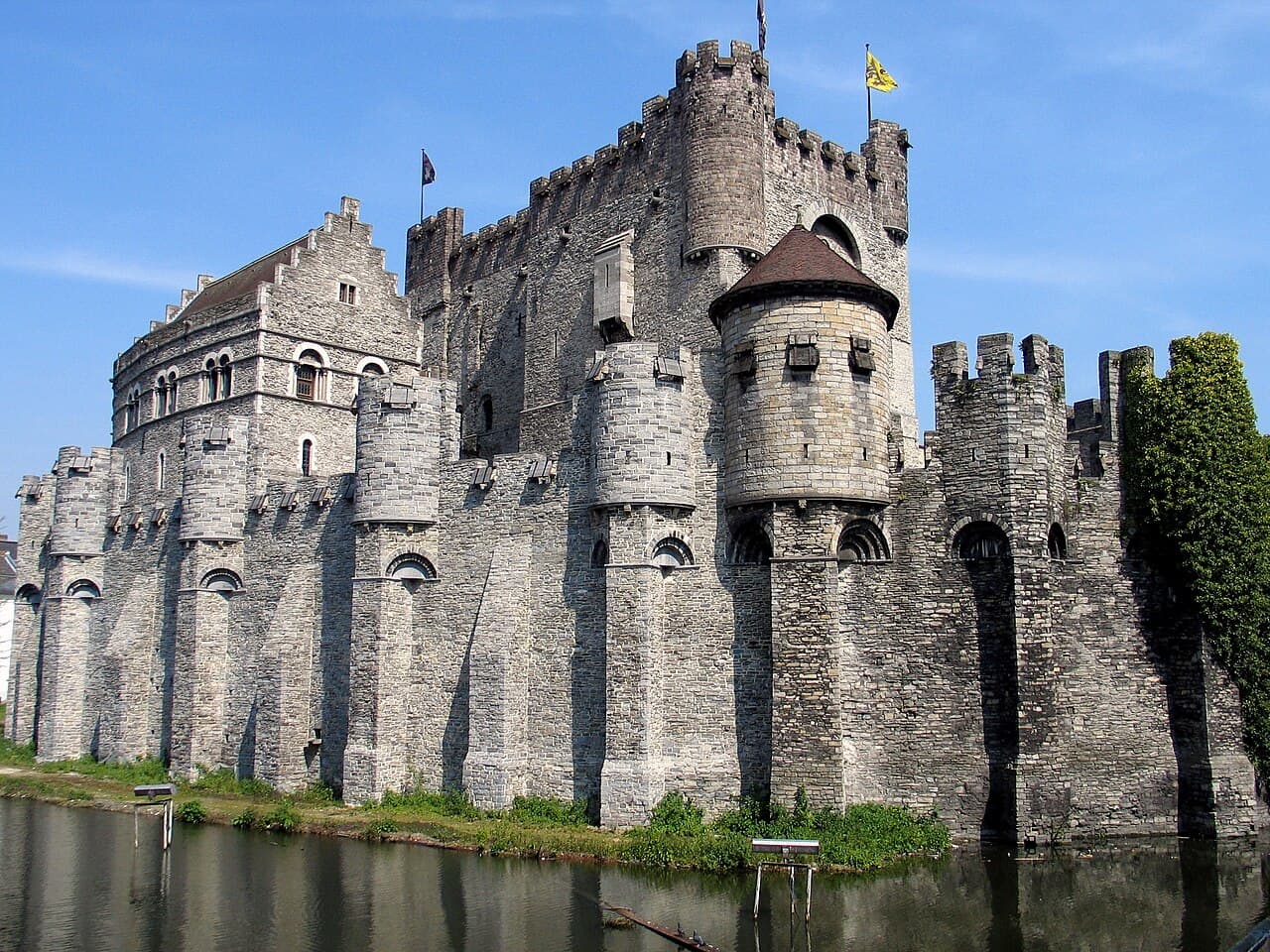
Gravensteen Castle stands as a formidable symbol of medieval power in the heart of Ghent, Belgium. Constructed in the 12th century by Count Philip of Alsace, this imposing fortress was designed to project the authority and wealth of the Counts of Flanders. Its architecture draws inspiration from the grand crusader castles Philip encountered during the Second Crusade, blending military functionality with imposing aesthetics. The castle's strategic location on a sandy dune near the confluence of the Leie and Scheldt rivers underscores its historical military significance, guarding key waterways and trade routes.
Early fortifications and medieval origins
The site of Gravensteen has been fortified since at least the 9th century, when Count Baldwin I, known as Baldwin Iron Arm, established an initial wooden stronghold to defend against Viking raids. This early fortification was replaced in the 10th century by Count Arnulf I with a more substantial wooden castle. By the mid-12th century, under Count Robert I of Flanders, the wooden structures were largely replaced by stone, including a large stone keep measuring approximately 33 by 18.8 meters. The castle was built as a classic motte-and-bailey design, featuring a raised earth mound and a surrounding moat. A devastating fire in 1176 destroyed many of the wooden buildings within the complex, prompting further stone reconstruction.
Construction under count philip of alsace
Circa 1180, Count Philip of Alsace undertook a major rebuilding project that shaped the castle into the form recognizable today. He expanded and raised the motte, erecting a central donjon approximately 30 meters tall, surrounded by a robust stone curtain wall fortified with 24 projecting towers and a fortified gatehouse with a forebuilding. This extensive fortification was intended not only for defense but also as a powerful statement of the Count's status and influence. The castle was initially known as "novum castellum" or "new castle," reflecting its modernity and grandeur at the time.
Role as the seat of the counts of flanders
For nearly two centuries, Gravensteen served as the residence and administrative center of the Counts of Flanders. It was often called the "Castle of the Counts" due to its association with the ruling dynasty. The castle's towering walls and imposing donjon symbolized the Counts' dominance over the region. However, in the 14th century, the Counts abandoned Gravensteen as their primary residence, relocating to the more comfortable Hof ten Walle (later the Prinsenhof). Despite this, the castle retained significant administrative functions, housing the Ghent Mint from 1353 and the Council of Flanders—the highest regional court—from 1407.
Judicial and penal functions
Following its residential use, Gravensteen became a center for justice and incarceration. It functioned as a courthouse and prison, with multiple courtrooms and subterranean dungeons where accused criminals were held under harsh conditions. The castle's dark reputation grew due to the use of torture devices and the infamous guillotine displayed today in its museum. These instruments reflect the medieval judicial practices once carried out within its walls.
Decline and industrial use
By the 18th and 19th centuries, the castle had fallen into disrepair. Its defensive moats had silted up and were overbuilt by houses, obscuring the once formidable fortress. After the Council of Flanders ceased operations in 1778, the castle was sold to private owners and repurposed for industrial use, including a cotton mill established in 1807. This industrial phase accelerated the castle's deterioration, and by the late 19th century, it was slated for demolition.
Restoration and preservation efforts
Recognizing its historical and cultural value, the city of Ghent repurchased Gravensteen in 1885. Between 1893 and 1903, architect Joseph de Waele led a comprehensive restoration project aimed at returning the castle to a romanticized version of its medieval appearance. This restoration involved removing non-medieval structures, demolishing houses built against the walls, and restoring the stone curtain walls and donjon. However, some features added during this period, such as flat roofs and certain window designs, do not accurately reflect the original medieval architecture.
Architectural features and layout
Gravensteen is a classic example of a hill castle with a motte-and-bailey layout. The central donjon stands about 30 meters tall and contains three floors with large halls stacked vertically, connected by a monumental stone staircase. The donjon includes wall fireplaces, latrines, and carefully placed light openings, demonstrating medieval efforts to balance defense with comfort and status.
The castle is enclosed by a formidable stone curtain wall featuring 24 projecting towers and a fortified gatehouse with a forebuilding. This enclosure creates an inner courtyard and separates an upper bailey, called the opperhof, from a lower bailey, the voorhof, where wooden utility buildings once stood. The castle sits atop an expanded motte formed by soil excavated from the surrounding moat, which originally encircled the entire complex and was filled with water. Restoration efforts have partially restored the moat to about two-thirds of its original capacity.
The castle's construction employs various colored stones, giving it a distinctive polychrome appearance. Archaeological excavations during restoration have revealed insights into the castle's development and earlier phases, including the original wooden fortifications.
Museum and cultural significance
Today, Gravensteen houses a museum that showcases a unique collection of medieval judicial instruments and torture devices, including a guillotine. The museum also displays a historical weapons collection assembled in the 19th century by industrialist Adolphe Neyt. Visitors can explore the castle's halls, dungeons, and ramparts, gaining insight into medieval justice and military architecture.
The castle is also linked to local cultural events, notably the 1949 student occupation known as the "Slag om het Gravensteen," a protest against beer price increases and police uniform changes. This event is commemorated annually by student festivals, highlighting the castle's ongoing role in Ghent's communal life.
Notable artifacts and archaeological finds
Among the castle's intriguing artifacts is a mummified wolf's paw, believed to have been nailed to the castle gate around 1700 as a trophy. This unusual relic is preserved in Ghent's city museum, STAM, underscoring the castle's rich and varied history beyond its military and judicial functions.
Frequently asked questions (FAQ)
- What are the opening hours of Gravensteen Castle?
- Gravensteen Castle is typically open to visitors daily from 10:00 to 18:00, with the last admission usually one hour before closing. Hours may vary seasonally, so it is advisable to check ahead before planning your visit.
- Can I tour the interior of Gravensteen Castle?
- Yes, visitors can explore the castle's interior, including the donjon, courtyards, and museum exhibits featuring medieval torture devices and weapons. Guided tours are often available to provide historical context.
- Is Gravensteen Castle accessible for people with mobility issues?
- Due to its medieval architecture with steep stairs and uneven surfaces, accessibility is limited. Some areas may be challenging for visitors with mobility impairments, so it is recommended to inquire in advance about available accommodations.
- What is the historical significance of Gravensteen Castle?
- Gravensteen Castle was the seat of the Counts of Flanders and a symbol of their power from the 12th to 14th centuries. It later served as a courthouse and prison, playing a central role in regional justice and administration.
- Are there any special events held at Gravensteen Castle?
- The castle hosts various cultural events, including reenactments and medieval festivals. It is also associated with the annual student festival commemorating the 1949 'Slag om het Gravensteen' protest.
Photo gallery

Information
Sources & official resources
Verify the information above using these authoritative references.
Loading map...
Visitor reviews
No reviews yet. Been here? Write the first review and help other travelers!
Write the first reviewVisited this castle? Share your experience
Your review helps other travelers and adds first-hand knowledge to our encyclopedia.