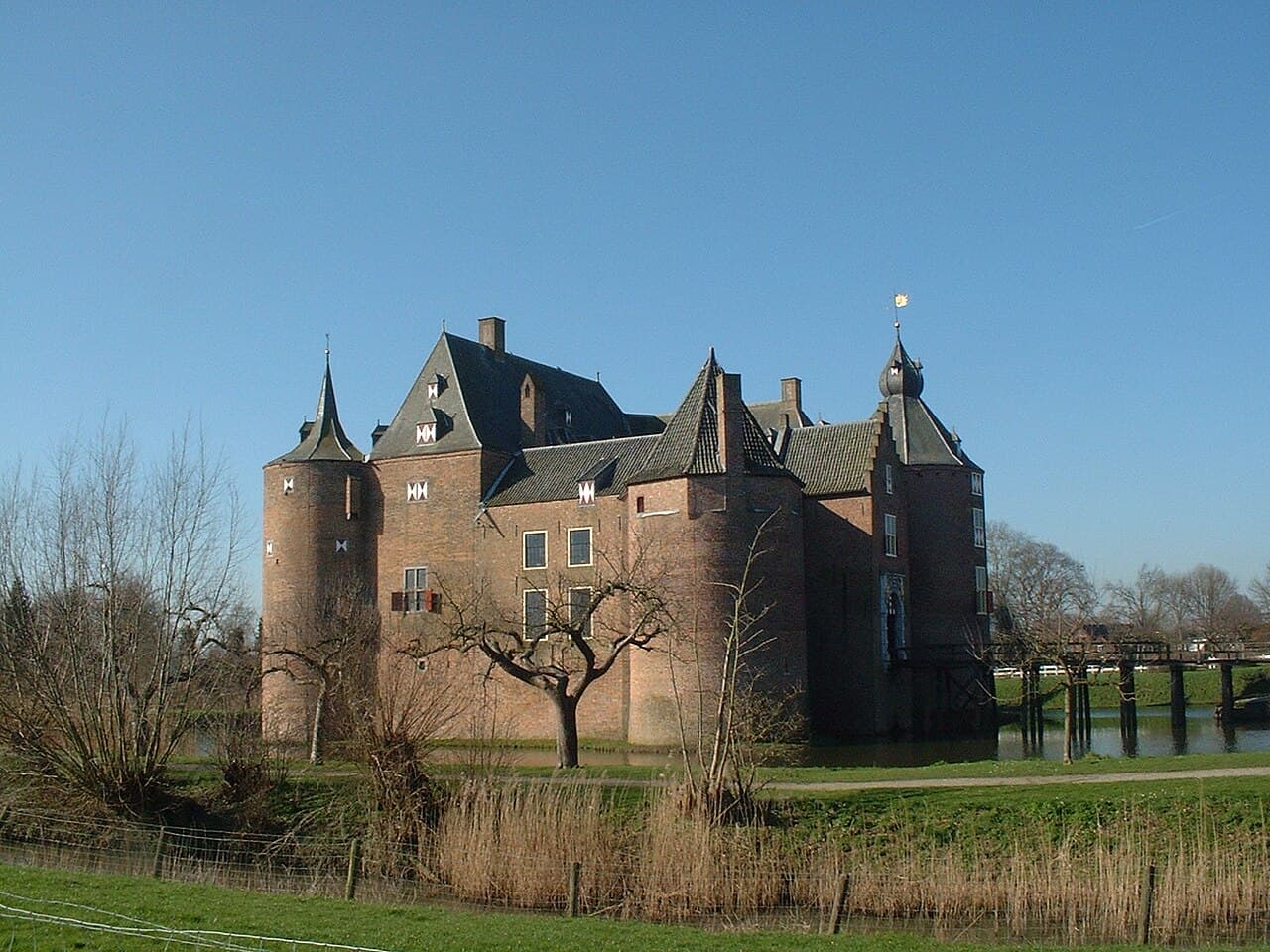
Ammersoyen Castle
Ammersoyen Castle, locally known as Kasteel Ammersoyen, is a remarkable example of a medieval water castle located near the village of Ammerzoden in the Gelderland province of the Netherlands. Constructed around 1350 by the Van Herlaer family, this castle stands as a testament to medieval defensive architecture and the turbulent history of the region. Its strategic location near the Meuse River and its characteristic square layout with four massive round corner towers make it a significant heritage site.
Medieval origins and architectural design
The castle was built along a branch of the River Maas (Meuse), which was later rerouted, leaving the castle surrounded by a moat fed by constructed canals. Ammersoyen Castle's design is notable for its rectangular, almost square layout comprising four wings that enclose a small central courtyard. Each corner is fortified with heavy round towers, a defensive feature that was common in medieval fortifications but executed here with particular symmetry and strength.
This design is similar to other Dutch castles such as Helmond Castle, Muiden Castle, and the partially surviving Radboud Castle. The castle was constructed following a fixed plan rather than in stages, reflecting architectural influences popularized by Count Floris V of Holland. The entire complex was originally surrounded by a moat, with access controlled by a single drawbridge on the northern side leading to an artificial island, which served as a fortified outer bailey or forburg. A second drawbridge connected this island to the mainland, enhancing the castle's defensive capabilities.
Historical significance and ownership
The castle's history is marked by frequent changes in ownership and military conflicts. Initially built by Dirk van Herlaer, the castle was seized in 1386 by Duke William of Gelre during regional conflicts and granted to his illegitimate son, Willem van Wachtendonk, in 1405. It was sold in 1424 to Johan van Broekhuizen, Lord of Waardenburg, and later came into the possession of the Van Arkel family through marriage in 1496. The Van Arkels maintained ownership for nearly two centuries.
The castle endured several sieges, notably in 1513 when it was damaged during a siege by Burgundian troops led by Count Henry III of Nassau-Dillenburg-Dietz, and again in 1574 when Spanish troops occupied it during the Eighty Years’ War. The castle escaped serious damage during these events, but in 1590, a devastating fire gutted the interior, killing the owner Joris van Arkel and leaving the castle in ruins.
Reconstruction began only after the end of the Eighty Years’ War in 1648, lasting until 1667. Thomas Walraven van Arkel restored the exterior to its original medieval appearance, while modernizing the interiors for 17th-century living. In 1672, during the French invasion known as the "Year of Disaster," the castle was spared destruction by paying a ransom of 7,000 guilders to French troops, a financial burden that contributed to the Van Arkel family's decline.
Following the death of the last Van Arkel lord in 1694, the castle passed through several owners from the Southern Netherlands, who rarely resided there. In the 19th century, Baron Arthur de Woëlmont acquired the castle and renovated its interiors in a neo-Gothic style. In 1873, the castle was sold to the Roman Catholic Church and converted into a convent for the Poor Clares. The moat was filled in, and a chapel was added to the western side, altering the castle's medieval landscape.
Damage, restoration, and modern use
The castle suffered heavy damage during World War II due to Allied shelling between 1944 and 1945. After the war, it served various functions, including as a factory and municipal office. In 1957, the Friends of Gelderland Castles Foundation purchased Ammersoyen and initiated a comprehensive restoration program that lasted until 1975. This restoration aimed to return the castle to its medieval appearance, uncovering original architectural features such as medieval staircases, arrow slits (embrasures), plastered fireplaces, and hidden chambers.
The restoration also involved re-excavating the moat and reconstructing the drawbridges, reinstating the castle's historic water-surrounded setting. Archaeological excavations around the castle uncovered an extensive collection of artifacts, including ceramics, jewelry, clothing fragments, weapons, and children’s toys, representing five centuries of history. These items are now displayed in a permanent exhibition within the castle.
Today, Ammersoyen Castle operates partly as a museum open to the public and partly as office space. The museum offers guided tours, cultural events, and exhibitions that highlight the castle's rich history and architectural significance.
Architectural features and grounds
The castle's primary building material is stone, which forms the thick defensive walls and robust towers. The Knight’s Hall is a notable interior space featuring a restored high ceiling and multiple fireplaces. The entrance pediment is adorned with decorative coats of arms from the Van Arkel and De la Kethulle families, symbolizing the castle's noble heritage.
The castle grounds include a small French-style garden on the northern island, planted with heliotrope, lavender, daisies, pink begonias, mulberry, fig, and pear trees, alongside ornamental shrubs and flowers situated between the inner and outer moats. These gardens enhance the castle's aesthetic and historical ambiance.
Archaeological importance and cultural heritage
Archaeological investigations have revealed the castle's continuous occupation and adaptation over centuries. The moat's filled layers preserved artifacts from the 14th century onwards, providing invaluable insights into medieval and post-medieval life. The extensive artifact collection displayed at Ammersoyen Castle is among the largest in the Netherlands, offering a unique window into the daily lives of its inhabitants.
The castle is a prime example of a medieval water castle that has survived through centuries of warfare, neglect, and restoration. Its preservation and public accessibility contribute significantly to the cultural heritage of Gelderland and the Netherlands as a whole.
Frequently asked questions (FAQ)
- How do I get to Ammersoyen Castle?
- Ammersoyen Castle is located at Kasteellaan 5 in Ammerzoden, Gelderland, Netherlands. It is accessible by car and public transport; the nearest train station is in Den Bosch, from where you can take a bus or taxi to the castle.
- What are the opening hours of Ammersoyen Castle?
- The castle museum is generally open to visitors from Tuesday to Sunday, 10:00 to 17:00, but it is advisable to check the official website for seasonal variations and special closures.
- Is Ammersoyen Castle wheelchair accessible?
- While the castle has some accessibility features, due to its medieval structure with stairs and uneven surfaces, full wheelchair access may be limited. Visitors with mobility issues should contact the museum in advance for assistance.
- What is the historical significance of Ammersoyen Castle?
- Ammersoyen Castle is a well-preserved example of a medieval water castle with a unique square layout and four corner towers. It played a significant role in regional conflicts and reflects the architectural and social history of Gelderland from the 14th century onward.
- Can I take guided tours at Ammersoyen Castle?
- Yes, the castle offers guided tours that provide detailed insights into its history, architecture, and archaeological findings. These tours are available during the museum's opening hours and can be booked in advance.
- Are there any special events held at Ammersoyen Castle?
- The castle hosts various cultural events, exhibitions, and educational programs throughout the year, enhancing visitor experience and engagement with its heritage.
- What can I see in the museum exhibitions?
- The museum exhibitions feature artifacts recovered from archaeological digs around the castle, including ceramics, jewelry, clothing fragments, weapons, and children’s toys, illustrating centuries of life at Ammersoyen.
Photo gallery

Information
Sources & official resources
Verify the information above using these authoritative references.
Loading map...
Visitor reviews
No reviews yet. Been here? Write the first review and help other travelers!
Write the first reviewVisited this castle? Share your experience
Your review helps other travelers and adds first-hand knowledge to our encyclopedia.



