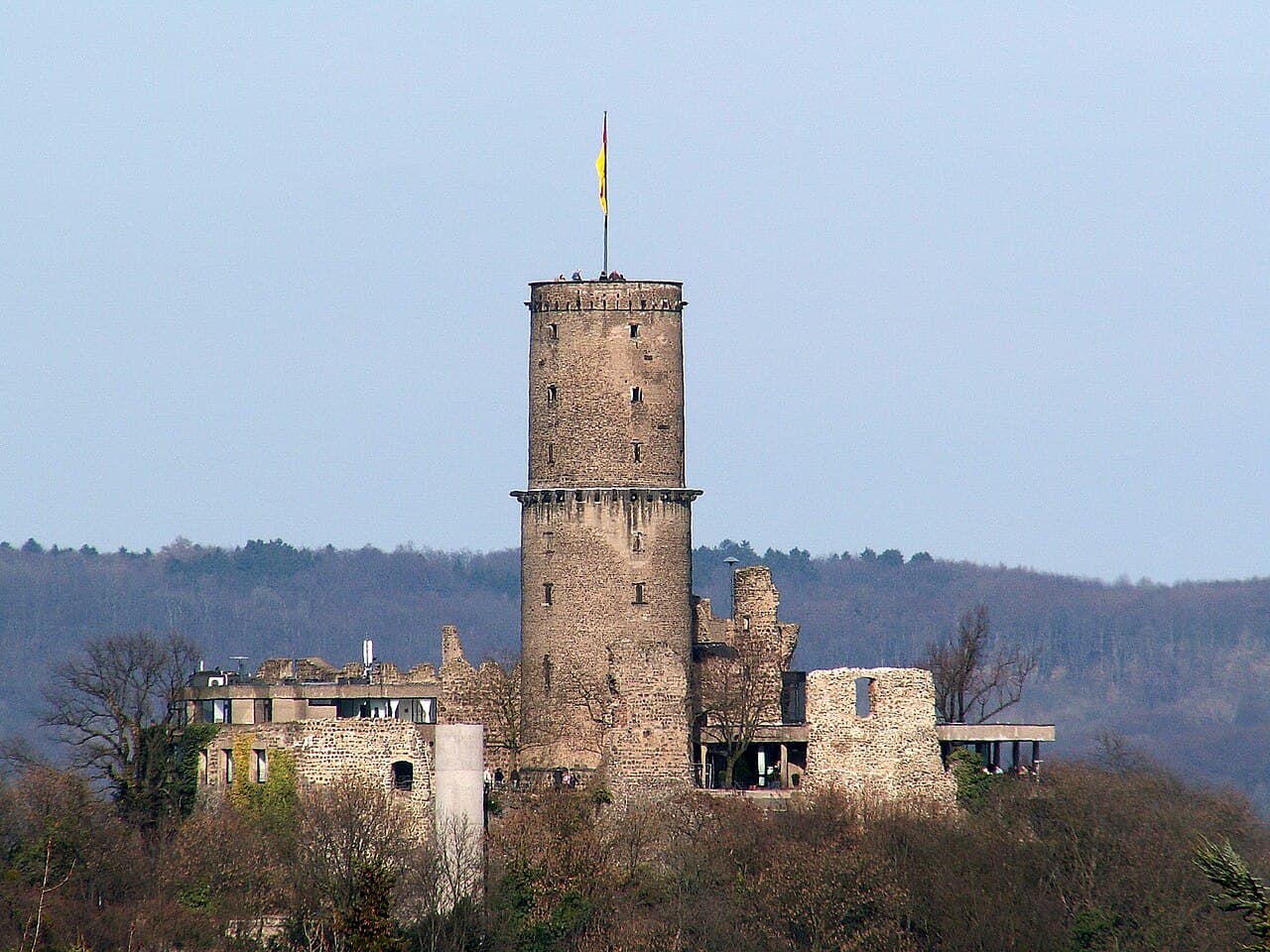
Godesburg Castle
Godesburg castle stands as a significant medieval fortress located on the volcanic hill of Godesberg in what is now the Bad Godesberg district of Bonn, Germany. Constructed in the early 13th century, the castle was originally commissioned under the direction of Dietrich I, Archbishop of Cologne, and completed by his successors after his death in 1224. The fortress was strategically positioned on the hill to exert control over the surrounding region and to symbolize the archbishop's power during a period of frequent conflicts with the patricians of the imperial city of Cologne.
Historical origins and early significance
The site of Godesburg castle has a history that predates the medieval fortress. Documented references to the location date back to the early 8th century, when it was believed to be a cult site associated with ancient Germanic worship. The name "Godesburg" is derived from the old Germanic terms Wotansberg, Woudensberg, or Gotansberg, which relate to the god Wotan (Odin). This connection to pagan traditions highlights the site's longstanding cultural importance before its transformation into a Christian stronghold.
Architectural development and fortifications
The castle's initial construction in the High Medieval period featured typical medieval defensive elements, including thick stone walls, a moat, and a central keep. The castle's bergfried—a tall, cylindrical tower—was a distinctive feature, differing from the more common square donjons of the era. Over the centuries, successive archbishops enhanced the fortress's defenses by strengthening the walls, expanding the moats, and adding a curtain wall to improve protection.
Notable architectural features
- The bergfried was raised in height and reinforced to serve both as a lookout and a last line of defense.
- The inner courtyard included a small residence, dungeons, and a chapel, reflecting the castle's dual role as a military fortress and an episcopal residence.
- Roads leading to the castle were improved for better access and supply lines.
Military history and sieges
Godesburg castle was a focal point in regional power struggles during the Middle Ages. Notably, during the reign of Siegfried II of Westwald (1275–1295), the fortress successfully withstood a five-week siege by Count William of Cleves, underscoring its strategic strength. The castle's military importance continued into the 16th century, during which it was further fortified with influences from Italian military architecture, reflecting advances in artillery and siege warfare.
The siege of 1583 and destruction
In 1583, at the outset of the Cologne War, Godesburg castle was besieged and largely destroyed. The siege marked a turning point in the castle's history, leading to its ruinous state. Despite its destruction, the castle remained a potent symbol of the Electorate of Cologne's authority. By the late 14th century, it had served as the repository for the Elector's valuables and archives, and by the mid-16th century, it was considered the Elector's "lieblingssitz" or favorite residence.
Modern restoration and current use
After centuries as a ruin, the site of Godesburg castle underwent significant restoration in the 20th century. In 1891, the castle ruins were donated to the city of Bad Godesberg by German Emperor Wilhelm II. Later, in 1959, renowned architect Gottfried Böhm led a reconstruction project that transformed the ruins into a mixed-use facility. The restoration preserved the castle's historic character while adapting it for modern use, including a restaurant and a hotel.
Today, the former hotel section has been converted into private apartments, but the restaurant remains operational, offering visitors a unique opportunity to dine within the historic walls of this medieval fortress. The site continues to attract tourists and history enthusiasts interested in its architectural features and its role in the region's medieval and early modern history.
Architectural style and classification
Godesburg castle is classified as an archaeological ruins site, reflecting its partial preservation following the 1583 siege and subsequent centuries of decay. Its architectural style is primarily High Medieval, with later modifications influenced by Renaissance military engineering principles, particularly those popularized by Italian architects. The castle's strategic hilltop location classifies it as a hill castle, typical of medieval fortifications designed for defense and territorial control.
Photo gallery

Information
Website
Visit websiteSources & official resources
Verify the information above using these authoritative references.
Loading map...
Visitor reviews
No reviews yet. Been here? Write the first review and help other travelers!
Write the first reviewVisited this castle? Share your experience
Your review helps other travelers and adds first-hand knowledge to our encyclopedia.


