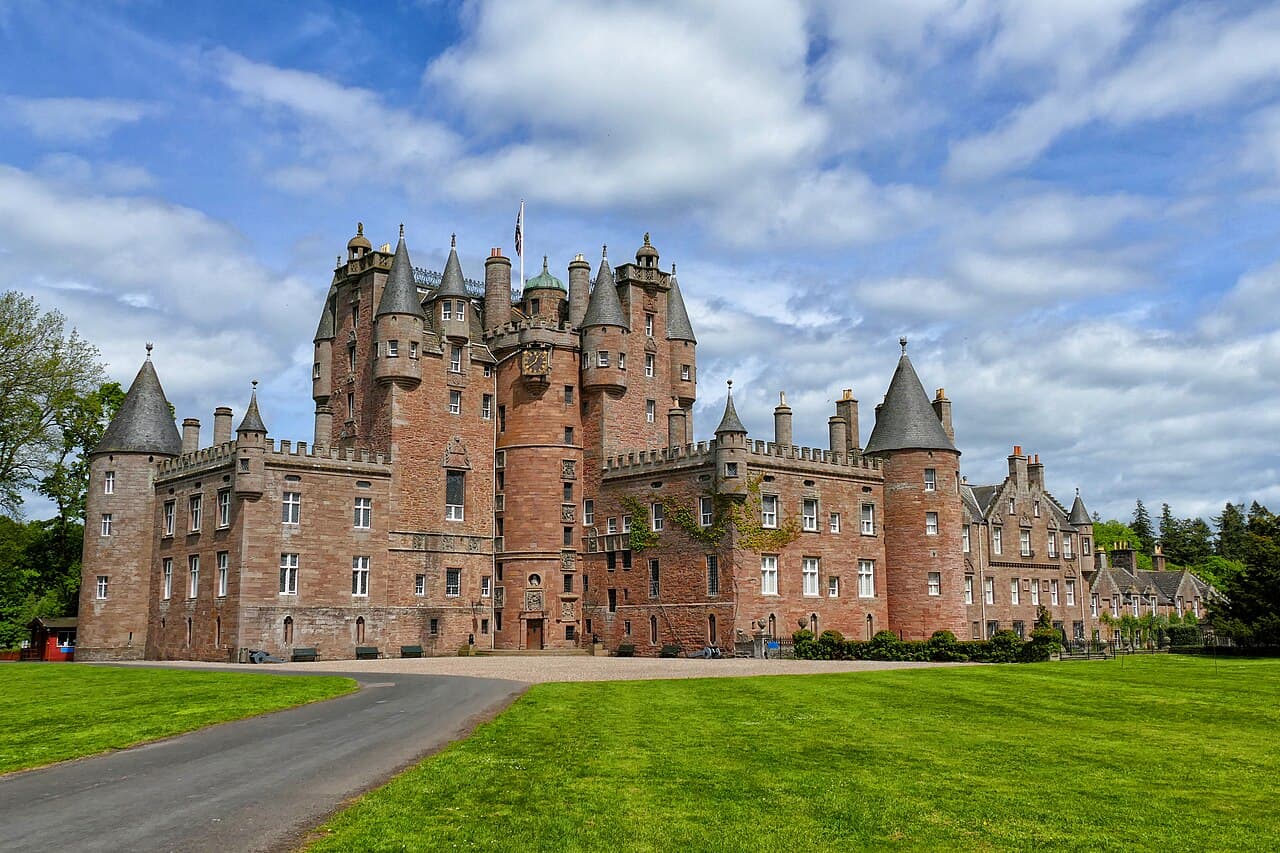
Glamis Castle
Glamis Castle stands as a remarkable example of Scottish medieval architecture and aristocratic heritage. Located near the village of Glamis in Angus, Scotland, this hill castle has been the ancestral home of the Bowes-Lyon family, Earls of Strathmore and Kinghorne, since the 14th century. Its historical significance is deeply intertwined with Scotland's royal history, as well as with rich folklore and ghost stories that have captivated visitors for centuries.
The castle's origins trace back to a royal hunting lodge on the site where King Malcolm II was fatally wounded in 1034, long before the current structure was built. By 1372, a castle was established when King Robert II granted the estate to Sir John Lyon, Thane of Glamis, marking the beginning of the Lyon family's long association with the property. The castle was rebuilt as an L-plan tower house in the early 15th century, with the main tower erected in 1435, serving as a fortified stronghold during turbulent times.
Architectural evolution and significant additions
Glamis Castle's architecture reflects centuries of development, blending late medieval defensive elements with later stylistic enhancements. The castle's walls are approximately one meter thick, designed for strong defense, and feature two front towers each about seven meters in diameter and four meters high, topped with modern parapets that harmonize historic and contemporary features.
During the 17th century, significant expansions were made, including the construction of the West Wing and a small north-east wing housing the castle chapel. The fortified courtyard walls were removed and replaced with elegant Baroque sculptures and landscaped yards, reflecting changing tastes and the castle's transition from a fortress to a stately home. The castle's grounds were transformed in the 18th century by renowned landscape architects, including Capability Brown, who designed the parks and tree-lined avenues leading to the castle.
Further renovations in the late 18th and early 19th centuries introduced castellations replacing the sloping roofs of the East Wing and the reconstruction of the West Wing in a complementary style. The addition of the Dutch Garden in 1893 and the Italian Garden in 1910 enhanced the castle's exterior beauty, showcasing a blend of formal garden design and romantic landscaping.
Historical significance and royal connections
Glamis Castle is historically notable for its royal associations and dramatic events. It was the childhood home of Queen Elizabeth The Queen Mother, wife of King George VI, who was born there in 1900. Her daughter, Princess Margaret, Countess of Snowdon, was also born at Glamis in 1930. The castle served as a military hospital during World War I and survived a major fire in 1916, thanks in part to the Queen Mother's efforts in rescuing its contents.
The castle's history includes dark chapters such as the tragic fate of Janet Douglas, Lady Glamis, who was accused of witchcraft and burned at the stake in 1537. Her story is immortalized in the castle's legends and ghost lore. The castle also played a role during the Commonwealth period when it was garrisoned by soldiers, and it underwent restoration after being found uninhabitable in 1670.
Ghost stories and folklore
Glamis Castle is renowned as one of the most haunted castles in the British Isles, with numerous reports of supernatural occurrences. Among the most famous apparitions is the woman without a tongue, a ghostly figure seen with a severely injured face wandering the grounds and peering from a barred window. The Grey Lady, believed to be Lady Glamis herself, is said to haunt the castle, her tragic story tied to accusations of witchcraft and royal intrigue.
Other spectral figures include the ghost of a young servant boy often seen near the Queen's room door and the infamous Earl Beardie, Alexander Lindsay, the fourth Earl of Crawford. According to legend, Earl Beardie made a pact with the devil to play cards for eternity, his ghostly presence felt throughout the castle, especially by children who report seeing a dark figure standing over their beds.
Interior features and estate grounds
The castle's interiors boast exquisite 18th- and 19th-century features, including a large fireplace relocated from Gibside, adorned with the Blakiston family coat of arms. The ceilings display some of Scotland's finest stucco work, comparable to other distinguished castles like Muchalls and Craigievar. The small chapel within the castle seats 46 people and is still used for family ceremonies. A seat is traditionally reserved for the "White Lady," linking the chapel to the castle's ghostly heritage.
The estate covers over 57 square kilometers (14,000 acres), including parks, gardens, and an arboretum with rare and ancient trees. It supports agricultural activities such as lumber production and beef farming. Approaching the castle, visitors are greeted by four 17th-century bronze statues of monarchs Charles I, James VI, Charles II, and James VII, two of which were crafted by sculptor Arnold Quellin.
The castle archives, housed in the clock tower, contain significant historical documents, including a papal bull and memoirs of Mary Eleanor Bowes, connected to the University of Dundee's collections. These archives provide valuable insights into the castle's long and storied history.
Cultural impact and modern significance
Glamis Castle holds a prominent place in Scottish cultural heritage and popular imagination. It is famously referenced in William Shakespeare's play Macbeth, where the titular character is associated with Glamis, although the historical King Macbeth had no direct connection to the castle. Since 1987, an illustration of Glamis Castle has appeared on the reverse side of the Royal Bank of Scotland's ten-pound notes, underscoring its iconic status.
Today, Glamis Castle remains the family home of Simon Bowes-Lyon, the 19th Earl of Strathmore and Kinghorne, who succeeded in 2016. The castle is open to the public, offering visitors a chance to explore its rich history, architectural grandeur, and enchanting gardens. Its blend of medieval fortification, baroque elegance, and romantic landscaping makes it a unique destination for those interested in Scottish history and heritage.
Frequently asked questions (FAQ)
- How do I get to Glamis Castle?
- Glamis Castle is located in the picturesque village of Glamis, Scotland, just a short drive from the city of Dundee. The castle is easily accessible by car, and there is ample parking available for visitors. If you prefer public transport, take a train to Dundee and then a local bus or taxi to reach the castle.
- What is the historical significance of Glamis Castle?
- Glamis Castle has a rich history dating back to the 14th century and is renowned as the ancestral home of the earls of Strathmore and Kinghorne. It is famously associated with Shakespeare's Macbeth and is often referred to as one of the most haunted castles in Scotland. The castle has also been a residence of the British royal family, making it a significant site in Scottish history.
- When was Glamis Castle built?
- The original fortress at Glamis was constructed in the 14th century, with extensive renovations and additions made over the centuries. The castle we see today features elements from the 16th century and onward, showcasing a blend of architectural styles, including Gothic and Renaissance influences. Its iconic turrets and intricate stonework make it a stunning example of Scottish castle architecture.
- Can I visit Glamis Castle year-round?
- Yes, Glamis Castle is open to the public throughout the year, although specific areas may have seasonal closures. The best time to visit is during the spring and summer months when the gardens are in full bloom and guided tours are available. Always check the official website for the most current information on opening times and any special events.
- Why is Glamis Castle considered haunted?
- Glamis Castle is famous for its ghost stories and supernatural legends, making it one of Scotland's most haunted locations. Tales of mysterious apparitions, including the Grey Lady and the Earl Beard, have been passed down through generations. Visitors often report feeling a strange presence, adding to the castle's eerie charm.
- Is it possible to take guided tours of Glamis Castle?
- Yes, guided tours are available at Glamis Castle and provide an in-depth look at its history, architecture, and the fascinating stories associated with it. Tours are led by knowledgeable guides who share captivating anecdotes and insights about the castle. Audio guides are also available for visitors who prefer exploring at their own pace.
- What are the ticket prices for Glamis Castle?
- Ticket prices for Glamis Castle vary depending on age and type of tour selected. Generally, adult tickets are around £12, while concessions and children's tickets are offered at reduced rates. Family tickets are also available, providing a great value for those visiting with children.
- What are the opening hours of Glamis Castle?
- Glamis Castle typically opens from 10:00 AM to 5:00 PM during the summer months, with reduced hours in the winter. It's advisable to check the official website for the most accurate and up-to-date information on opening hours and any seasonal changes. Special events may also influence regular visiting hours.
- What nearby attractions can I visit while at Glamis Castle?
- While visiting Glamis Castle, you can explore the beautiful surrounding countryside, including the scenic Angus Glens and the picturesque village of Glamis itself. Nearby attractions include the historic village of Forfar and the stunning landscapes of the Cairngorms National Park. Additionally, the enchanting town of Dundee is just a short drive away, featuring museums and cultural sites.
Photo gallery

Information
Website
Visit websiteSources & official resources
Verify the information above using these authoritative references.
Loading map...
Visitor reviews
No reviews yet. Been here? Write the first review and help other travelers!
Write the first reviewVisited this castle? Share your experience
Your review helps other travelers and adds first-hand knowledge to our encyclopedia.



