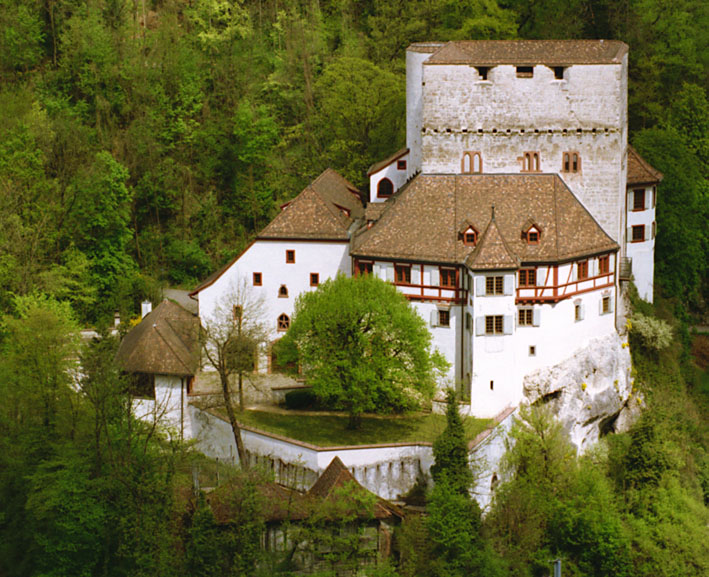
Gilgenberg Castle Ruin
Gilgenberg castle ruin stands prominently above the municipality of Zullwil in Switzerland, representing a significant example of a hill castle from the medieval period. Its origins date back to around 1200, when an initial structure was established on the site, which was later expanded into a formidable fortress in the early 14th century. This castle embodies the architectural and historical developments of medieval noble residences in the region.
Medieval origins and noble lineage
The castle was constructed by the Lords of Brislach, who later adopted the name von Ramstein. As ministeriales—unfree knights serving higher lords—they were vassals to the Bishop of Basel. Around 1300, they built the hilltop fortress that became known as Gilgenberg castle. This construction did not replace their original family seat, which was destroyed by forces from Basel in 1303. Instead, Gilgenberg served as an administrative center for the family's extensive lands, which they expanded through land clearing and acquisition.
The castle is first mentioned in historical documents in 1312. The von Ramstein family pledged allegiance to the Habsburg dynasty during the late 13th-century conflicts, reflecting the complex political landscape of the time.
Strategic importance and feudal status
Gilgenberg castle was originally held as an allodial estate, meaning it was owned outright without feudal obligations. However, after the Basel earthquake of 1356 damaged the castle, its status shifted to that of a fief granted by the Bishop of Basel. This transition, documented in 1371, was likely a strategic move to strengthen defense and governance. The castle held jurisdiction over several nearby villages and estates, cementing its role as a local seat of power.
Near the main complex was a separate tower on a rocky spur about 180 meters to the south, which disappears from records after 1400. This tower likely served as an additional defensive or watch post, although its exact fate remains unclear.
Ownership changes and military history
Throughout the 15th century, the von Ramstein family retained the castle as a fief but often resided elsewhere, leaving the fortress under the care of a bailiff. After the death of Rudolf von Ramstein in 1459, an inheritance dispute arose due to his illegitimate son, Hans Bernhard von Gilgenberg, who nonetheless inherited the castle. Hans Bernhard died in 1474 while serving under Charles the Bold, Duke of Burgundy. His son, Hans Imer von Gilgenberg, continued the family's military and civic tradition as a military leader and mayor of Basel.
During the Burgundian and Swabian wars in the late 15th and early 16th centuries, the castle was occupied by Solothurn troops. Conflicts over jurisdiction with the city of Basel led to Solothurn acquiring the fortress and its surrounding villages in 1527. The Bishop of Basel formally relinquished his rights over the property in 1580. Under Solothurn’s authority, the castle became the center of a bailiwick, known colloquially as the "Geissenvogtei", reflecting its modest income.
Architectural features and modifications
Gilgenberg castle occupies a rocky hilltop at about 710 meters above sea level, nestled within a wooded valley basin southeast of Zullwil. The core of the fortress is a long, fortified residential building known as a palas, rising five stories and roughly hexagonal in shape. Its ground plan measures approximately 30 meters in length and 10 meters in width, illustrating the substantial scale typical of a noble dwelling from the early 14th century.
Access to the castle was carefully controlled. Visitors approached from the southwest via a covered bridge spanning a man-made neck ditch, an artificial trench isolating the hilltop spur from surrounding terrain. Beyond this bridge lay a small zwinger, an outer defensive ward designed as a killing zone to slow and expose attackers before reaching the main gate, emphasizing the fortress's defensive capabilities.
Adjacent to the main residence were economic buildings such as storerooms and workshops, supporting the castle's daily operations. Some remains of these auxiliary structures survive, offering insight into the working environment of the castle. In 1734, a small bell tower was added above the castle chapel, marking its continued religious use and reflecting modifications into the early modern period.
Decline, destruction, and preservation efforts
The castle's active use ended dramatically when it was set on fire during the Helvetic Revolution in 1798. Following this destruction, the site was quarried for building materials, accelerating its decline into ruin.
Conservation efforts began in the early 20th century, with initial restoration work in 1930. Ownership was transferred to the Stiftung Schloss Gilgenberg foundation in 1941, ensuring continued protection. The last significant masonry stabilization occurred in 1982, preserving the ruins for study and public appreciation.
Current condition and visitor experience
Today, the Gilgenberg castle ruin remains a well-preserved testament to medieval fortification architecture. Visitors can explore the imposing palas ruins, the defensive features such as the neck ditch and zwinger, and the scenic hilltop setting that offers panoramic views of the surrounding valley. The site provides valuable insights into the region’s feudal history, military conflicts, and architectural evolution over several centuries.
Historical significance
Gilgenberg castle's history reflects the complex political and military dynamics of medieval Switzerland. Its transition from an allodial estate to a bishopric fief, involvement in regional conflicts, and eventual integration into Solothurn’s jurisdiction illustrate the shifting allegiances and governance structures of the time. The castle’s architectural adaptations and survival through natural disasters and warfare underscore its resilience and importance as a regional stronghold.
Frequently asked questions (FAQ)
- How do I get to Gilgenberg Castle Ruin?
- Gilgenberg Castle Ruin is located in Zullwil, Switzerland, easily accessible by car or public transport. The nearest train station is in Liestal, from where you can take a bus or taxi to reach the castle. There are also well-marked hiking trails from nearby towns for those who enjoy walking.
- What is the historical significance of Gilgenberg Castle Ruin?
- Gilgenberg Castle was built in the 13th century and served as a strategic fortification in the region. It played a vital role in the feudal system and controlled trade routes in the area. Today, it stands as a testament to medieval architecture and is an important site for understanding local history.
- When was Gilgenberg Castle Ruin abandoned?
- The castle was abandoned in the late 15th century, primarily due to changing political dynamics and the decline of its strategic importance. Over the centuries, it fell into disrepair, and nature began to reclaim the structure. Today, it remains a picturesque ruin that attracts history enthusiasts and visitors alike.
- Can I explore the ruins of Gilgenberg Castle?
- Yes, visitors can freely explore the ruins of Gilgenberg Castle. There are no formal guided tours, but informational panels provide insights into the castle's history and architecture. Be sure to wear appropriate footwear as the terrain can be uneven.
- Why is Gilgenberg Castle Ruin a popular tourist destination?
- Gilgenberg Castle Ruin is popular for its stunning panoramic views of the surrounding landscape and its rich history. Many visitors are drawn to its romantic atmosphere, making it a perfect spot for photography and picnics. The castle's serene location also offers a peaceful retreat from the hustle and bustle of city life.
- Is it possible to visit Gilgenberg Castle Ruin year-round?
- Yes, Gilgenberg Castle Ruin is open to visitors year-round, allowing for exploration at any time. However, accessibility may vary during winter months due to snow and ice. It’s best to check local weather conditions before planning your visit during the colder seasons.
- What are the opening hours for Gilgenberg Castle Ruin?
- Gilgenberg Castle Ruin does not have specific opening hours as it is an open-air site. Visitors can access the ruins at any time, making it a flexible option for those looking to explore. However, daylight hours are recommended for a safe visit.
- Are there any nearby attractions to Gilgenberg Castle Ruin?
- Yes, there are several attractions near Gilgenberg Castle Ruin, including beautiful hiking trails and the charming village of Zullwil. Nearby, you can also explore other historical sites and enjoy the natural beauty of the surrounding Jura Mountains. These attractions make for a wonderful day trip or a leisurely weekend getaway.
- What are the ticket prices for visiting Gilgenberg Castle Ruin?
- Visiting Gilgenberg Castle Ruin is free of charge, making it an accessible destination for everyone. There are no tickets required, allowing visitors to enjoy the site without any financial burden. Donations for the preservation of the site are appreciated but not mandatory.
Information
Website
Visit websiteSources & official resources
Verify the information above using these authoritative references.
Loading map...
Visitor reviews
No reviews yet. Been here? Write the first review and help other travelers!
Write the first reviewVisited this castle? Share your experience
Your review helps other travelers and adds first-hand knowledge to our encyclopedia.