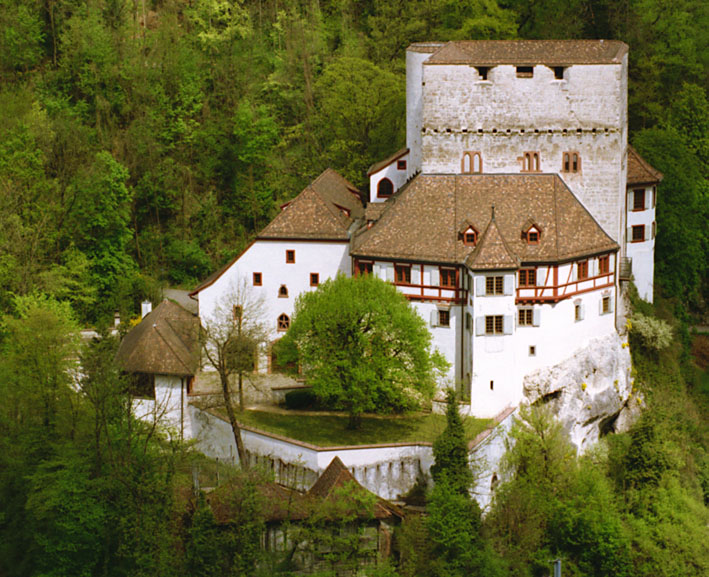
Aesch Castle
Aesch Castle stands as a prominent example of a Renaissance mansion constructed in the early 17th century in Aesch, Switzerland. Built between 1605 and 1606 by the influential Blarer of Wartensee family, the castle reflects the family's rising status and wealth derived from the linen trade and their expanding political influence in the Basel region. The Blarers originally hailed from St. Gallen, with one branch establishing itself at Wartensee Castle near Rorschach, which lent the family its name. The election of Jacob Christoph Blarer of Wartensee as a canon of the Basel cathedral in 1575 marked a significant expansion of the family's power and presence in the area.
Jacob Christoph Blarer was a leading figure in the Counter-Reformation in Birseck and played a key role in consolidating the family's influence. He appointed his brother Wolfgang Dietrich Blarer as the upper Vogt of Pfeffingen in 1583, a position that secured steady income through tithes, taxes, and other privileges. The family’s wealth continued to grow, notably after Jacob Christoph granted a charter in 1604, which further solidified their local power. Before his death in 1608, Jacob Christoph tasked his nephew Wilhelm Blarer with establishing a family seat in Aesch by building a castle, which Wilhelm received along with surrounding lands in 1607. The Bishop of Basel also freed Wilhelm from all offerings, enhancing his autonomy.
Architectural design and features
Aesch Castle was designed primarily as a representative multi-story mansion rather than a fortress, reflecting the diminished military role of castles in the age of gunpowder. The nearby Pfeffingen Castle served the family's defensive needs, allowing Aesch Castle to focus on comfort and prestige. The main building includes a vaulted cellar basement and was originally surrounded by several support buildings such as a wine press and stables, some of which survive today.
The precise architect remains uncertain, with surviving receipts suggesting the builder could have been Michael Brauwn or Braun. The castle underwent Baroque extensions in the 1730s and 1740s, including the addition of a French garden. The perimeter wall was enhanced with turrets and bartizans, and lattice doors controlled access to the grounds. Much of the castle’s current exterior dates back to this 18th-century expansion, although parts of the perimeter wall have been altered or demolished.
Historical significance and ownership
During the Thirty Years' War, Aesch Castle sustained damage but was promptly repaired, demonstrating its importance to the Blarer family. By 1702, the family shifted their residence from the less comfortable Pfeffingen Castle to Aesch, which better suited their status. The castle served various roles over the centuries, including functioning as a hospital during the French Revolution.
In 1851, the municipality of Aesch acquired the castle from the Blarer family and adapted it for public use, adding two classrooms and teachers' houses. A significant renovation in 1900 by Rudolf Sandreuter introduced Gothic revival elements and a half-round tower, while relocating the main entrance to face the village. From 1909, the castle was used as a school and community center. A later restoration in 1958-59 aimed to restore the castle’s original condition, after which it became the seat of the municipal administration.
Current condition and public access
Today, Aesch Castle is well preserved and serves as the municipal government building. The castle grounds, including the public park, are accessible to visitors during office hours. The vaulted cellar has been expanded and is available for special events, providing a unique venue within the historic structure. Additionally, a former outbuilding on the west side now houses the local museum of Aesch, offering cultural insights into the region’s history.
Relationship with Pfeffingen Castle
Nearby Pfeffingen Castle, one of the largest castle ruins in the Basel-Land canton, played a complementary role to Aesch Castle in the Blarer family's history. Originally part of a Franconian royal court area, Pfeffingen Castle was first mentioned in 1135 and underwent significant rebuilding in the 13th century. It was a fortified structure with a large residential tower and curtain walls, serving as the family's defensive stronghold.
The castle endured multiple sieges and damages, including during the Old Zürich War and the Thirty Years' War, after which it was left in poor condition. By the mid-18th century, the Blarer family abandoned Pfeffingen in favor of the more comfortable and prestigious Aesch Castle. Pfeffingen Castle subsequently fell into ruin, but recent conservation efforts since 2013 have focused on stabilizing and restoring the remaining structures, especially the residential tower.
Architectural and cultural legacy
Aesch Castle exemplifies the transition from medieval fortified castles to Renaissance and Baroque manor houses emphasizing status and residence over defense. Its architectural evolution, from the original early 17th-century construction through 18th-century expansions and 20th-century restorations, reflects changing tastes and functions over four centuries.
The castle's blend of Renaissance foundations with Baroque additions and Gothic revival touches illustrates the layering of architectural styles common in Swiss noble residences. Its preservation and adaptive reuse as a municipal building and cultural site ensure that Aesch Castle remains a vital part of the local heritage, connecting the community with its historical roots.
Frequently asked questions (FAQ)
- How do I get to Aesch Castle?
- Aesch Castle is located in the picturesque village of Aesch, Switzerland, easily accessible by public transportation. Visitors can take the S-Bahn from Basel to Aesch, followed by a short walk to the castle grounds.
- What is the historical significance of Aesch Castle?
- Aesch Castle dates back to the 12th century and has played a crucial role in the region's history, serving as a noble residence and military stronghold. Its architecture reflects the transition from medieval fortifications to more elegant residential styles, making it an important example of Swiss heritage.
- When was Aesch Castle built?
- Construction of Aesch Castle began in the early 12th century, with various renovations and expansions occurring over the centuries. The castle's enduring structure showcases the architectural trends and historical events of its time.
- Can I take guided tours of Aesch Castle?
- Yes, guided tours of Aesch Castle are available, providing visitors with in-depth knowledge about its history and architecture. It's advisable to check the castle's official website for tour schedules and to book in advance, especially during peak tourist seasons.
- Why is Aesch Castle considered an architectural gem?
- Aesch Castle is renowned for its blend of medieval and Renaissance architectural styles, featuring impressive stonework and beautiful interior designs. The castle's layout and surrounding landscape also contribute to its charm, captivating visitors with its historical ambiance.
- Is it possible to host events at Aesch Castle?
- Yes, Aesch Castle can be rented for private events, including weddings and corporate gatherings. The stunning backdrop and historical significance make it a unique venue, but it's recommended to contact the management for availability and specific arrangements.
- What are the opening hours for Aesch Castle?
- Aesch Castle is open to visitors from Tuesday to Sunday, with varying hours depending on the season. It's best to visit the official website for the most up-to-date information on opening times before planning your trip.
- What are the ticket prices for visiting Aesch Castle?
- Ticket prices for Aesch Castle are generally affordable, with discounts available for students, seniors, and children. Visitors can purchase tickets on-site or online, and it's advisable to check for any special exhibitions or events that may have different pricing.
- When is the best time to visit Aesch Castle?
- The best time to visit Aesch Castle is during the spring and early autumn months when the weather is mild, and the surrounding landscape is in full bloom. Additionally, these seasons tend to attract fewer crowds, allowing for a more enjoyable experience.
- What nearby attractions can I visit while at Aesch Castle?
- While visiting Aesch Castle, you can also explore the charming village of Aesch and its beautiful parks. Nearby attractions include the scenic hiking trails in the region and the vibrant city of Basel, which is just a short train ride away.
Information
Loading map...
Visitor reviews
No reviews yet. Been here? Write the first review and help other travelers!
Write the first reviewVisited this castle? Share your experience
Your review helps other travelers and adds first-hand knowledge to our encyclopedia.