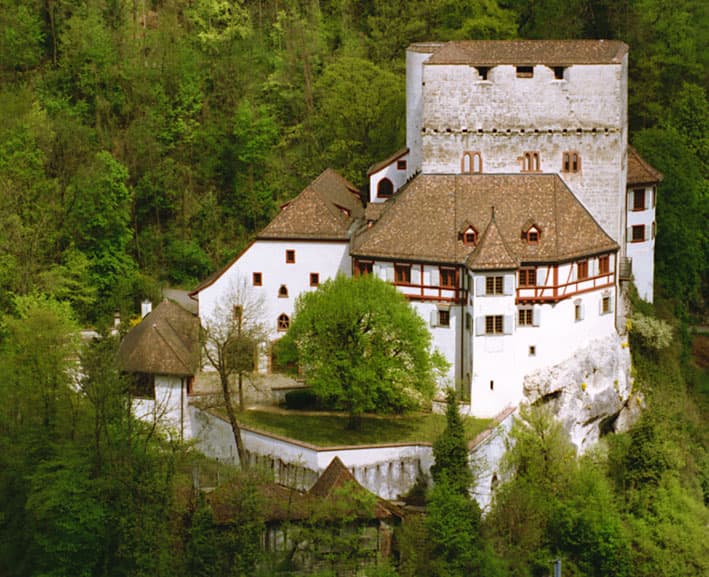
Angenstein Castle
Angenstein Castle is a prominent hill castle located near Duggingen in the canton of Basel-Landschaft, Switzerland. Perched on a narrow rocky spur overlooking the Birs river gorge, this castle has played a significant role as a strategic outpost controlling the passage between Basel and the Jura region since the mid-13th century. Recognized as a Swiss heritage site of national significance, Angenstein Castle offers a fascinating glimpse into medieval fortification architecture, later residential adaptations, and religious art.
Constructed initially in the late medieval period, Angenstein Castle was likely founded by local noble families such as the Counts of Pfirt or the episcopal ministeriales Münch family. By 1271, half of the estate was ceded to the Bishop of Basel, who subsequently granted the castle as a fief to the Counts of Thierstein. Throughout its history, the castle was jointly held by important regional powers including the Habsburg-Laufenburg family and the bishopric, reflecting its strategic importance in the border region between the Sisgau and Sundgau territories.
Medieval origins and strategic significance
Angenstein Castle's location on a broad rock head between Aesch and Duggingen allowed it to dominate the narrow passage where the Birs river cuts through the Jura mountains. This position made it a vital fortified outpost for controlling movement and asserting territorial claims. The castle's role as a border fortress was underscored by its proximity to the historic boundary between French and Austrian domains, represented by the Sisgau and Sundgau regions.
The original fortress was damaged during the 1356 Basel earthquake but was promptly repaired by the Münch family, who held the castle until their lineage ended in 1460. Following this, the Thierstein family reclaimed the fief and granted it to various noble owners amidst regional conflicts, including the city of Basel's growing influence.
Fires, reconstruction, and architectural transformation
Angenstein Castle suffered two major fires in 1494 and 1517, which caused extensive damage. After the second fire, the owner at the time, Wolfgang von Lichtenfels, was killed. The castle was left in ruins until 1557, when Wendelin Zipper, the chancellor of the Bishop of Basel, was granted the fief and undertook a significant reconstruction.
Zipper transformed the medieval fortress into a knightly-romantic residence, adding timber-framed buildings to the existing four-storey donjon. This donjon, with its thick masonry walls and original five-story height, remains a defining feature of the castle's silhouette today. The reconstruction also included a new chapel built in 1562, dedicated to St. Anna and St. Wendelin, designed following early Christian architectural models.
The chapel is notable for its three splendid stained-glass windows, which depict scenes from Good Friday, Christmas, and Pentecost. These windows were gifts from the bishop and canons, representing some of the finest religious art associated with the castle. The outer curtain walls were lowered during this period to garden wall height, reflecting the transition from a defensive fortress to a noble residence.
Military history and later ownership
During the Thirty Years' War, Angenstein Castle was occupied by Swedish forces between 1637 and 1640. It served as the headquarters for Duke Bernhard of Weimar, highlighting its continued military relevance despite its residential modifications. After the war, the castle passed through several noble families, including the Noël and de Grandvillars families.
Despite the turbulent political changes in the region, the castle escaped damage during the revolutionary period and remained privately owned. Following the Congress of Vienna in 1815, the castle came under the jurisdiction of the canton of Bern but stayed in private hands, later owned by the Bertschi family in the 19th century.
Modern preservation and cultural significance
In 1951, the canton of Basel-Stadt acquired Angenstein Castle, marking the beginning of its modern preservation efforts. The castle suffered a significant fire in 1984, which led to a comprehensive restoration project completed between 1988 and 1991. This restoration made the castle habitable again and included the careful repair of the chapel and several social rooms.
Two chapel bells dating from 1826, lost in the 1984 fire, were rediscovered in a nearby forest in 2010, adding to the castle's historical narrative. Today, Angenstein Castle is not only a heritage monument but also a cultural landmark, lending its name to local organizations such as a scout group and various companies.
Architectural features and layout
Location and defensive structures
Angenstein Castle occupies a commanding position on a rocky spur overlooking the Birs river gorge. The castle complex controlled the important Basel–Delsberg road and the narrow river passage through the Jura mountains. Beneath the castle runs a 64-meter railway tunnel constructed in 1870 for the Jura Railway, connecting Basel and Delemont.
The original entrance was situated on the west side, accessed via a small defensive courtyard known as a zwinger, which has since been lost. The present entrance on the northeast side is a modern addition. The castle's outer ring wall once featured loopholes for archers and a battlement walkway, though these were lowered during the residential conversion.
The donjon and residential buildings
The central feature of Angenstein Castle is its donjon, measuring approximately 16 by 19 meters with walls about two meters thick. The masonry of the donjon remains intact up to the full height of the original five stories. Numerous beam holes in the exterior walls indicate the former presence of a wooden gallery and a battlement walkway along the top, crowned by a pyramidal roof.
Adjoining the donjon are timber-framed residential buildings dating from around 1560, built atop the inner ring wall. These buildings include two apartments that remain inhabited today, limiting public access to the interior. The castle chapel, accessible from the donjon, is a highlight of the complex with its stained-glass triptych and early Christian design.
Surrounding structures and fortifications
Across the Birs river from the castle are a former customs house, now converted into housing, and a tavern that continues to operate as a restaurant. Below the castle, a series of World War II infantry fortifications were constructed in the 1960s. These consist of camouflaged concrete bunkers with gun openings, forming the Angenstein A 3476 main eastern work and the Muggenberg A 3476 western counterwork. These bunkers are maintained by a local officers’ society and are accessible from the southwest or through the railway tunnel beneath the castle.
While interior access to Angenstein Castle is limited due to private residences, the castle's exterior and surrounding historical features remain well preserved. Visitors can appreciate the castle's imposing presence, architectural evolution, and its enduring role in the region's history.
Frequently asked questions (FAQ)
- How do I get to Angenstein Castle?
- Angenstein Castle is located in Duggingen, Switzerland, and can be accessed by car or public transportation. If traveling by train, the nearest station is in Liestal, from where you can take a bus or taxi to the castle. There are also well-marked walking paths that lead to the castle for those who enjoy hiking.
- What is the historical significance of Angenstein Castle?
- Angenstein Castle dates back to the 13th century and is notable for its strategic location overseeing the region. It served as a defensive fortress and residence for local nobility throughout its history. The castle has witnessed numerous historical events, making it an important site for understanding the region's medieval past.
- When was Angenstein Castle built?
- Angenstein Castle was constructed in the early 13th century, with its first documented mention occurring in 1230. Over the centuries, the castle underwent various renovations and expansions, reflecting the architectural styles of different eras. Today, it stands as a testament to medieval fortification techniques.
- Can I take guided tours of Angenstein Castle?
- Yes, guided tours of Angenstein Castle are available and offer visitors a comprehensive look at its history and architecture. Tours typically include access to key areas of the castle and insights from knowledgeable guides. It's recommended to check the schedule in advance, as tours may vary by season.
- Why is Angenstein Castle a popular tourist destination?
- Angenstein Castle is popular due to its rich history, stunning architecture, and breathtaking views of the surrounding landscape. Visitors are drawn to its well-preserved structure and the opportunity to explore a piece of Switzerland's medieval heritage. The castle also hosts various cultural events and exhibitions throughout the year.
- Is it possible to rent the castle for events?
- Yes, Angenstein Castle offers rental options for private events such as weddings, corporate gatherings, and cultural celebrations. The unique setting provides a memorable backdrop for various occasions. It is advisable to contact the castle administration well in advance to discuss availability and arrangements.
- What are the opening hours for Angenstein Castle?
- Angenstein Castle typically opens to visitors from April to October, with varying hours depending on the day of the week. During peak season, it may offer extended hours to accommodate more guests. Always check the official website for the most current information regarding opening times before planning your visit.
- Are there any nearby attractions to visit?
- Yes, the area surrounding Angenstein Castle features several attractions worth exploring, such as the picturesque town of Liestal and the scenic hiking trails in the region. Additionally, the nearby Basel offers a vibrant cultural scene, including museums and galleries. Combining your visit to the castle with these nearby sites can enhance your experience.
- What are the ticket prices for Angenstein Castle?
- Ticket prices for Angenstein Castle are generally affordable, with discounts available for children, seniors, and groups. There may also be special pricing for guided tours or events. For the most accurate and up-to-date information regarding ticket costs, please visit the castle's official website before your visit.
Photo gallery

Photo by Aschweizer•Public domain
Information
Website
Visit websiteSources & official resources
Verify the information above using these authoritative references.
Loading map...
Visitor reviews
No reviews yet. Been here? Write the first review and help other travelers!
Write the first reviewVisited this castle? Share your experience
Your review helps other travelers and adds first-hand knowledge to our encyclopedia.



