Gardiki Castle
Gardiki Castle stands as a significant 13th-century Byzantine fortress located on the southwestern coast of Corfu, Greece. It is notably the only surviving medieval fortress on the southern part of the island, embodying the military architecture and strategic defense systems of the High Medieval period. Constructed during the rule of the Despotate of Epirus, this castle was part of a network of fortifications that protected Corfu before the onset of Venetian control in the early 15th century.
The castle's strategic location on a low hill near the village of Agios Matthaios allowed it to guard the fertile southern plains and control access along the southwestern coastline. Its position near Korissia Lake, separated from the sea by a narrow land strip, further enhanced its defensive advantage. Archaeological findings at the site, including stone tools and animal bones from the Upper Paleolithic era (circa 20,000 BC), reveal the area's long-standing significance as a human settlement, predating the castle by millennia.
Historical context and significance
Gardiki Castle was likely built by either Michael I Komnenos Doukas or his son Michael II Komnenos Doukas, rulers of the Despotate of Epirus, during the 13th century. This period was marked by Byzantine efforts to fortify territories against external threats, including Latin crusaders and later Venetian ambitions. Gardiki formed one vertex of a defensive triangle with Kassiopi Castle in the northeast and Angelokastro in the northwest, collectively securing Corfu against invasions and raids.
Throughout the Byzantine and early Venetian periods, the castle played a key military and administrative role. The Despots of Epirus invested in strengthening Corfu's defenses, as historical records from the 17th century indicate, emphasizing the importance of Gardiki within the island's fortification system. However, the castle's prominence declined during Venetian rule, as new fortifications and military strategies evolved.
Architectural features and construction
Layout and structural design
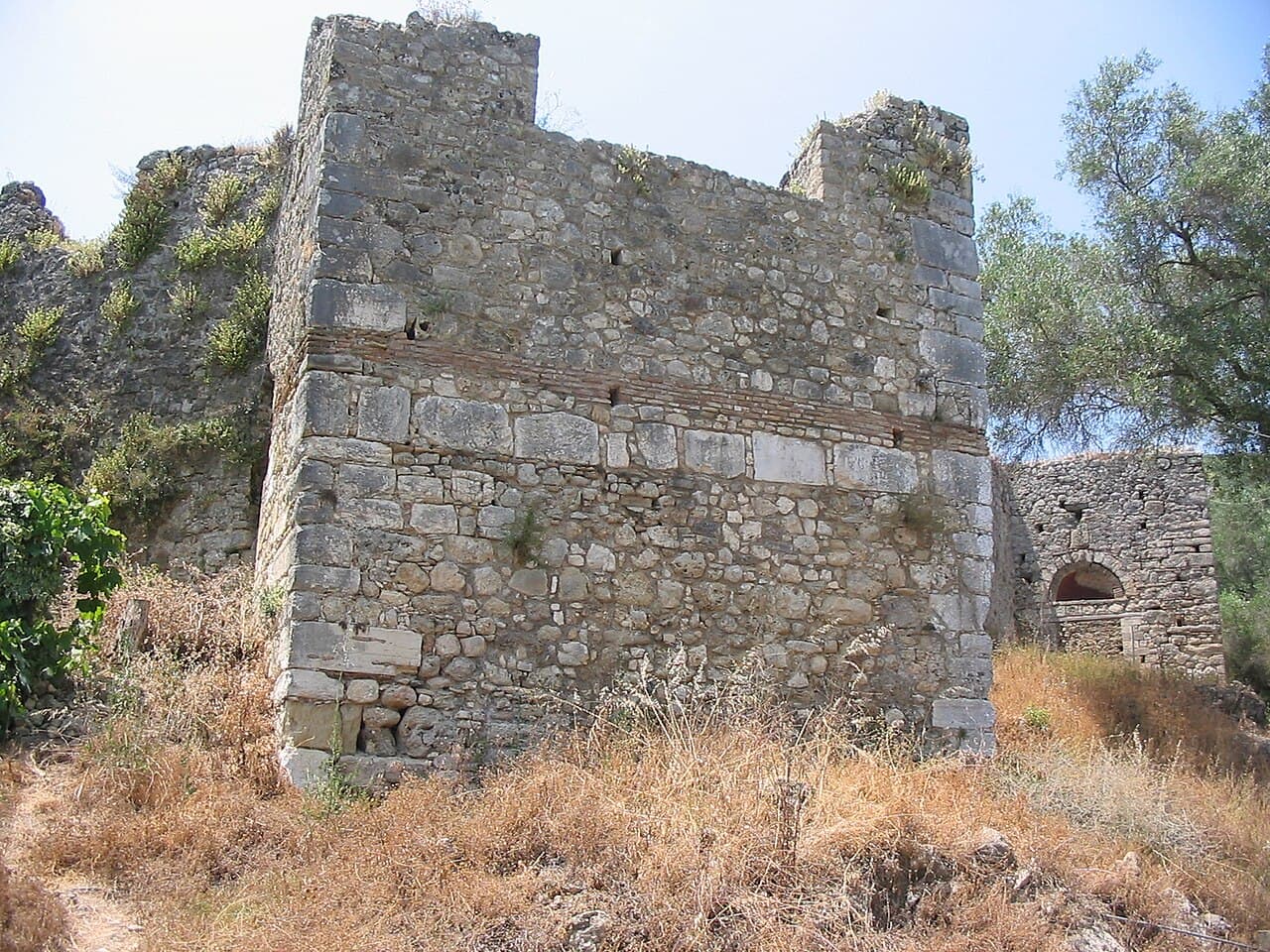
The castle is distinguished by its octagonal plan, with walls forming an almost elliptical outline. This design is relatively rare among Byzantine fortresses and reflects a sophisticated approach to defense, maximizing coverage and minimizing blind spots. The walls are constructed from local stone and are punctuated by eight square towers, each decorated with rows of tiles that add both structural strength and aesthetic detail.
Towers and defensive elements
Each of the eight towers rises to its original height, despite the castle's current state of partial ruin. The towers provided vantage points for surveillance and defense, featuring battlements and arrow slits typical of medieval military architecture. The southern tower is particularly notable for housing the remains of a small chapel, where fragments of religious frescoes depicting saints are still visible, offering insight into the spiritual life within the fortress.
Reuse of ancient materials
Gardiki Castle incorporates elements from an earlier ancient structure, believed to have been a fountain-house. These materials were integrated into the castle's walls, demonstrating practical reuse of local resources and continuity of occupation at the site. This blending of ancient and medieval construction techniques enriches the castle's architectural narrative.
Current condition and preservation
Today, Gardiki Castle is in a state of partial ruin. While the exterior walls and towers retain much of their original height and form, the interior has deteriorated significantly. The main entrance, particularly the southern gate, remains accessible and provides visitors with a tangible connection to the castle's historic function. The site is an important cultural landmark, representing one of the most intact medieval fortifications in the Ionian Islands.
Archaeological and cultural importance
The castle's location has yielded valuable archaeological discoveries, including artifacts from the Upper Paleolithic period found at the nearby rock shelter of Grava Gardikiou. These finds, now exhibited at the Archaeological Museum of Corfu, highlight the area's long-term human habitation and strategic value. Gardiki Castle itself is a testament to the island's layered history, reflecting Byzantine military architecture and the complex political landscape of medieval Greece.
As a site, Gardiki Castle offers insight into the defensive strategies employed by the Despotate of Epirus and the broader Byzantine world. Its preservation allows for ongoing study and appreciation of medieval fortification techniques, as well as the cultural exchanges that shaped Corfu's heritage.
Frequently asked questions (FAQ)
- How do I visit Gardiki Castle?
- Gardiki Castle is open daily from 09:00 to 17:00 and admission is free. Visitors can explore the exterior walls and towers, but the interior is in ruins, so caution is advised.
- What is the historical significance of Gardiki Castle?
- Gardiki Castle was built in the 13th century by the Despotate of Epirus and formed part of a defensive triangle protecting Corfu before Venetian rule. It played a key role in the island's medieval military strategy.
- Can I see frescoes at Gardiki Castle?
- Yes, remnants of religious frescoes depicting saints can be found on the southern tower, although they are heavily damaged and weathered.
- Is Gardiki Castle accessible for visitors with mobility issues?
- The castle's terrain and ruins may pose challenges for visitors with mobility issues. The site has uneven surfaces and limited facilities, so assistance or careful planning is recommended.
- When is the best time to visit Gardiki Castle?
- Spring and autumn offer mild weather and fewer crowds, making these seasons ideal for visiting Gardiki Castle and exploring the surrounding landscape.

Information
Opening hours
09:00-17:00, daily
Ticket prices
Free
Current owner
Greek Ministry of Culture
Website
Visit websiteSources & official resources
Verify the information above using these authoritative references.
Loading map...
Visitor reviews
No reviews yet. Been here? Write the first review and help other travelers!
Write the first reviewVisited this castle? Share your experience
Your review helps other travelers and adds first-hand knowledge to our encyclopedia.