Gallipoli Castle
Gallipoli Castle stands as a remarkable example of a medieval coastal fortress in the region of Puglia, Italy. Situated on the eastern tip of the island that forms the historic center of Gallipoli, this castle is uniquely surrounded by the sea on all sides, serving historically as a vital defensive stronghold protecting the city and its strategic harbor. Its location allows it to be visible from the entrance of the peninsula, near the seventeenth-century bridge connecting the isthmus to the mainland, highlighting its commanding presence over the surrounding waters.
The origins of Gallipoli Castle trace back to an ancient Roman fortress built after 265 BCE, initially constructed to house legionaries and defend the city from external threats. This early fortification was a critical military installation designed to control access to the city and safeguard its maritime approaches. However, the fortress suffered destruction or heavy damage during the 5th century amid invasions by groups such as the Vandals and Goths.
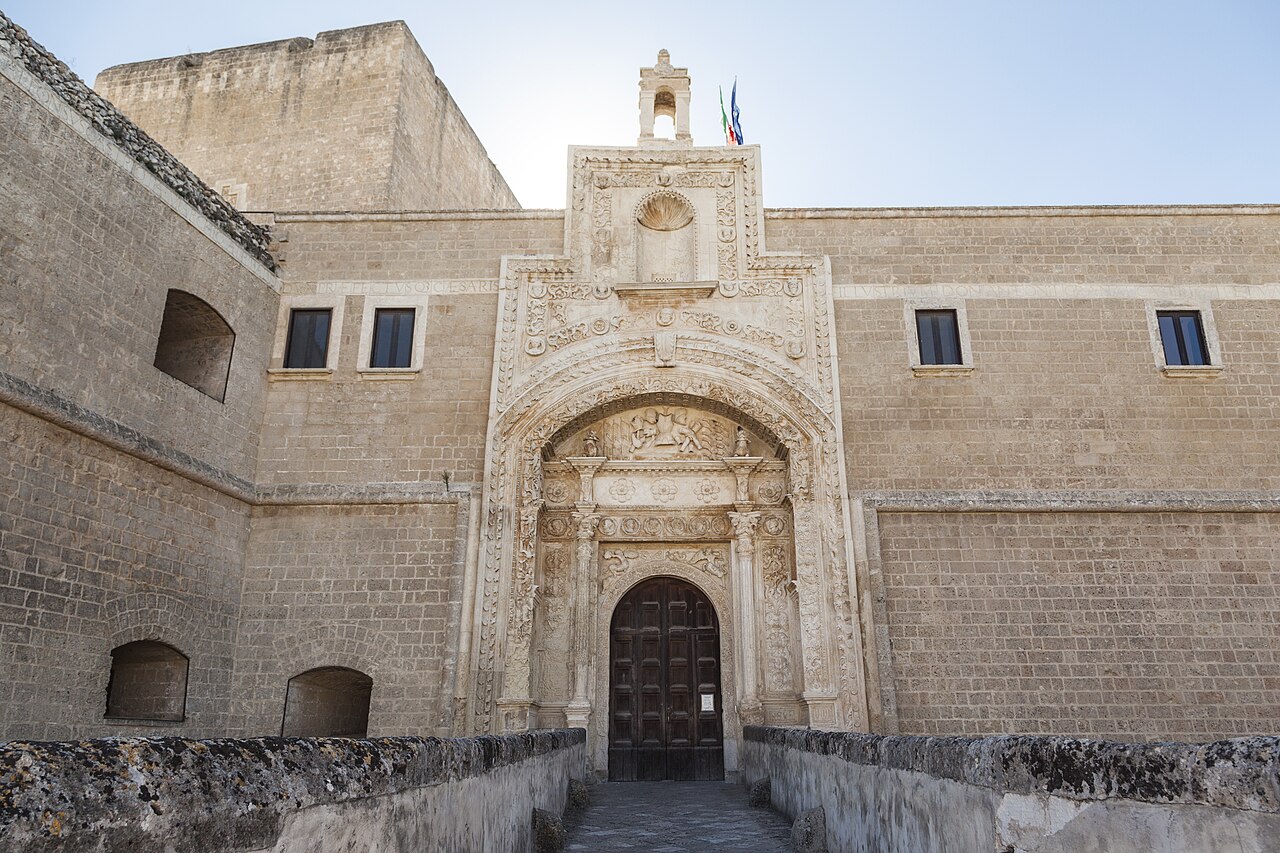
During the Byzantine period, the castle was rebuilt and expanded, as evidenced by a letter from Pope Gregory the Great in 599 CE warning the Byzantine tribune Occiliano about the proper use of the castle, which was then property of the Church of Rome. At this time, the fortress primarily consisted of a polygonal tower connected to the city by a pontoon bridge, featuring defensive elements like firing slits and a drawbridge to control access.
Norman and medieval transformations
In the mid-11th century, the castle withstood a siege by Robert Guiscard but was eventually captured by the Normans in 1071. Under Norman rule, the fortress retained its military importance, as indicated by an inscription dated 1132 on the main entrance gate. Despite this, the castle gradually declined during the Norman period.
The late 12th century brought significant reconstruction under Emperor Frederick II, who renewed the castle's defenses to adapt to evolving military needs. The Angevin dynasty further enhanced the fortress in 1320, as marked by another inscription on the gate. Between the 15th and 16th centuries, the castle underwent major fortifications during the combined Angevin and Aragonese rule, reflecting the era's advancements in military architecture.
Architectural features and fortifications
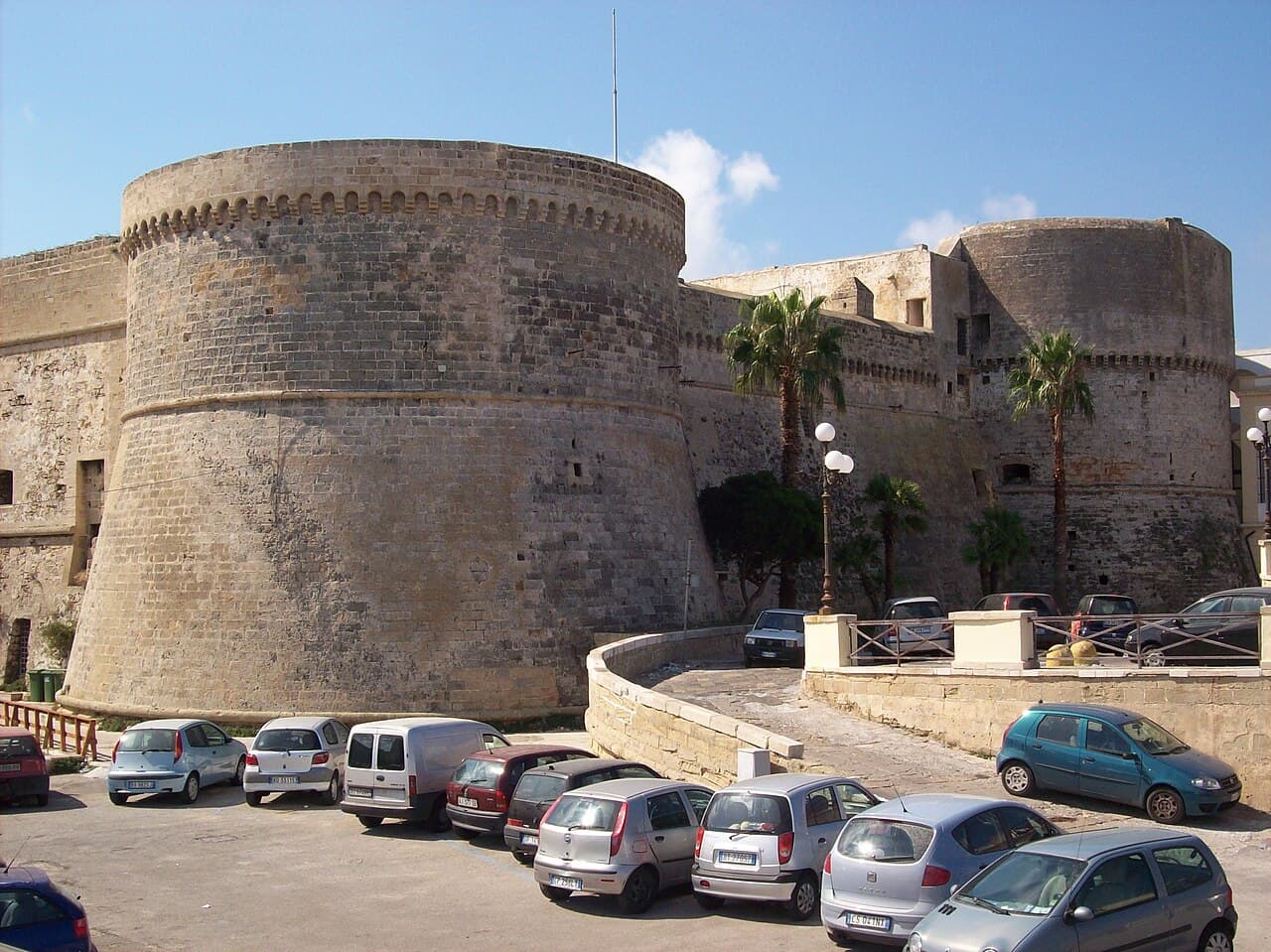
The castle today has a distinctive quadrangular layout strengthened by four corner towers—three round and one polygonal. The polygonal tower is particularly notable as it represents the original Byzantine fortification, once standing alone and connected to the city by a pontoon bridge. This tower features merlons crowning its polygonal canopy, a classic defensive element providing cover for lookouts and archers.
The other three towers are adorned with a string course and decorated with small arches, adding both structural reinforcement and aesthetic detail. A fifth tower, known as the Rivellino, is a circular outwork detached from the main perimeter and isolated in the surrounding waters. This ravelin was constructed in 1522 under the direction of the renowned architect Francesco di Giorgio Martini to bolster the castle's defenses, particularly at the eastern entrance, preventing enemy forces from establishing siege camps nearby.
During the 17th century, the ravelin was separated from the main castle to accommodate a square tower above the flag tower, partially obscuring the original structure. Additionally, a secondary bridge once connected the fortress to the opposite shore near the Church of Saint Christine, remnants of which still survive in stone and wood near the ravelin.
Interior spaces and defensive systems
Inside the fortress, visitors can find large halls featuring barrel vaults and ribbed (cross) vaults, architectural techniques that provided both strength and spacious interiors. These vaulted rooms likely served various military and administrative functions. The castle also contains a network of tunnels and galleries, facilitating internal movement and communication during sieges.
Significant defensive artifacts remain preserved, including an array of catapults and cannons housed in the polygonal tower, underscoring the castle's active role in the defense of Gallipoli through the centuries.
Historical significance and notable events
Gallipoli Castle has witnessed numerous historical events and hosted prominent figures. It provided refuge to Conradin in 1268, Philip I of Taranto and Robert of Anjou in the early 14th century, Queen Joanna II of Naples in 1414, Ferdinand I of Naples in 1463, and Isabella of Aragon in 1495. Some historians also suggest that the famous painter Jusepe de Ribera, known as "Spagnoletto," may have been born within the castle walls.
The castle's military relevance is reflected in its resilience during sieges and its continuous adaptation to changing warfare technologies and political powers. The replacement of the original wooden drawbridge with a permanent masonry bridge in the 16th century further illustrates its evolving infrastructure to meet strategic needs.
Changes in the modern era and preservation efforts
In the 19th century, significant alterations occurred when the moat surrounding the castle was filled between 1870 and 1879, changing the fortress's immediate defensive environment. Additionally, the construction of a fish market alongside the waterfront partially obscured the castle's façade, impacting its visibility and prominence in the cityscape.
The 20th century saw renewed interest in preserving Gallipoli Castle. Public access initiatives began in 1977, culminating in a comprehensive reopening in 2014. Since 2016, the castle has been under municipal ownership, integrated into local cultural events and activities, enhancing its role as a heritage site.
Despite these efforts, the castle has faced challenges related to conservation. In 2013, archaeologist Paul Arthur highlighted the neglected state of the fortress, describing Gallipoli as a "black hole" on the archaeological and monumental map of the Salento region, emphasizing the need for greater attention to its historic heritage.
Architectural legacy and cultural importance
Gallipoli Castle embodies a layered history of military architecture, reflecting the influences of Roman, Byzantine, Norman, Angevin, and Aragonese periods. Its strategic location, robust fortifications, and complex internal structures illustrate the evolution of defensive design from antiquity through the Renaissance.
The castle remains a key symbol of Gallipoli's historical identity and maritime heritage. Its preservation and continued study offer valuable insights into the military, political, and cultural developments of southern Italy across centuries.
Visitors to Gallipoli Castle can explore its imposing walls, towers, and vaulted interiors, gaining a comprehensive understanding of its role as a coastal fortress and witness to centuries of Mediterranean history.
Frequently asked questions (FAQ)
- How do I visit Gallipoli Castle?
- Gallipoli Castle is open to the public with visiting hours typically from morning to late afternoon. It is advisable to check the local municipality website or tourist information for current opening times and guided tour availability.
- What is the historical significance of Gallipoli Castle?
- Gallipoli Castle has served as a strategic coastal fortress since Roman times, evolving through Byzantine, Norman, Angevin, and Aragonese periods. It has protected the city and hosted notable historical figures, reflecting its military and cultural importance.
- Can I explore the interior of Gallipoli Castle?
- Yes, visitors can explore the castle's interior, including large vaulted halls, tunnels, and defensive towers. The castle offers a glimpse into medieval military architecture and the evolution of fortifications over centuries.
- Is Gallipoli Castle accessible for people with disabilities?
- Accessibility may be limited due to the castle's historic structure and uneven terrain. Visitors with mobility challenges should inquire in advance about available accommodations and assistance.
- When is the best time to visit Gallipoli Castle?
- The best time to visit is during spring and early autumn when the weather is mild and the site is less crowded. Summer months can be hot, and winter may see reduced opening hours.
Photo gallery

Information
Sources & official resources
Verify the information above using these authoritative references.
Loading map...
Visitor reviews
No reviews yet. Been here? Write the first review and help other travelers!
Write the first reviewVisited this castle? Share your experience
Your review helps other travelers and adds first-hand knowledge to our encyclopedia.