Frœnsbourg Castle
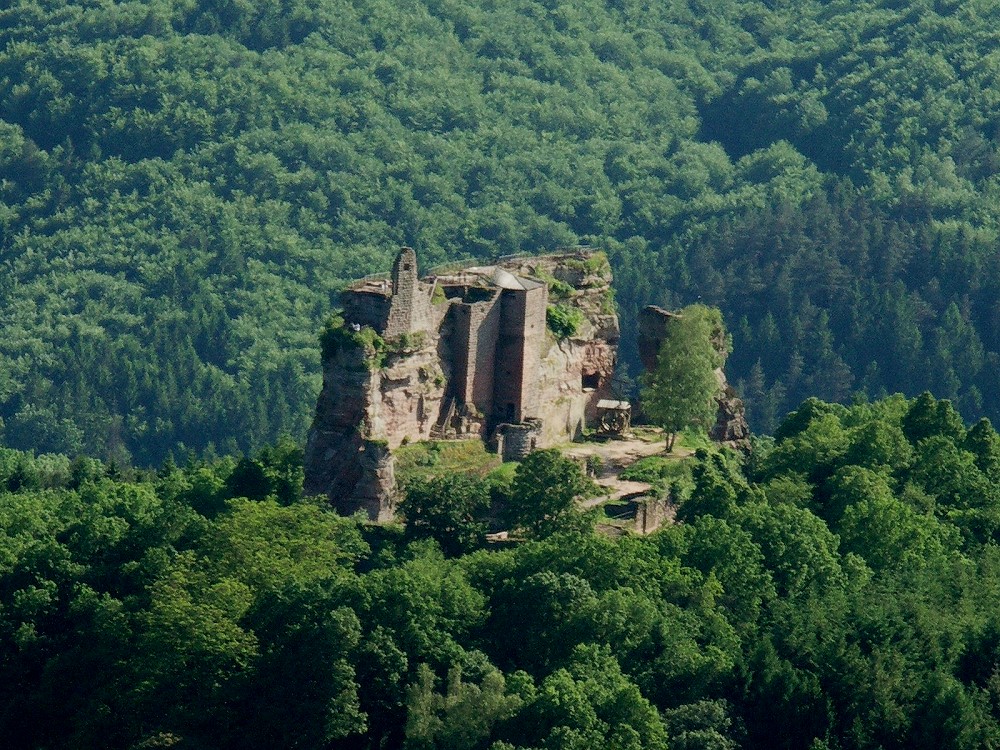
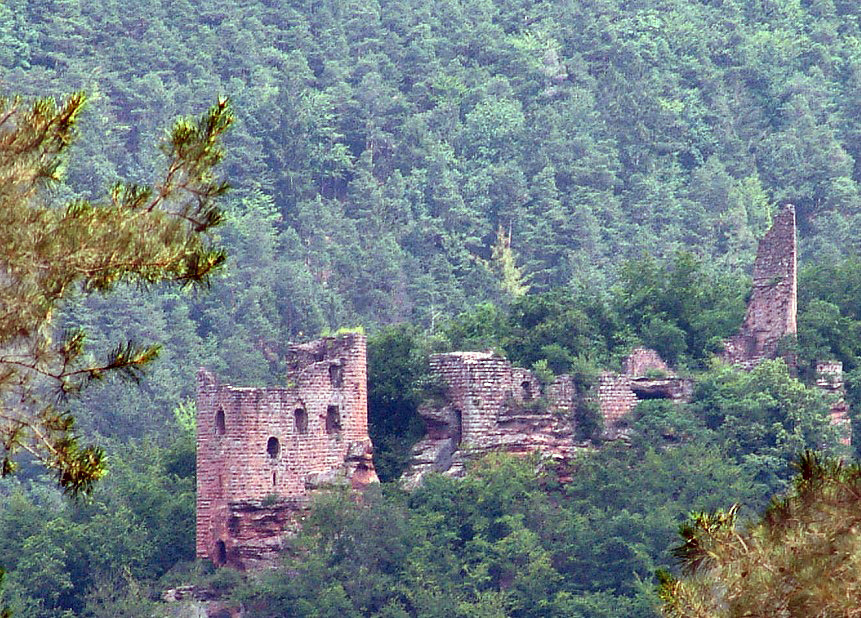
Frœnsbourg Castle, also known as Château du Frœnsbourg in French and Frönsburg or Freundsburg in German, stands as a remarkable example of a late medieval fortress nestled in the dense woods east of the village of Niedersteinbach, within the Bas-Rhin department of France. This region, often referred to as Northern Alsace or the Northern Vosges, is rich in historical significance and natural beauty. The castle's strategic location on a narrow sandstone spur, rising approximately 40 meters above the surrounding terrain, provided a commanding vantage point for defense and surveillance during its active years.
Early history and ownership
The origins of Frœnsbourg Castle can be traced back to the early 13th century, with indirect mentions as early as 1235 linked to an Eberhard von Frundesberg, who resided near the nearby Fleckenstein Castle. The first explicit documentary reference to the castle itself appears in 1269, indicating its established presence by that time. Initially, the castle was the exclusive possession of the Frœnsbourg family until the 1340s, a lineage likely related to the Fleckenstein family, as suggested by their shared armorial bearings.
During the mid-14th century, ownership became fragmented with parts of the castle held by several noble families including the Loewenstein and Sickingen families. Notably, Reinhard von Sickingen, who owned a portion of the castle, gained notoriety as a robber knight. His actions led to a siege in 1349, resulting in the castle's partial ruin. Following this, the castle was restored and offered to Count Palatine Rupert I in 1358. However, its turbulent history continued as it was destroyed again in 1359 by the Bishop of Strasbourg, Jean de Lichtenberg. The Holy Roman Emperor Charles IV subsequently forbade its reconstruction, emphasizing the castle's contentious role in regional power struggles.
Reconstruction and architectural features
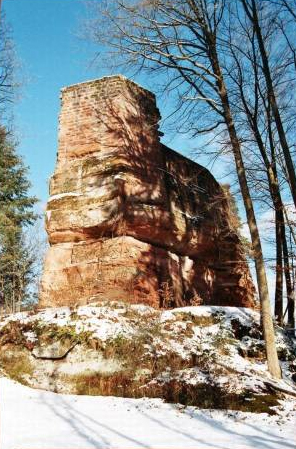
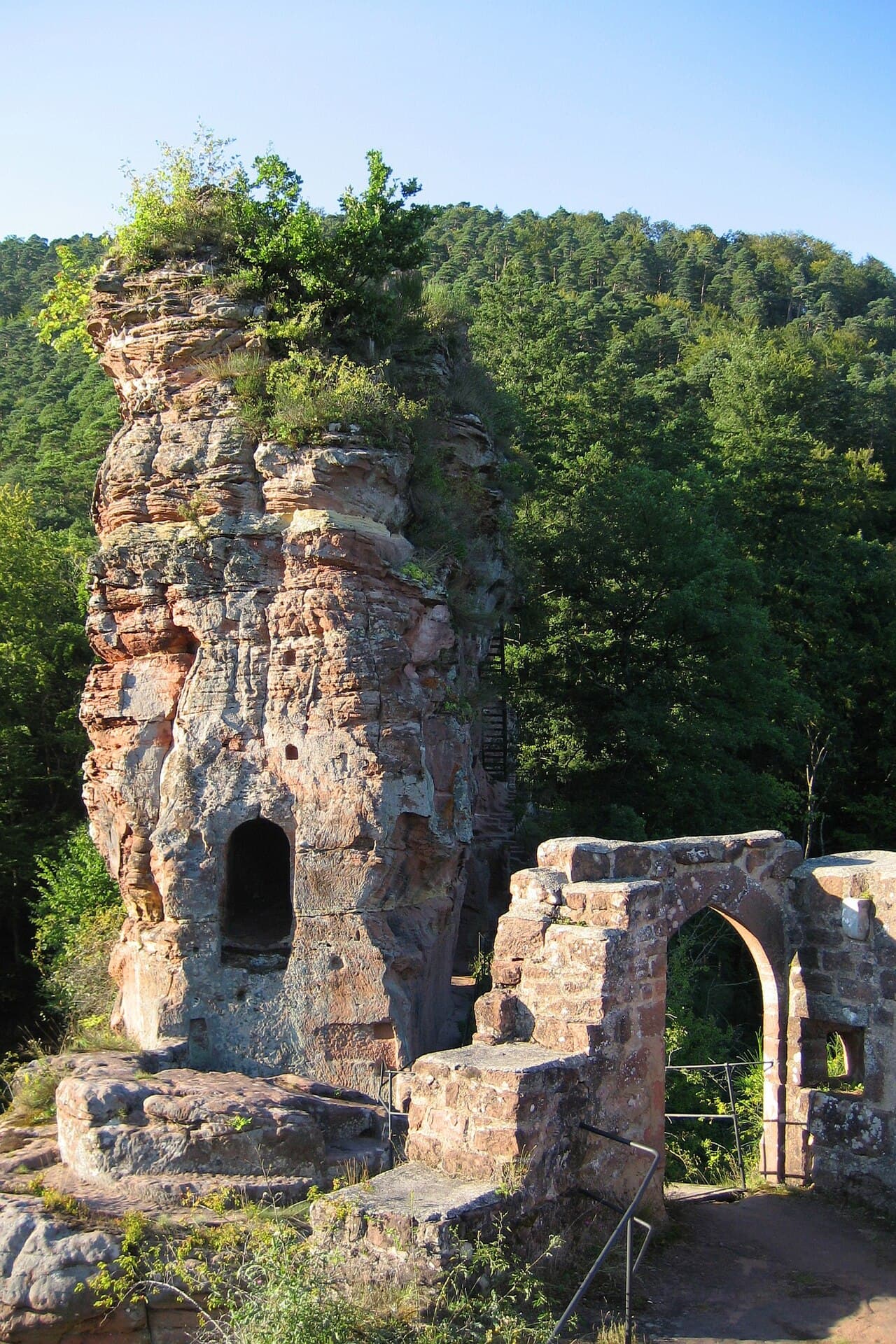
In the latter half of the 15th century, the castle came under the ownership of the Lords of Fleckenstein, who undertook significant restoration efforts in 1481. This reconstruction included the rebuilding of the dwelling tower on the southern rock, also known as the "small castle," which prominently features a Gothic arch doorway dated to 1481. The castle's layout is uniquely adapted to its geological setting, built on a spur divided by a natural fault into two distinct rock formations—the northern and southern rocks.
The northern rock, or "big castle," encompasses the main defensive structures, including a keep with living quarters situated on its higher southern side. The castle's common buildings and dependencies, primarily constructed of wood, were located on the middle and lower floors. Evidence of these wooden structures remains in the form of anchorings embedded in the sandstone. The castle also features several troglodytic rooms carved directly into the rock, cisterns for water storage, and multiple staircases hewn from the sandstone, which facilitated movement between different levels of the fortress.
The castle's defensive design includes a lower courtyard positioned to the west and a ditch to the north, enhancing its protection against attackers. Architectural elements such as a drawbridge, indicated by anchoring points above the entrance, and a winding staircase carved into the rock further demonstrate the castle's sophisticated medieval military engineering.
Decline and destruction
Despite its robust construction and strategic importance, Frœnsbourg Castle was eventually abandoned in the 16th century. Its decline culminated in 1677 when French troops under the command of cavalry general Joseph de Montclar deliberately demolished the fortress during military campaigns in the region. By this time, the castle had already fallen out of use and was in a state of ruin.
Today, Frœnsbourg Castle remains a captivating ruin, freely accessible to visitors who can explore its semi-troglodyte chambers, staircases, and cisterns. The site offers a vivid glimpse into medieval fortification architecture and the turbulent history of the Alsace borderlands.
Architectural and cultural significance
Frœnsbourg Castle is an exemplary semi-troglodyte fortress, integrating natural rock formations with man-made defensive structures. Its dual-rock layout, with a connecting footbridge at mid-level, is a distinctive feature that illustrates the adaptation of medieval builders to challenging terrain. The presence of Gothic architectural elements, such as the 1481 doorway, highlights the castle's evolution through the late medieval period.
The castle's history of sieges, ownership changes, and destruction reflects the broader political and military conflicts that shaped the Alsace region during the Middle Ages and early modern period. As a ruin, it serves both as a cultural monument and a popular destination for hikers and history enthusiasts interested in medieval architecture and regional heritage.
Visiting frœnsbourg castle
Visitors to Frœnsbourg Castle can enjoy exploring the extensive rock-cut rooms, staircases, and cisterns that remain accessible. The castle's location in the scenic Northern Vosges forest provides an excellent backdrop for hiking and outdoor activities. Although the site is in ruins, safety precautions should be observed due to uneven terrain and exposed rock surfaces. There are no entrance fees, and the castle is open year-round, making it an attractive destination for those interested in medieval history and architecture.
Nearby attractions
The castle's proximity to other notable sites, such as Fleckenstein Castle, enriches the visitor experience by offering a broader understanding of the region's medieval fortifications. The surrounding Alsace region is renowned for its picturesque villages, vineyards, and cultural landmarks, providing ample opportunities for extended exploration.
Frequently asked questions (FAQ)
- What is the historical significance of Frœnsbourg Castle?
- Frœnsbourg Castle, located in Niedersteinbach, France, dates back to the 12th century and is an excellent example of medieval military architecture. It played a crucial role in regional defense during the Middle Ages and reflects the historical tumult of feudal conflicts in the Alsace region.
- When was Frœnsbourg Castle built?
- The castle was constructed in the early 12th century, with its strategic location chosen to oversee the surrounding valley. Over the centuries, it has undergone various modifications, adapting to the changing needs of its inhabitants and the evolving nature of warfare.
- Can I visit Frœnsbourg Castle?
- Yes, visitors can explore Frœnsbourg Castle, but access may be limited to certain areas due to preservation efforts. Guided tours are often available, providing insights into the castle's rich history and architectural features.
- What are the opening hours for Frœnsbourg Castle?
- The castle typically opens to visitors from April to October, with specific hours varying by day. It is recommended to check the official website or local tourist information for the most current opening times before planning your visit.
- Is it possible to access Frœnsbourg Castle with mobility restrictions?
- The castle's historic structure presents some challenges for visitors with mobility restrictions, as many areas feature uneven terrain and steep steps. However, efforts are made to accommodate all visitors, and it's advisable to contact the castle management in advance for assistance.
- What is the best time to visit Frœnsbourg Castle?
- The best time to visit Frœnsbourg Castle is during the spring and early autumn months when the weather is mild and the surrounding landscape is beautiful. Additionally, visiting during these periods often means fewer crowds, allowing for a more enjoyable experience.
- Are there any nearby attractions to Frœnsbourg Castle?
- Yes, the region surrounding Frœnsbourg Castle is rich with attractions, including scenic hiking trails and charming villages in the Alsace region. Visitors may also explore other historical sites and enjoy local cuisine, making it a perfect day trip destination.
- What are the ticket prices for visiting Frœnsbourg Castle?
- Ticket prices for Frœnsbourg Castle can vary depending on the season and type of tour offered. It is advisable to check the official website for the latest pricing information and any possible discounts for students or groups.

Information
Address
North of the D3 road, Niedersteinbach, Bas-Rhin, France
Loading map...
Visitor reviews
No reviews yet. Been here? Write the first review and help other travelers!
Write the first reviewVisited this castle? Share your experience
Your review helps other travelers and adds first-hand knowledge to our encyclopedia.