Frauenthal Castle
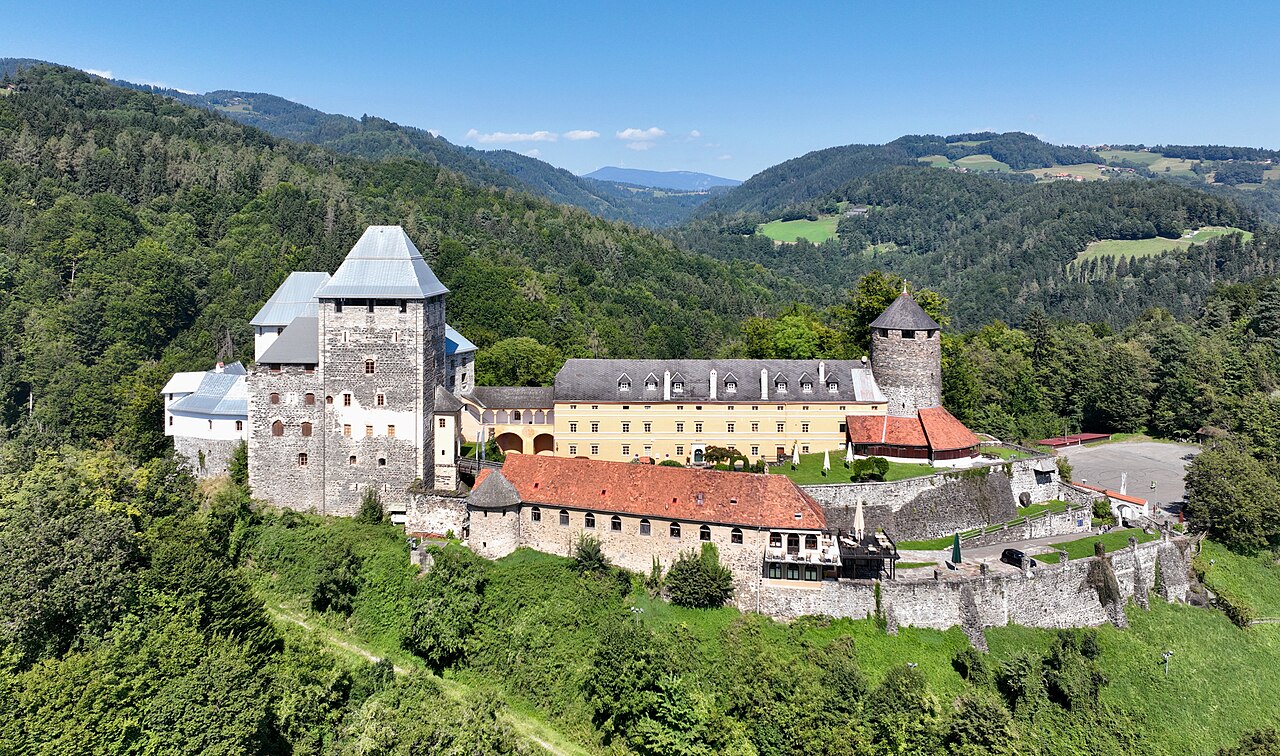
Frauenthal Castle is a remarkable hill castle located in the municipality of Deutschlandsberg in Austria. Its origins trace back to an early medieval settlement known as the Nidrinhof, established around 700 AD by representatives of Aquileia as part of efforts to spread Christianity within the Noricum kingdom. This early establishment served as a bilingual lordship center where Slavic and Bavarian cultures intersected, reflecting the region’s diverse ethnic heritage and strategic importance during the early Middle Ages.
The Nidrinhof first appears in historical documents in 970 AD, when Emperor Otto I granted it to Archbishop Friedrich of Salzburg. Its Slavic name, Udulenidvor, meaning "low-lying farmstead," indicates its original function as an agricultural estate with administrative roles. Over time, as the nearby fortress at Deutschlandsberg rose in prominence, the significance of the Nidrinhof diminished, transitioning from a local power center to a more modest farmstead before evolving into a noble residence in the late Middle Ages.
Medieval origins and transformation
By 1267, records mention the settlement under the name Vraundorf or Frauendorf, alongside a church dedicated to Saint Ulrich, serving the local community’s spiritual needs. The site underwent significant transformation in the mid-16th century, particularly in 1542, when Gall von Racknitz developed it into a noble residence. This marked the beginning of its known castle phase, with architectural expansions and refinements occurring in subsequent centuries.
Baroque remodeling and noble ownership
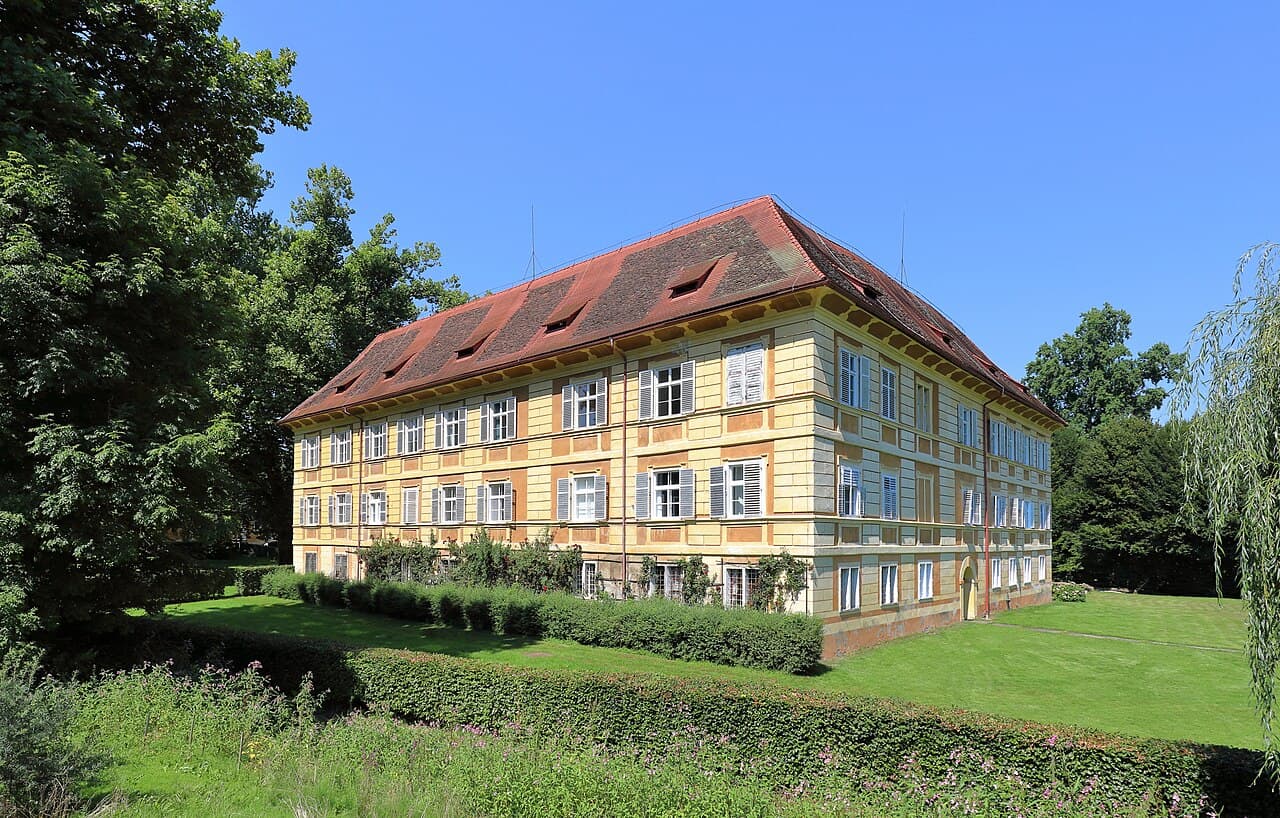
A major remodeling took place in 1675 under Count Ferdinand Zehentner, likely guided by the architect Jakob Schmerlaib. This renovation introduced Baroque stylistic elements that enhanced the castle’s grandeur and aesthetic appeal. Ownership of the castle passed through several noble families, including the Kuenburgers, Maileggers, and Batthyánys, each contributing to its evolving legacy.
Economic challenges in the mid-18th century prompted administrative changes, reflecting broader shifts in regional political and financial stability. The castle experienced a resurgence of prosperity during the early 19th century under Moritz Count von Fries, approximately between 1812 and 1820. In 1820, the Liechtenstein family acquired the property, with Prince Johann I. Josef purchasing it for his son Franz de Paula, the great-grandfather of Franz Josef II, the future head of state of Liechtenstein, who was born at Frauenthal in 1906.
Architectural features and layout
Frauenthal Castle presents a consistent architectural composition featuring a three-story structure arranged in four wings around a central courtyard. This layout creates an enclosed courtyard space notable for its series of arcades supported by pillars spanning three levels. These arcades form a striking visual element that frames the inner courtyard and exemplify Renaissance and Baroque influences in castle design.
The entrance to the inner courtyard is marked by a rusticated portal, a masonry technique where large, roughly cut stones create a textured surface, lending a bold and sturdy appearance to the doorway. Above this portal rests the coat of arms of Ferdinand Count Zehentner, accompanied by an inscription commemorating his renovation work in the late 17th century.
Chapel of Saint Joseph
Within the castle grounds lies a chapel dedicated to Saint Joseph, rising two stories in height. The chapel’s interior features stucco decorations dated around 1685, attributed to the workshop of the artist Alexander Serenio. Stucco here refers to a fine plaster used for molding decorative elements on walls and ceilings. Complementing these reliefs are stained glass windows from the same period, illustrating scenes from the life of the Virgin Mary, adding a colorful and religious dimension to the sacred space.
Geographical setting and historical significance
The castle is situated in the cadastral community called Hörbing, near the town of Deutschlandsberg. Its location features mountainous terrain to the west and flat lands to the east, positioned at an elevation of approximately 428 meters above sea level. This strategic placement influenced the castle’s historical role, providing commanding views over the surrounding landscape and serving as a symbol of noble authority in the region.
Throughout its history, Frauenthal Castle has reflected the layered cultural and political dynamics of Styria and the broader Austrian territories. Its evolution from an early medieval estate to a Renaissance-Baroque noble residence encapsulates significant architectural and historical transitions spanning over a millennium.
Modern history and preservation
In the late 20th century, significant restoration efforts were undertaken in 1969 and 1970 to preserve the castle’s historic fabric. Between 1978 and 2021, the castle served as a vocational school specializing in agriculture and nutrition, highlighting its adaptive reuse in modern times. The school’s closure due to declining enrollment marked the end of this educational chapter.
Today, Frauenthal Castle stands as a well-preserved example of a hill castle with architectural elements that showcase Renaissance and Baroque styles. Its arcaded courtyard, rusticated portal, and chapel with artistic stucco and stained glass remain key features attracting historians, architects, and visitors interested in Austria’s rich medieval and early modern heritage.
Frequently asked questions (FAQ)
- How do I get to Frauenthal Castle in Deutschlandsberg?
- Frauenthal Castle is located near the town of Deutschlandsberg in Styria, Austria. It is accessible by car via local roads from Deutschlandsberg town center, with parking available nearby. Public transportation options may be limited, so driving is recommended for visitors.
- What architectural styles are featured at Frauenthal Castle?
- Frauenthal Castle exhibits a blend of architectural styles, primarily Renaissance and Baroque, visible in its arcaded courtyard, rusticated portal, and chapel decorations. The castle's origins date back to the early medieval period, reflecting a mixed architectural heritage.
- When was Frauenthal Castle originally built?
- The site of Frauenthal Castle originated as an early medieval settlement around 700 AD. The castle structure as known today began to take shape in the mid-16th century, with significant remodeling in the late 17th century.
- Is Frauenthal Castle open to the public?
- The castle has served various functions over time, including as a vocational school until 2021. Current public access may be limited or require prior arrangement, so visitors should check locally for opening hours and tours.
- What notable historical figures are associated with Frauenthal Castle?
- Notable figures include Count Ferdinand Zehentner, who remodeled the castle in 1675, and members of the Liechtenstein family, including Franz de Paula and Franz Josef II, who was born at the castle in 1906.
Photo gallery

Information
Website
Visit websiteSources & official resources
Verify the information above using these authoritative references.
Loading map...
Visitor reviews
No reviews yet. Been here? Write the first review and help other travelers!
Write the first reviewVisited this castle? Share your experience
Your review helps other travelers and adds first-hand knowledge to our encyclopedia.